硅谷风险投资人正奉行极简主义的投资哲学,向一批带着模糊愿景离开老牌模型制造商、自立门户创办所谓“新实验室”(neolabs)的人工智能超级明星投入数十亿美元。自OpenAI联合创始人伊利亚·苏茨克维于2024年6月创办“安全超级智能”(SSI)开启新实验室时代以来,据风投公司Radical Ventures统计,两年内共有29家新实验室成立,PitchBook的数据显示它们已累计筹集了230亿美元。其中,Reflection AI于10月5日发布的开源权重模型Beam被誉为美国对迅速占领西方市场的廉价中国模型的回应。然而,《经济学人》对公开声明的分析显示,在这些初创公司中,推出商业化产品的比例不到35%,略高于一半的公司仅发布了供开发者整合的代码(通常只是展示研究路径的演示版)。估值高达320亿美元的SSI甚至表示在实现“超级智能”前不会发布任何产品,但在今年7月宣称拥有“值得扩大规模”的研究后,便从芯片巨头英伟达处再获50亿美元注资,使其融资总额达到80亿美元。
苏茨克维在OpenAI的前同事米拉·穆拉蒂创办的“思维机器实验室”(TML)出货速度更快:在以120亿美元估值筹集首笔20亿美元几个月后,TML于去年12月推出了允许工程师定制开源权重模型的Tinker服务,并于今年7月发布了自研模型Inkling。据知情人士透露,TML的年化收入已突破2亿美元,远超其他新实验室,但这与其在新一轮融资中瞄准的约400亿美元估值相比仍微不足道,且Inkling未能进入AI市场OpenRouter上最受欢迎的20个模型榜单。该榜单上唯一的新实验室产品是超廉价任务路由模型Jev,其背后的Typesafe公司在9月发布该模型前仅筹集了4000万美元,但在本月从风投手中追加筹集了8.7亿美元。
新实验室及其支持者押注精干专注的小团队更有可能产生新颖突破,但它们不仅要防范模仿者(例如Jev发布后已涌现出多个竞争对手),还要与老牌实验室争夺算力。这迫使许多新实验室投向英伟达的怀抱:据Radical Ventures估算,英伟达已对初创模型制造商进行了32项投资,超过任何其他公司或风投机构,且已从英伟达筹集8亿美元的Reflection据传正在洽谈另一笔巨额投资甚至收购;英伟达的竞争对手AMD也在今年9月斥资80亿美元收购了另一位AI巨星李飞飞创办的新实验室World Labs。尽管像生物技术等领域的风投习惯于承担长期风险,但生物技术公司拥有人体试验等预设的衡量里程碑,而新实验室尚未建立此类评估体系;如果新实验室时代要持续下去,这些初创公司就必须开始更频繁地拿出实质性成果。
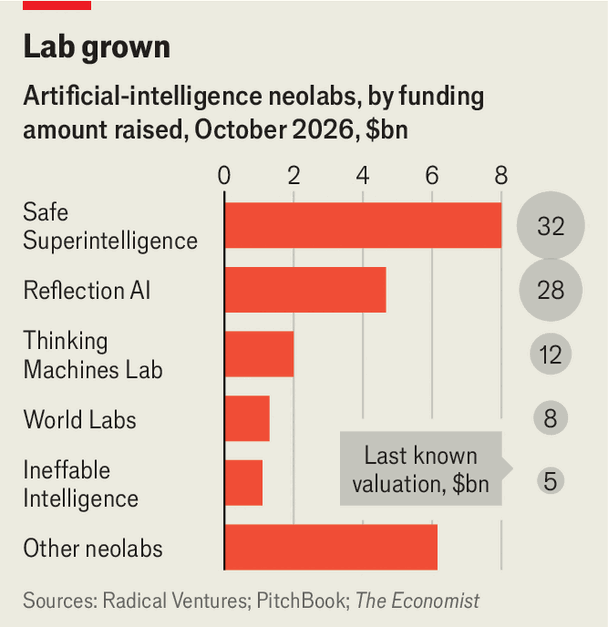
Silicon Valley venture capitalists have poured billions into AI superstars leaving established model-makers to found “neolabs” on little more than vague ambitions. Since OpenAI co-founder Ilya Sutskever launched Safe Superintelligence (SSI) in June 2024, Radical Ventures counts 29 neolabs founded over two years, raising a combined $23bn according to PitchBook. While Reflection AI’s open-weight Beam model, announced on October 5th, was hailed as America’s answer to cheap Chinese models, under 35% of the cohort have released commercial offerings, and slightly over half have shared only research-demo code. SSI, valued at $32bn, refuses to release a product until achieving “superintelligence”; after Mr Sutskever declared in July that SSI had research “worthy of scaling up”, chip giant Nvidia handed it another $5bn, bringing its total funding to $8bn.
Mira Murati, another former OpenAI executive, has shipped products faster at Thinking Machines Lab (TML): after raising $2bn at a $12bn valuation, TML released its model-customisation service Tinker in December and its own model, Inkling, in July. Although TML’s annualised revenue has crossed $200m, that remains tiny against the roughly $40bn valuation targeted in its next fundraising round, and Inkling missed the top 20 models on the OpenRouter marketplace. The only neolab model on that list is Jev, an ultra-cheap task-routing model whose creator, Typesafe, raised just $40m before Jev’s September release before securing an additional $870m this month.
Betting that small, focused teams can achieve novel breakthroughs, neolabs nonetheless face rapid copycats and fierce competition for computing power. Need for chips has driven startups to Nvidia, which has made a record 32 investments in startup model-makers and is reportedly in talks to further invest in or acquire Reflection, in which it has already invested $800m; rival AMD likewise paid $8bn in September to acquire Fei-Fei Li’s World Labs. Unlike biotech startups that raise capital against clear clinical-trial milestones, AI neolabs lack defined progress benchmarks, meaning they must start producing more frequent results to sustain investor patience.
Source: AI neolabs are raising huge sums. Most have little to show for it
Subtitle: Superstar researchers who branch out on their own need to start producing results
Dateline: Oct 15th 2026\n