四十多年来,半导体行业一直受两大定律支配:芯片上的晶体管数量不断增加(目前领先的人工智能处理器包含超过2000亿个晶体管,预计到本十年末将达到1万亿个),以及每一次繁荣都以萧条告终。2026年上半年,受人工智能(AI)需求的推动,半导体销售额的同比增长速度创下了20世纪80年代以来的最高纪录。本月,全球最大的芯片代工厂台积电(TSMC)公布了连续第六个季度的创纪录利润,韩国芯片巨头三星电子也迎来了连续第四个季度的利润新高。然而,投资者却日益紧张:自10月6日以来,领先半导体企业指数已下跌超过10%,而芯片设计巨头博通(Broadcom)总裁陈福阳在10月12日更是将许多AI投资者比作赌场里“毫无头绪”的赌徒。不过,即便AI超级周期终结,制造业的高度集中也将使芯片制造商免受以往那种毁灭性崩盘的冲击:21世纪初约有25家企业能制造最先进的处理器,如今仅剩4家(高端芯片几乎全由台积电代工);1990年有20多家企业制造先进存储芯片,如今几乎全由三星、SK海力士和美光这三家包揽。
行业整合使少数占据主导地位的芯片制造商得以控制扩张步伐并维持极佳的定价环境。尽管台积电今年的资本支出预计将达到约620亿美元(是2025年的1.5倍以上),明年预计达760亿美元左右,但其资本支出占营收的比例预计将从2023年的44%降至今年的36%。此外,芯片制造商完全依靠自身充沛的现金流而非借贷来为投资买单:今年台积电的产能扩张仅消耗其略高于一半的经营现金流,三星更是仅占五分之一左右。在定价方面,广泛用于电子产品的动态随机存取存储器(DRAM)价格已达到2023年初的约六倍;台积电自2022年底推出3纳米制造工艺以来也一直未按常规在几年后降价。同时,由于许多新工厂建在施工时间“大约长一倍”的美国,产能扩张速度也受到了客观限制。
更重要的是,行业整合赋予了芯片制造商更强的议价能力,将市场放缓的风险转嫁给了买家。过去,存储芯片主要在现货市场或通过短期合同销售,需求疲软时价格便会崩盘;如今,由于产能稀缺且供应商寥寥无几,买家不得不按卖方条件提前数年签约。英伟达已承诺投入超过2500亿美元以确保到2029年1月前的供应链和组件;美光在9月表示,“照付不议”(take-or-pay)协议已锁定其到2030年35%的营收,涉及价值320亿美元的承诺(大部分包含现金押金)。尽管AI热潮的终结仍会导致价格下跌、利润萎缩、股价回落以及客户要求重新谈判合同,但这一次,客户将与芯片制造商共同分担萧条的苦果。
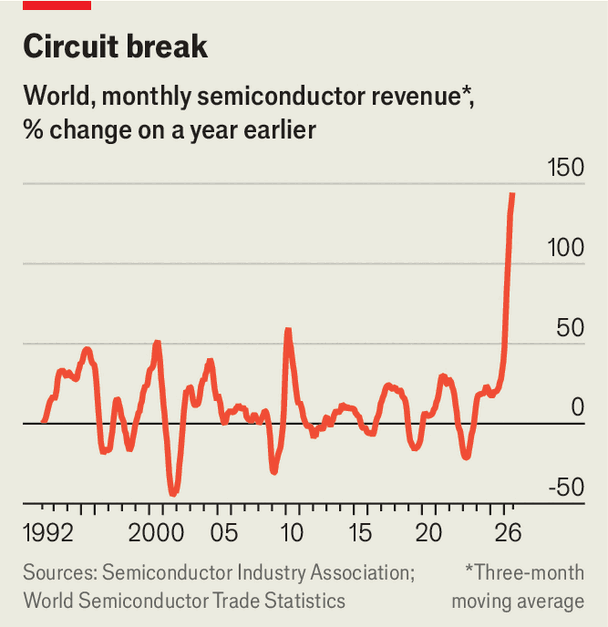
For over four decades, the semiconductor industry has followed two laws: transistor counts keep rising—from over 200bn in today’s leading AI processors toward a projected 1trn by the end of the decade—and every boom ends in a bust. In the first half of 2026, AI demand drove the fastest year-on-year semiconductor sales growth since the 1980s, with foundry giant TSMC reporting its sixth consecutive quarter of record profits this month and Samsung Electronics its fourth. Yet a leading semiconductor index has fallen over 10% since October 6th, rattled further on October 12th when Broadcom boss Hock Tan likened AI investors to clueless casino gamblers. Even if the AI supercycle ends, however, extreme manufacturing concentration should cushion chipmakers: whereas some 25 firms made cutting-edge processors in the early 2000s and over 20 made advanced memory in 1990, today just four make advanced logic (with TSMC dominating the high end) and three—Samsung, SK Hynix, and Micron—make nearly all advanced memory.
Consolidation allows dominant manufacturers to pace expansion and preserve strong pricing. Although TSMC’s capital expenditure is projected to hit $62bn this year—over 1.5 times its 2025 level—and $76bn next year, its capital spending as a share of revenue is set to fall from 44% in 2023 to 36% this year. Moreover, expansions are funded from operating cashflow rather than debt, consuming just over half of TSMC’s operating cashflow this year and barely a fifth of Samsung’s. Meanwhile, DRAM memory prices sit at roughly six times their early-2023 level, TSMC has not cut prices on the three-nanometre process it launched in late 2022, and building new fabs in America takes roughly twice as long, naturally curbing oversupply.
Crucially, bargaining power has shifted the risk of a downturn onto buyers. Abandoning spot markets and short-term contracts, customers now sign multi-year deals on sellers’ terms: Nvidia has committed over $250bn to secure supply through January 2029, while Micron reported in September that “take-or-pay” agreements—mostly backed by cash deposits—have locked in 35% of its revenue through 2030 via $32bn in commitments. While an AI slowdown would still shrink profits, deflate stock prices, and prompt contract renegotiations, customers will now share the hangover.
Source: Is the semiconductor industry headed for an almighty crash?
Subtitle: There are reasons to believe a bust, if it comes, will be less vertiginous than the boom
Dateline: Oct 15th 2026\n