谷歌DeepMind创始人德米斯·哈萨比斯(Demis Hassabis)表示,他创立该公司的初衷是打造“终极科学工具”;迄今其研究已九次登上《自然》杂志封面,其蛋白质折叠模型AlphaFold更助他在2024年分享了诺贝尔奖。如今同行正在迎头赶上:今年秋天,OpenAI不仅解决了一个里程碑式的千禧年大奖难题,还在一天内公布了300多个未解数学问题的答案;Anthropic首席执行官达里奥·阿莫迪(Dario Amodei)也在9月宣布利用Claude模型发现了基因编辑技术CRISPR的潜在继任者。小型公司同样参与其中,东京研究机构Sakana AI在2024年推出的“AI科学家”撰写了一篇论文,并在今年3月发表于《自然》的同行评审文章中报告称,该论文通过了顶级AI会议的首轮同行评审,而近三分之一的人类论文在此折戟。这种AI公司不仅提供工具而且亲自下场做科研的做法令学术界不安,除了追求探索宇宙的声誉外,商业利润也是重要动机:从DeepMind分拆出来的Isomorphic Labs已利用升级版AlphaFold 3开发出17种针对癌症、心血管和免疫疾病的候选药物分子。
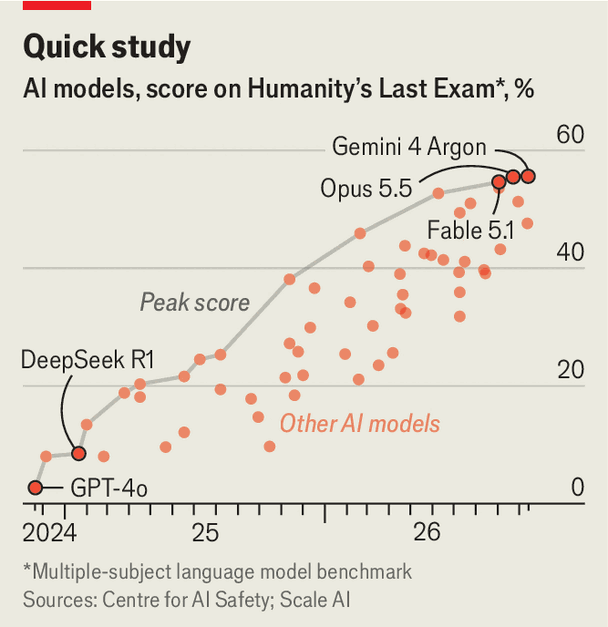
然而,AI实验室热衷于投资科学的核心原因在于这是改进模型的最佳途径。早期的语言模型仅能应付高中科学测验,而如今最顶尖的模型已能解答研究生级别的问题,在涵盖所有领域的极限知识测试“人类最后一场考试”中得分略高于50%。由于测试数据即将耗尽,AI必须亲自开展新研究。特别是数学领域的未解难题,因其答案可以被正式证明和验证,完美契合了前沿AI开发所依赖的“可验证奖励强化学习”。不过,在数学上领先的AI可能会出现能力“参差不齐”(jagged)的现象,即在某些领域表现超凡却在其他领域犯下可笑错误。
但OpenAI首席研究官陈信翰(Mark Chen)援引AI领域的“苦涩教训”(bitter lesson)指出,不加繁琐专业化干预的更大、架构更简单的通用系统往往表现更好。上海交通大学刘勇团队的初步研究证实了这一点:在未经微观管理的情况下,针对蛋白质折叠问答进行训练的阿里巴巴开源模型Qwen,在空间、图表、科学和通用推理能力上均有所提升。因此,不仅OpenAI押注于全能模型,连一贯开发专用模型的DeepMind也在今年5月推出了基于多个Gemini实例的通用“联合科学家”(co-scientist)系统。如果这一趋势持续,科研格局将被重塑:牛津大学物理学家Héloïse Stevance表示,训练一个AI超新星探测器仅需1.5万个样本和一台笔记本电脑的算力,但构建前沿大模型则需要数TB数据和整个服务器农场的算力,唯有全球最富有的少数公司能够企及;而Anthropic联合创始人杰克·克拉克(Jack Clark)预测,到2028年AI系统将完全具备自主提升训练效率和降低芯片能耗的能力,开启“AI科学家制造更强AI科学家”的未来。
Sir Demis Hassabis founded Google DeepMind to create “the ultimate tool for science”, resulting in nine Nature covers and a shared 2024 Nobel prize for its AlphaFold protein-folding model. Rivals are rapidly catching up: this autumn, OpenAI solved a landmark Millennium Prize mathematics problem and published solutions to over 300 open questions in a single day, while Anthropic boss Dario Amodei announced in September that its Claude model had discovered a potential successor to CRISPR gene editing. Smaller labs are also advancing; in a March Nature article, Tokyo-based Sakana AI reported that its “AI scientist”, unveiled in 2024, wrote a paper that passed first-round peer review at a top-tier AI conference—a hurdle that defeated nearly a third of human-written submissions. While AI labs cite pure scientific curiosity for wielding these tools themselves, profit is also a motive: DeepMind spin-out Isomorphic Labs uses an updated AlphaFold 3 to model biochemical reactions and currently has 17 candidate drug molecules under development for cancer, cardiovascular, and immune conditions.
Beyond prestige and profit, AI companies invest heavily in science because it is the best way to improve their models. Whereas early large language models handled only high-school science quizzes, today’s frontier models tackle postgraduate-level questions, scoring just over 50% on “humanity’s last exam”. Running out of benchmark data, labs need AI to conduct novel research, particularly in mathematics, where unsolved problems support “reinforcement learning with verifiable rewards” through formal proofs. Although some fear this could make AI intelligence more “jagged”—superhuman in science yet prone to basic errors elsewhere—OpenAI chief research officer Mark Chen invokes AI’s “bitter lesson”: larger, architecturally simpler general systems outperform specialised ones.
Recent research led by Yong Liu at Shanghai Jiao Tong University supports this, showing that training Alibaba’s open-source Qwen model on protein-folding questions without micromanagement also improved its spatial, graph, scientific, and general reasoning. Even DeepMind, long known for specialised models, pivoted in May by releasing a general “co-scientist” system powered by multiple Gemini chatbot instances. This shift could reshape science: whereas Oxford physicist Héloïse Stevance trained a focused AI supernova detector using just 15,000 examples on a laptop, building frontier general models requires terabytes of data and server-farm compute accessible only to the richest tech giants—and with Anthropic co-founder Jack Clark predicting AI will autonomously optimise model training and chip efficiency by 2028, an era of AI scientists building better AI scientists looms.
Source: AI companies want to become frontier scientific researchers
Subtitle: Better AI models may be their reward
Dateline: Oct 15th 2026\n