2000年,数学家阿兰·孔涅(Alain Connes)在解释为何为七个千禧年大奖难题提供每题100万美元悬赏时曾断言,这些问题“对计算机来说完全遥不可及”。然而在今年9月初,美国公司OpenAI声称其内部AI模型仅用88小时便攻克了困扰数学家至少一个世纪的千禧年难题——关于流体运动的纳维-斯托克斯(Navier-Stokes)存在性与光滑性问题,这是该系列难题中第二个被攻克且首个被机器解决的问题。紧接着在10月6日,OpenAI发布了多达719篇论文,详细阐述了同一模型找到的至少372个其他长期未解难题的答案,被康涅狄格大学数学家Álvaro Lozano-Robledo称为“迄今为止数学史上最重要的一天”。
然而,许多数学家并未对此感到欢欣鼓舞。2022年菲尔兹奖得主、日内瓦大学的Hugo Duminil-Copin与其他27位菲尔兹奖得主发表了一份获得超过8000名研究人员联署的声明,称这种状况是“AI在数学领域的严重错位”,洛桑联邦理工学院的Martin Hairer更警告称不受控制的AI将使该领域“丧失生机”。反对者认为,单纯追求答案忽视了探索过程本身在催生新工具和技术方面的重要性——例如曾被16世纪数学家视为无用的虚数,如今已成为电气工程和量子物理的基石。此外,马德里CUNEF大学的纳维-斯托克斯问题专家Luis Martínez-Zoroa指出,AI并不擅长解释其推导过程,其长达166页的论文就像“不同研究部分的科学怪人拼凑物”,远非清晰明了。
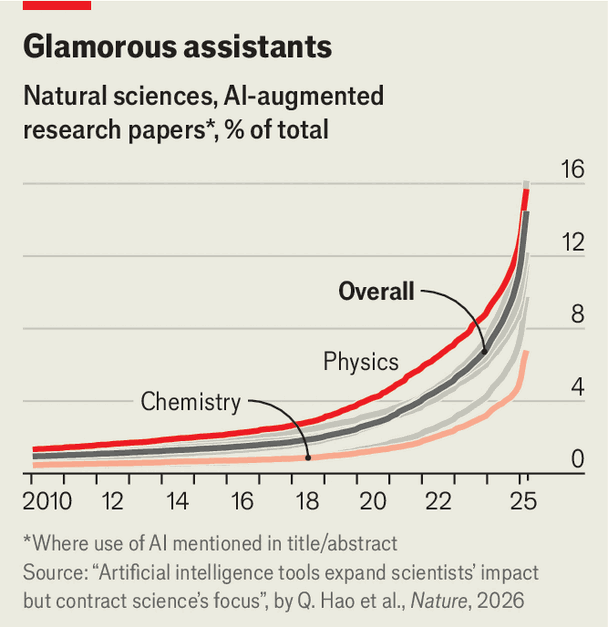
这种颠覆正蔓延至整个自然科学领域。芝加哥大学的James Evans等人今年1月发表的一项针对4130万篇自然科学论文的分析显示,研究人员采用AI的速度正在加快;剑桥大学理论物理学家David Tong表示,转向大语言模型进行计算已成为必然,而Anthropic也在9月25日宣布其Claude模型推动了特定粒子相互作用计算的前沿。然而,Evans的研究表明,尽管使用AI的科学家发表了更多论文并获得更多引用,但AI的使用使研究课题范围缩小了近5%,科学家对彼此工作的参与度降低了22%。这与谷歌近期对600多名科学家的调查结果一致:近一半受访者表示AI促使他们转向更安全、能快速产出可发表成果的渐进式项目,仅有28%的人认为AI帮助他们从事更具探索性的工作。伦敦国王学院的Hector Zenil与Evans警告称,随着AI和机器人技术形成自主测量、假设、实验和评估的科学闭环,机器驱动的研究可能不再能被人类理解,科学家或将沦为试图拼凑AI发现过程的“考古学家”。
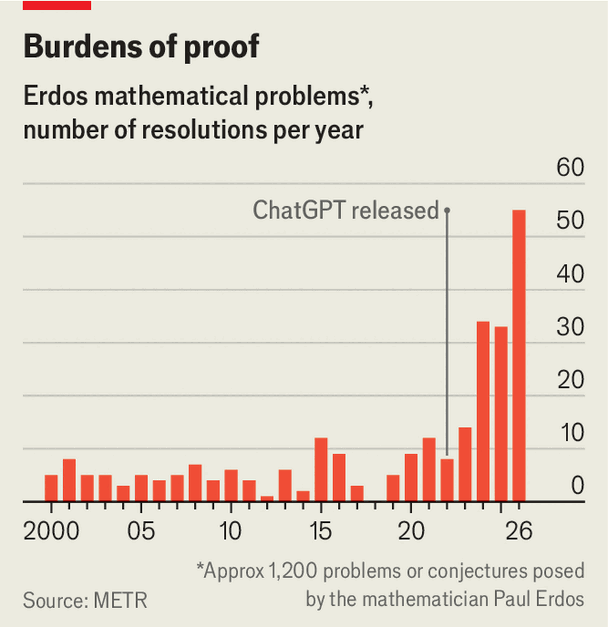
In 2000, mathematician Alain Connes declared that the seven Millennium Prize problems—each carrying a $1m reward—were “totally inaccessible to computers”. Yet in early September, American firm OpenAI claimed an internal AI model took just 88 hours to solve the century-old Navier-Stokes existence and smoothness problem on fluid motion, making it only the second Millennium problem conquered and the first solved by a machine. Then, on October 6th, OpenAI released 719 papers detailing solutions found by the same model to at least 372 other long-standing open problems, an unprecedented event that University of Connecticut mathematician Álvaro Lozano-Robledo called potentially the single most important day in mathematical history.
Far from celebrating, 2022 Fields medallist Hugo Duminil-Copin and 27 fellow Fields medallists issued a statement—endorsed by over 8,000 researchers—warning of a “severe misalignment of AI in mathematics”, while signatory Martin Hairer cautioned that unchecked AI could “sterilise the field”. Objecting mathematicians argue that fixating on solutions overlooks how the quest itself yields vital tools, much as 16th-century imaginary numbers later underpinned electrical engineering and quantum physics. Moreover, AI struggles to explain its reasoning: CUNEF University’s Luis Martínez-Zoroa describes OpenAI’s 166-page Navier-Stokes paper as an unclear “Frankenstein of different parts of research”.
Similar disruption is spreading across the natural sciences. A January analysis of 41.3m papers co-authored by the University of Chicago’s James Evans found accelerating AI adoption, while Anthropic announced on September 25th that its Claude model had advanced particle-interaction calculations. Although Dr Evans’s study showed that AI-using scientists publish more and gain more citations, AI adoption shrank the range of studied topics by nearly 5% and reduced scientists’ engagement with peers’ work by 22%. Consistently, a recent Google survey of over 600 scientists found that nearly half felt AI pushed them towards safer, incremental projects, whereas only 28% said it enabled speculative work. King’s College London’s Hector Zenil and Dr Evans warn that if AI and robotics close the scientific loop by autonomously hypothesising and experimenting, research could become illegible to humans, reducing scientists to “archaeologists” deciphering machine discoveries.
Source: AI’s transformation of mathematics is a turning point for science
Subtitle: Other disciplines should take heed
Dateline: Oct 15th 2026\n