与穿着白大褂在实验室做实验的刻板印象不同,现实中的科学家花费了惊人的时间处理文书工作:对澳大利亚科学家的调查显示,他们每年花1到3个月(平均占工作时间的16%)准备研究提案;其他研究也表明,一份典型的经费申请需要约34天的工作量,而成功率仅为20%左右。因此,根据科学出版商爱思唯尔(Elsevier)今年4月公布的调查,约四分之一的研究人员正使用人工智能工具来加速这一过程,伦敦大学学院的James Wilsdon提到一位常春藤盟校学者借助AI将每周写经费申请的时间从一整天缩短到了45分钟。同样,自2022年ChatGPT推出以来,《科学》(Science)系列期刊的投稿量和全球最大预印本服务器arXiv的上传量大幅增长,其中依赖实验室工作较少的计算机科学增幅最大:从2025年到2026年,国际机器学习大会(ICML)的论文投稿量翻了一番,达到2.4万篇。
然而,AI撰写的论文泛滥也带来了低质量和欺诈性科学的激增。今年5月发表在《柳叶刀》(Lancet)上的一项针对250万篇生物医学论文的分析发现,2023年至2026年初期间,伪造引用的比例增加了12倍,达到0.5%左右;而在作者付费发表的“掠夺性期刊”中,约90%的论文由AI生成。期刊分类公司Cabells的Simon Linacre估计,每年流向掠夺性期刊的费用高达约1.2亿美元,且虚假研究不仅浪费资金还会造成现实伤害并加速错误信息传播——例如近期瑞典研究人员将两篇关于虚构眼疾“bixonimania”的论文上传至预印本服务器后,几周内Gemini和ChatGPT等聊天机器人便开始将其当作真实疾病进行讨论。此外,去年12月《科学》上的一项研究指出,在大语言模型出现前,论文写作的复杂程度通常是衡量其科学质量的良好指标,但如今由于AI能轻易模仿专业术语和文风,这一关系已经逆转。
不过,AI工具也能帮助解决其引发的问题。出版商Frontiers的调查显示,2025年已有超过一半的审稿人使用AI检测篡改图像、文本矛盾或AI生成内容;斯坦福大学的James Zou去年对4万份审稿意见(人类与AI辅助各半)的研究发现,AI辅助审稿人更擅长发现矛盾和技术错误等客观任务,而人类更擅长评估研究新颖性和影响力等主观任务。在经费分配方面,巴塞罗那一家研究基金会已利用AI淘汰最缺乏前景的20%申请,Wilsdon等人则建议结合AI分析、申请人记录详查和面试来分配资金。尽管如此,非英语母语学者的顶刊发表率并未因AI润色而提高,arXiv甚至对新作者设立了标记系统,年轻学者还面临过度依赖模型导致“认知投降”的风险;同时,面对每年数万篇新论文,Zou博士虽只能精读约100篇,但正尝试用AI代理生成个性化摘要。正如RetractionWatch创始人Ivan Oransky所言,学术界“不发表就出局”的激励文化才是干柴,而AI只是助燃剂。
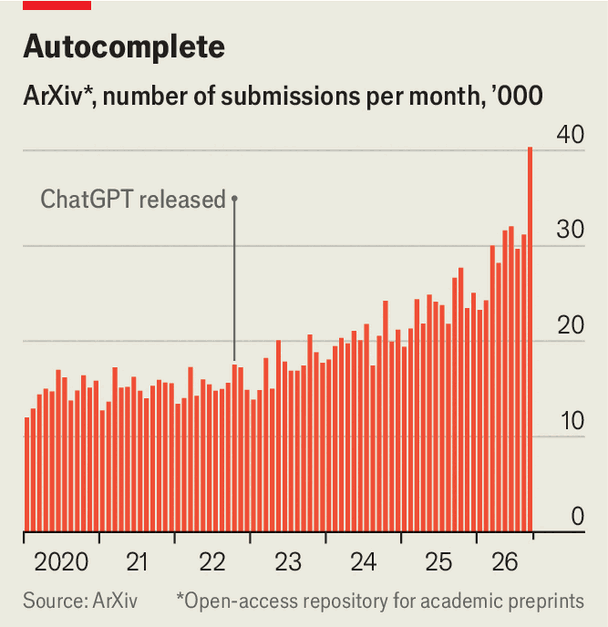
Contrary to the stereotype of lab-coat experimentation, scientists spend immense time on paperwork: Australian researchers spend one to three months annually—16% of their time on average—preparing grant proposals, and a typical application requires around 34 days of work for just a 20% success rate. Consequently, an April survey by publisher Elsevier found around a quarter of researchers use artificial intelligence to speed up applications, with one Ivy League academic cutting weekly grant-writing time from a full day to 45 minutes. Similarly, paper submissions to Science journals and preprints on arXiv have surged since ChatGPT’s 2022 launch, led by computer science, where submissions to the International Conference on Machine Learning doubled from 2025 to 2026 to reach 24,000.
Yet this surge has flooded academia with low-quality and fraudulent science. A May Lancet analysis of 2.5m biomedical papers found that fabricated citations rose 12-fold between 2023 and early 2026 to around 0.5%, while roughly 90% of papers in pay-to-publish “predatory journals”—which Cabells’s Simon Linacre estimates absorb $120m annually—are AI-generated. Beyond wasting money and causing clinical harm, AI accelerates misinformation: within weeks of Swedish researchers uploading two preprint papers about a fictional eye disease called bixonimania, chatbots like Gemini and ChatGPT were discussing it as real. Moreover, because LLMs easily mimic academic jargon, a December Science study found that writing sophistication, once a reliable indicator of scientific quality, now correlates inversely with it.
Still, AI can help manage the deluge it created. According to publisher Frontiers, over half of peer reviewers used AI tools in 2025 to spot manipulated images or text inconsistencies, and Stanford University’s James Zou found across 40,000 reviews—half human-written, half AI-assisted—that AI excelled at objective error detection while humans remained superior at judging novelty and impact. Similarly, a Barcelona foundation uses AI to cull the weakest 20% of grant applications, and researchers like Dr Zou—who can read only about 100 papers deeply each year out of tens of thousands—use AI agents to summarise literature. However, AI has not boosted top-journal publication rates for non-native English speakers, arXiv now flags unknown authors, and students risk “cognitive surrender”; ultimately, as RetractionWatch’s Ivan Oransky notes, AI is merely an accelerant for academia’s underlying “publish-or-perish” culture.
Source: Could AI help scientists with their paperwork?
Subtitle: Yes—but that amplifies existing problems
Dateline: Oct 15th 2026\n