在2025年国际学生评估项目(PISA)中,来自中国大陆的12,385名15岁参测学生取得了全球瞩目的顶尖成绩,在数学和科学领域斩获全球第一,在阅读素养上仅次于新加坡位居次席。然而,这一成绩仅代表被称为“BSJZ”的特定发达地区,即北京、上海、江苏和浙江。尽管这四省市涵盖了近2亿人口,但其教育资源与经济水平远超全国基准:普通高中及大学升学率显著高于全国平均,居民年人均可支配收入接近7万人民币(约合9,700美元),较全国大陆平均水平高出约60%。
为推算中国全境的真实学业表现,研究机构曾借鉴世界银行2018年的分析范式,利用中国各地区在不同发展阶段参与PISA的数据,建立了居民可支配收入与测验得分之间的计量回归关联。《经济学人》结合最新评估数据更新了该模型,原始趋势线显示即便全国所有省份统一参测,推算出的全国数学得分仍高达579分,依然领跑全球。然而,受疫情后续效应以及技术对学习习惯的冲击影响,2025年BSJZ地区的阅读成绩较2018年出现下滑,且各科成绩的增幅明显低于同期收入增长所对应的理论预期,表明传统增长趋势发生断裂。
通过将既往趋势线下调以拟合2025年BSJZ的实际表现,修正后的测算模型显示,中国全境的数学平均得分预计为536分。尽管这一估算值低于BSJZ实际取得的612分,但仍足以使中国位列全球第四;同时,推算出的全国三科总平均分为501分,将位居全球第七位。这一测算结果显著超越了同等收入经济体的常规教育表现,表明中国完全有底气摒弃局部的样本筛选模式,让全境学生共同参与这一国际评估。
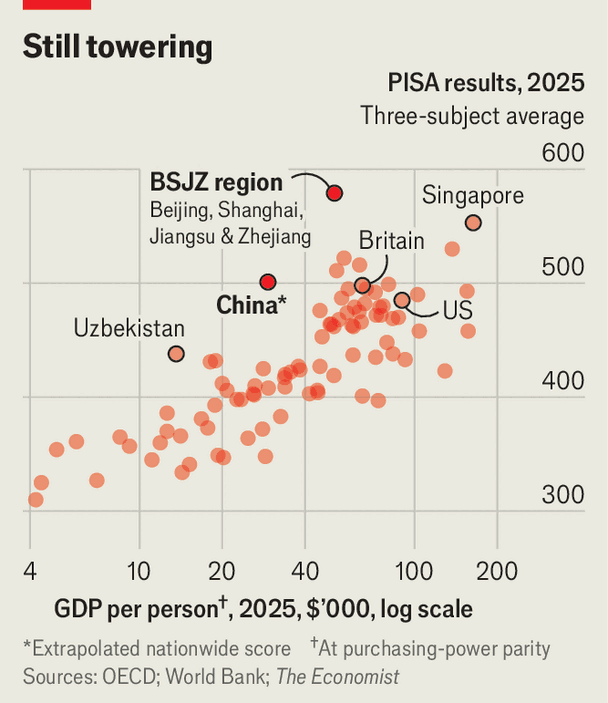
In the 2025 Programme for International Student Assessment (PISA), the 12,385 fifteen-year-old participants from mainland China achieved premier global rankings, placing first internationally in mathematics and science and second only to Singapore in reading literacy. However, these outcomes reflect a selective geographic cohort known as BSJZ, representing Beijing, Shanghai, Jiangsu, and Zhejiang. While encompassing nearly 200m residents, this prosperous eastern cluster diverges sharply from national demographics: academic secondary and tertiary enrollment rates significantly exceed broader benchmarks, while annual disposable income per person averages nearly 70,000 yuan ($9,700), roughly 60% higher than the mainland average.
To estimate performance across China’s entire socio-economic spectrum, researchers previously leveraged historic PISA participation across regions with disparate developmental levels to establish the statistical correlation between household disposable income and standardized academic achievement. Updating the World Bank’s 2018 methodology with subsequent testing data, an unadjusted regression model indicates that China’s nationwide mathematics score would reach 579, maintaining a world-leading position. Nevertheless, the 2025 cycle revealed widespread educational headwinds—stemming from lingering pandemic disruptions and shifts in learning habits—as BSJZ students recorded lower reading scores than in 2018 and failed to match expected income-driven score gains.
Adjusting the statistical model to align historical regressions with actual 2025 BSJZ metrics yields a calibrated national projection. Under this conservative baseline, China’s overall national mathematics score is estimated at 536—lower than the 612 recorded by the BSJZ cohort, but sufficient to secure fourth place globally. Furthermore, an extrapolated nationwide composite score across all three assessed subjects of 501 would place China seventh internationally, vastly exceeding the performance expected of a middle-income economy and underscoring the case for ending selective sub-national testing in favor of comprehensive nationwide participation.
Source: China’s kids rank near the top in global school tests
Subtitle: What if all of China’s provinces took part, not just rich areas?
Dateline: Sep 24th 2026\n