LEAP的前三轮调查汇集339名专家与大量公众样本,生成可量化的AI进展预测。专家预期2030–2040年将出现显著变动:生成式AI工作辅助从4.1%基线升至2030年的中位18%(下四分位9%,上四分位30%);私人AI投资从2024年的1,300亿美元翻倍至2030年的中位2,600亿美元,25%–75%区间约为1,750亿–4,000亿美元;AI用电在2030年达美国总量的7%,2040年达12%,下四分位仍为5%与8%。能力预测显示23%预期2030年前后达到FrontierMath饱和,相对19%的基线;并分别赋予AI在2030年与2040年实质性协助解决千禧难题20%与60%的概率。AI陪伴使用率预计从6%升至2030年的15%与2040年的30%。专家认为2030年出现“快速进展”的概率为23%,并认为2040年AI达到“千年级技术”影响的概率为32%。
预测分歧显著:专家间分歧占总体变异的51%。上四分位专家预测2040年AI发现药物销售占比为50%,下四分位仅10%;并对2040年AI协助千禧难题的概率给出至少81%对比30%。专家中位预测显著低于前沿实验室领袖的激进时间线,与其对2026–2029年出现类人或超人系统及五年内10–20%失业率的主张形成强烈对比。相较之下,专家中位预测2030年白领就业增长为2%,低于6.8%的趋势基线。
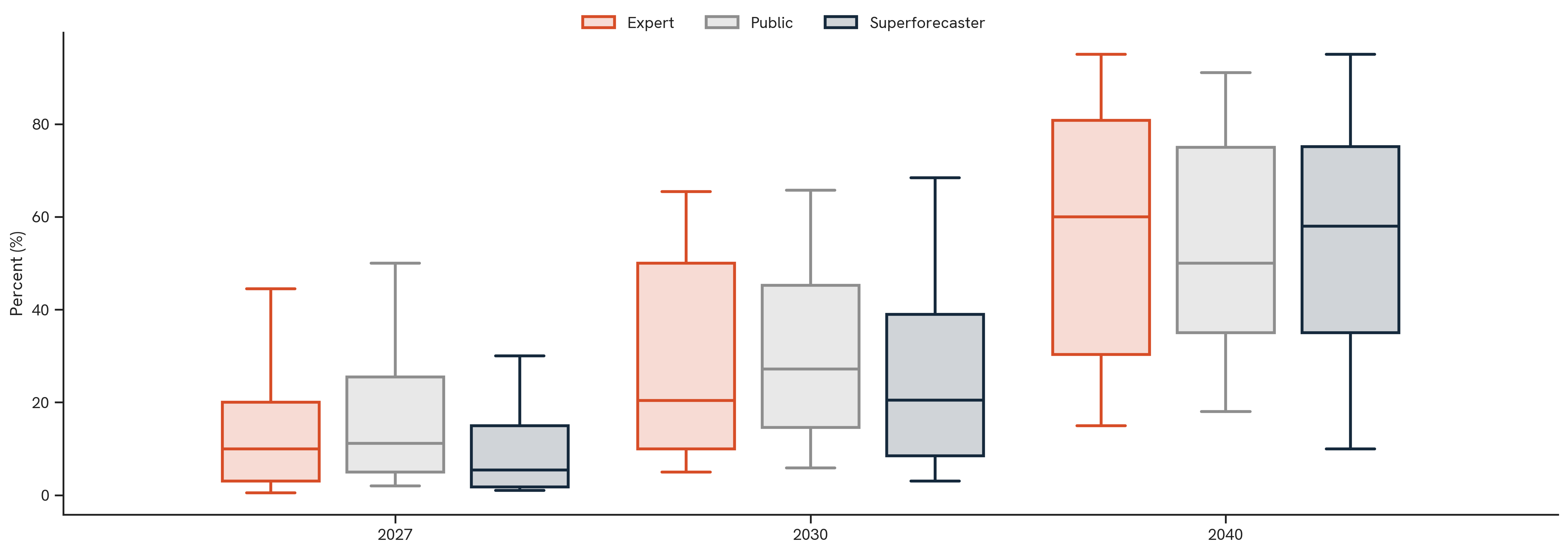
专家系统性地预测AI进展快于公众。到2030年,专家预测自动驾驶网约车渗透率为20%,公众为12%;生成式AI工作辅助为18%,公众为10%;AI参与科研论文约30%,公众约20%。仅6%公众预期FrontierMath饱和,而专家为23%。超级预测者普遍预测进展低于专家——例如他们给出8%而非20%的自动驾驶渗透率——唯独在药物发现上更乐观,预测2040年AI发现药物销售占比为45%,专家为25%。
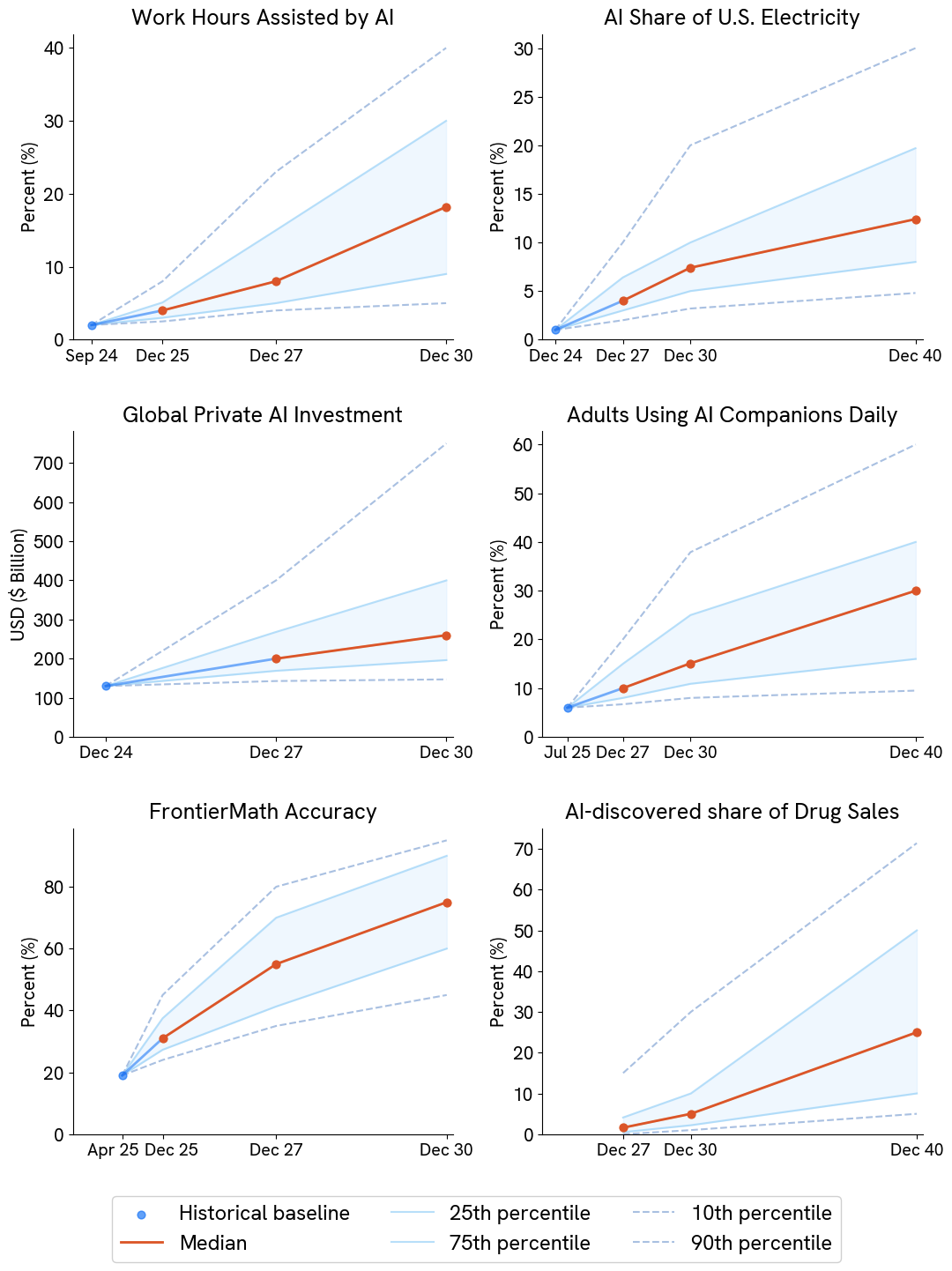
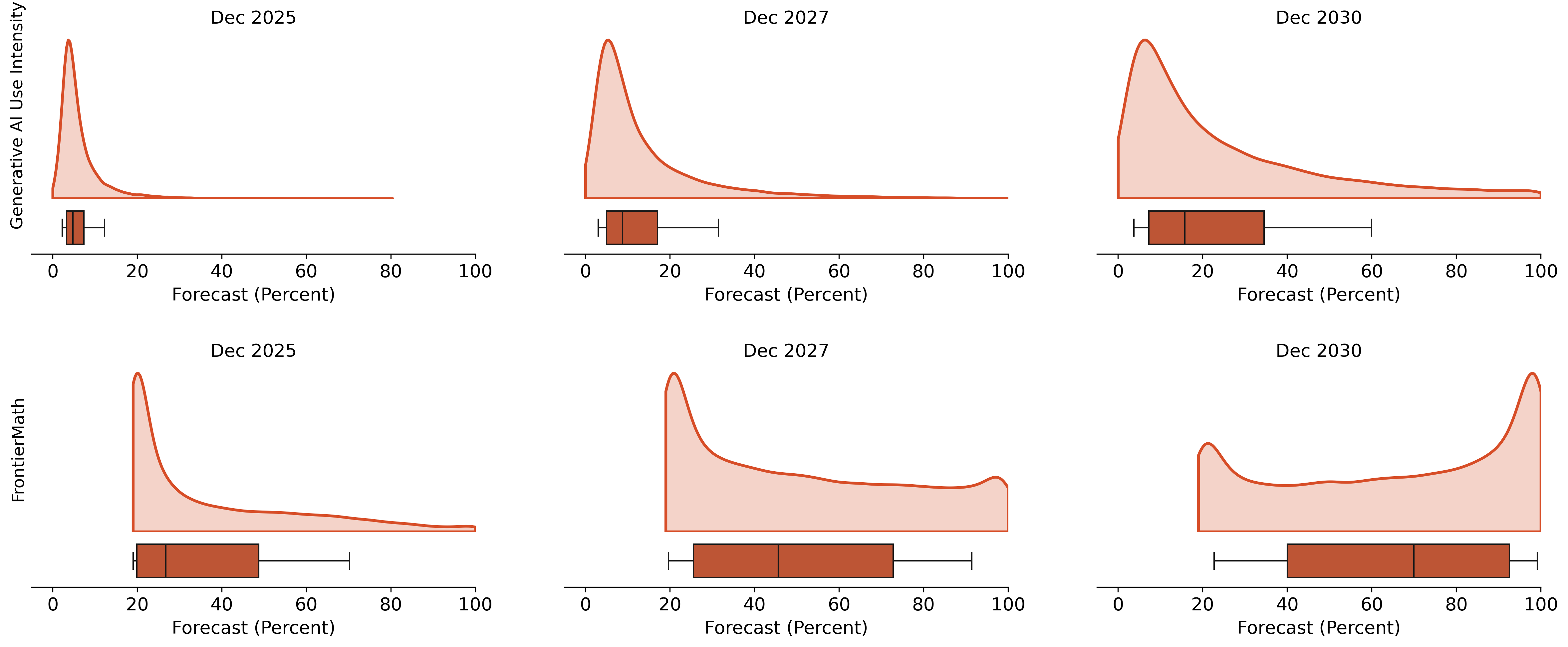
LEAP’s first three waves aggregate 339 experts and large public samples, producing quantifiable forecasts on AI progress. Experts project sizable shifts by 2030–2040: generative AI assistance rising from a 4.1% baseline to a median 18% of U.S. work hours by 2030 (bottom quartile 9%, top quartile 30%); private AI investment doubling from USD 130B (2024) to a median USD 260B by 2030 with a 25%–75% credible range of roughly USD 175B–400B; and AI electricity demand reaching 7% of U.S. consumption in 2030 and 12% by 2040, with bottom-quartile forecasts still at 5% and 8%. Capability forecasts show 23% expect FrontierMath saturation by 2030 relative to a 19% baseline, and experts assign 20% and 60% probabilities of AI substantially assisting a Millennium Prize solution by 2030 and 2040. Companionship use is projected to rise from 6% to 15% in 2030 and 30% in 2040. Experts assign a 23% probability to “rapid progress” by 2030 and a 32% probability that by 2040 AI reaches “technology-of-the-millennium” impact.
Forecast dispersion is large: between-expert disagreement accounts for 51% of total variation. Top-quartile experts predict 50% AI-discovered-drug sales by 2040 versus 10% for the bottom quartile, and ≥81% probability of Millennium-Problem assistance by 2040 versus 30% for the bottom quartile. Median expert expectations remain far below frontier-lab leaders’ timelines, contrasting sharply with claims of near-term human-level or superhuman systems and 10–20% unemployment within five years. Median expert forecasts instead imply moderate impacts, including 2% white-collar job growth by 2030 versus a 6.8% trend baseline.
Experts systematically forecast faster AI progress than the public. By 2030, experts predict 20% autonomous-vehicle rideshare penetration versus the public’s 12%; 18% generative-AI work-hour assistance versus 10%; and 30% AI-engaged science-paper share versus ~20%. Only 6% of the public expects FrontierMath saturation versus 23% of experts. Superforecasters generally forecast less progress than experts—8% versus 20% autonomous-vehicle share—except in drug discovery, where they project 45% AI-discovered-drug sales by 2040 versus experts’ 25%.