每年发射的卫星数量上升,使标准化的回报不断提高,而立方星——1999 年推出、由 10 厘米立方体模块组成——仍是最接近行业标准的形式。迄今已发射超过 3,000 颗,且在 2018 年有两颗抵达火星,尽管它们并未着陆。
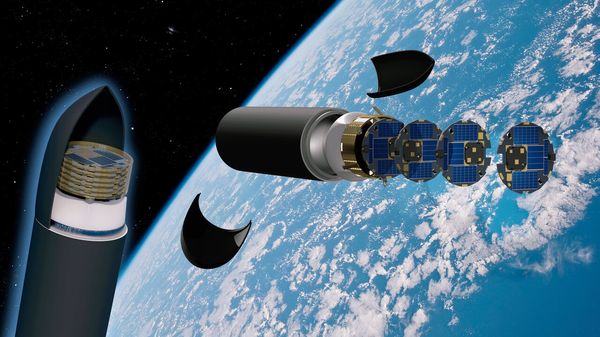
立方星的表面积与体积之比限制了可布置太阳能电池的面积相对于耗电载荷体积的规模,因而长期处于功率不足;航天公司(Aerospace Corporation)的工程师提出表面积/体积比更高的盘星(DiskSat)。首批 4 个盘星于 12 月 18 日搭乘 Rocket Lab 的 Electron 火箭(直径 1.2 米)发射,每个约 1 米宽、2.5 厘米厚,从而能紧密装入整流罩而不浪费空间。
盘状外形还通过边缘朝前飞行来降低低轨道中的热层阻力,从而更有利于在低轨保持轨道,其中热层是地表以上 85–600 公里范围的大气区域。目前这 4 个盘星在 550 公里高度运行,计划让其中 2 个下降到 300 公里以下(超低地球轨道),在更稠密的热层中测试性能,并以更近距离提升对地观测能力以满足美国太空军等赞助方需求。
Rising annual satellite launches are increasing the payoff from standardisation, and CubeSats—modular 10 cm cubes introduced in 1999—remain the closest thing to a standard. More than 3,000 have been launched, and in 2018 two reached Mars, though they did not land.
CubeSats’ surface-area-to-volume ratio limits solar-cell area relative to power-hungry volume, leaving them systematically underpowered; Aerospace Corporation engineers propose a higher-ratio DiskSat. Four DiskSats launched on December 18 aboard Rocket Lab’s Electron (1.2 m diameter), each about 1 m across and 2.5 cm thick to fit tightly.
The disk shape also helps low-orbit endurance by flying edge-first to cut thermospheric drag in the 85–600 km region. The quartet currently orbits at 550 km, with two planned to descend below 300 km (very-low Earth orbit), where a thicker thermosphere tests performance and closer range improves Earth observation for sponsors such as the U.S. Space Force.
Source: Real flying saucers
Subtitle: The latest satellites are flat and circular
Dateline: 1月 08, 2026 09:49 上午