9月23日,密苏里州共和党参议员乔希·霍利邀请多家监控技术公司高管出席参议院小组委员会听证会,就日益加剧的隐私侵犯问题作证,但所有受邀高管均拒绝出席。此举发生在美国最大的车牌自动识别(ALPR)运营商Flock Safety遭遇长达数月的广泛抵制之际。民调机构YouGov数据显示,反对在社区部署车牌识别摄像头的美国人比例在不到一年内从33%骤升至46%。虽然唐纳德·特朗普公开支持Flock以协助执法,但两党立法者已开始起草法案,试图对该项技术的大规模普及施加严格限制。
凭借远低于竞争对手的设备价格,Flock在全美已部署超过12万台摄像头,每台摄像头捕捉并生成数以百万计的图像。各机构能够将这些数据汇入全国数据库以实现跨城市与跨州联合检索,且人工智能技术可提取车身颜色等细节以拓宽追踪线索。警方声称该网络对侦破盗窃和绑架至关重要,Flock更宣称去年协助破获了10,000起失踪人口案件。然而,全美刑事辩护律师协会等团体严厉批评指出,警察无需司法搜查令即可任意查询车牌,而各州在记录检索理由、数据保留期限以及跨州共享规则上缺乏统一监管与问责标准。
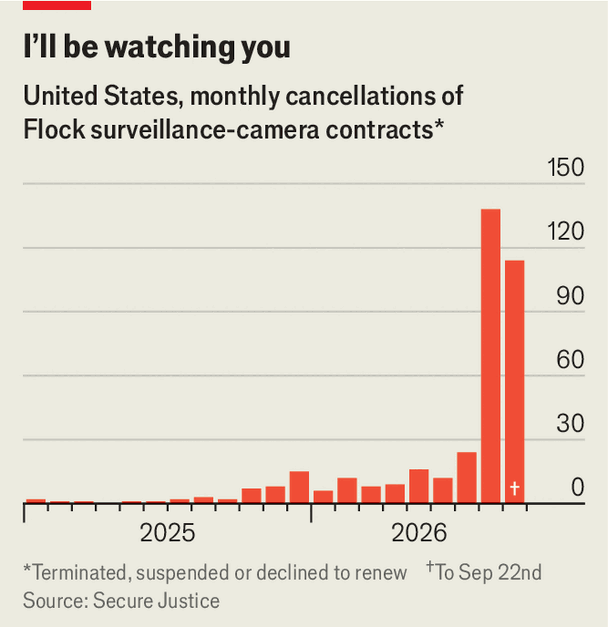
系统滥用和缺乏透明度进一步激化了公众愤怒。电子前沿基金会(EFF)对搜索日志的分析发现,警员在输入查询理由时随意填写“LOL”或“sexy”等无意义词汇,更有警员利用系统跟踪配偶或前任,软件识别错误亦导致无辜驾驶员被拦停。随着抵制浪潮演变为中期选举的核心政治议题,得克萨斯州州长格雷格·阿博特已暂停州政府对Flock的资金支持。反监控组织Secure Justice的追踪数据显示,仅在今年8月和9月,就有超过250个城市、城镇和学区终止了与Flock的合作合同,而去年同期解约的数量仅为5个。
On September 23rd, Missouri Republican Senator Josh Hawley summoned executives of prominent surveillance technology firms to testify before a Senate subcommittee over escalating privacy alarms, but all declined to appear. This confrontation followed severe backlash against Flock Safety, the largest US operator of automatic licence-plate readers (ALPRs). According to polling by YouGov, the share of Americans opposing local ALPR deployments surged from 33% to 46% in under a year. Although Donald Trump has endorsed Flock as an asset for law enforcement, bipartisan federal and state lawmakers are actively advancing legislative measures to curb the rapid, unchecked expansion of AI surveillance networks.
Flock has rapidly installed over 120,000 cameras across the United States by undercutting competitor pricing, generating millions of images per device that feed into inter-agency and nationwide searchable databases with AI extracting vehicle features like colour. While law enforcement credited the platform with aiding 10,000 missing-person investigations last year, civil liberties advocates such as the National Association of Criminal Defence Lawyers stress that the tool operates without search-warrant requirements, subject only to fragmented state statutes governing data retention limits and interstate footage transmission. The absence of strict judicial safeguards has turned widespread passive vehicular monitoring into an unprecedented domestic surveillance apparatus.
Severe operational abuse and operational opacity have magnified public outrage across the country. Investigations by the Electronic Frontier Foundation (EFF) uncovered police officers conducting unjustified lookups for stalking ex-partners or logging spurious justifications such as “LOL” and “sexy”, while algorithmic errors prompted wrongful traffic stops. Consequently, the controversy has spilled into midterm politics, prompting Texas Governor Greg Abbott to halt state funding for Flock systems. Furthermore, surveillance tracker Secure Justice documented that more than 250 municipalities, towns, and school districts terminated contracts with Flock across August and September, compared to merely five cancellations during the exact same period last year.
Source: Why licence-plate readers are angering Americans
Subtitle: Surveillance cameras are becoming the new data centres
Dateline: Sep 24th 2026\n