非洲拥有全球13%的天然气储量,分布在54个国家中的24国,但其管道网络密度仅为北美的十分之一,全球发电用气的消耗占比不足5%。2025年非洲天然气总产量估计达2620亿立方米(bcm),同比增长2.5%,然而撒哈拉以南非洲产量的43%直接用于出口。在该地区消费的天然气中,近一半用于发电,仅17%进入工业领域(远低于南美的近40%和亚洲的逾30%),且全区仅有9座城市铺设了管道燃气网络。下游基础设施的极端匮乏与买卖双方的融资互锁,导致天然气未能有效转化为推动工业化的内生动力。
当前全球能源动荡推动了上游投资的活跃,道达尔能源(TotalEnergies)和埃尼(ENI)等跨国企业正扩大在非液化天然气(LNG)布局,莫桑比克此前因叛乱搁置的200亿美元LNG项目已重新推进;咨询机构睿咨得(Rystad)预测,得益于本土企业的扩张,尼日利亚日产量到2030年可达110亿立方英尺(年产约1140亿立方米)。在下游替代煤炭方面,南非正推进价值9.5亿美元的天然气电厂与进口码头规划。睿咨得估计,若南非、尼日利亚及莫桑比克、坦桑尼亚、科特迪瓦等重点项目顺利投产,撒哈拉以南非洲的燃气发电装机容量将从目前的26吉瓦(GW)翻倍至2035年的52吉瓦,超过煤电的35吉瓦,但仍远逊于光伏预期的140吉瓦。
然而,非洲推进天然气化面临严重的结构性瓶颈与市场错配。非洲公用事业部门财务拮据,尼日利亚在其“天然气十年”计划中途仍面临电网薄弱导致的消纳受限,被迫将大部分新增产能导向出口;同时,坦桑尼亚和塞内加尔在内销配额及政府价格管制上的争议削弱了外资意愿。尽管加纳Genser Energy铺设逾400公里管道并融资5亿美元,拉各斯与达累斯萨拉姆也形成了依托天然气的工业集聚,多边贷款机构亦放宽了气电融资,但多项目同时上马蕴含重大市场风险;若未来全球供过于求压低气价,或长时储能技术的突破削弱气电相对于可再生能源的成本优势,高成本的非洲天然气资产将面临沦为搁浅资产的巨大隐患。
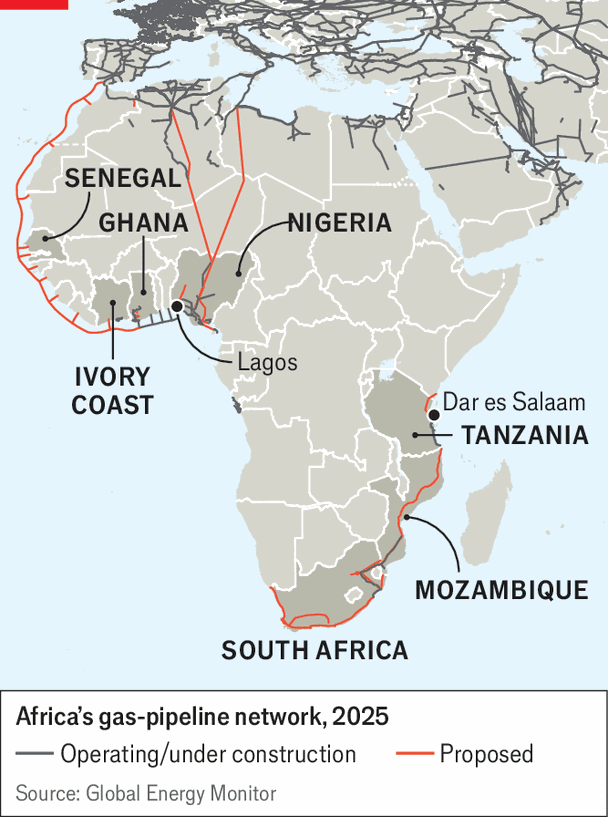
Africa holds 13% of global natural-gas reserves spread across 24 of its 54 countries, yet its pipeline network is only one-tenth as dense as North America’s, and the continent consumes under 5% of worldwide gas used for power. Continental production expanded by 2.5% in 2025 to reach an estimated 262bn cubic metres (bcm), but roughly 43% of sub-Saharan output was shipped abroad. Domestically, nearly half of consumed gas powers electricity, while industry absorbs just 17%—trailing South America’s nearly 40% and Asia’s 30%—and only nine sub-Saharan cities possess municipal piped-gas networks, stymieing downstream economic integration due to mutual infrastructure financing bottlenecks.
Global energy market dislocations have revitalised upstream investments: TotalEnergies and ENI are expanding export operations, while Mozambique revived a long-stalled $20bn LNG development. Rystad Energy projects that domestic operators could lift Nigerian gas production to 11bn cubic feet daily—roughly 114bcm annually—by 2030. Downstream, South Africa is pursuing $9.5bn in gas infrastructure and LNG terminals to replace coal; consequently, Rystad projects sub-Saharan gas-fired electricity capacity could double from 26 gigawatts (GW) today to 52GW by 2035 across South Africa, Nigeria, Mozambique, Tanzania, and Ivory Coast, surpassing coal’s projected 35GW but trailing solar’s 140GW.
Nevertheless, domestic adoption faces severe fiscal and structural impediments. Financially frail public utilities struggle to purchase relatively expensive gas power, and in Nigeria—halfway through its “Decade of Gas”—grid transmission failures force producers to prioritize external exports over domestic supply, while price controls in Tanzania and Senegal disincentivise multinational operators. While Ghanaian operator Genser Energy raised $500m after constructing 400km of industrial pipeline and clusters around Lagos and Dar es Salaam thrive on local gas, rapid expansion carries grave macroeconomic exposure: multilateral financing relaxations could trigger oversupply, where future global gluts and advances in long-duration storage render high-cost African infrastructure uncompetitive stranded assets.
Source: How realistic is Africa’s dream of a gas-powered future?
Subtitle: Political risk, structural weaknesses and a lack of financing hamper the fuel’s potential
Dateline: Sep 24th 2026\n