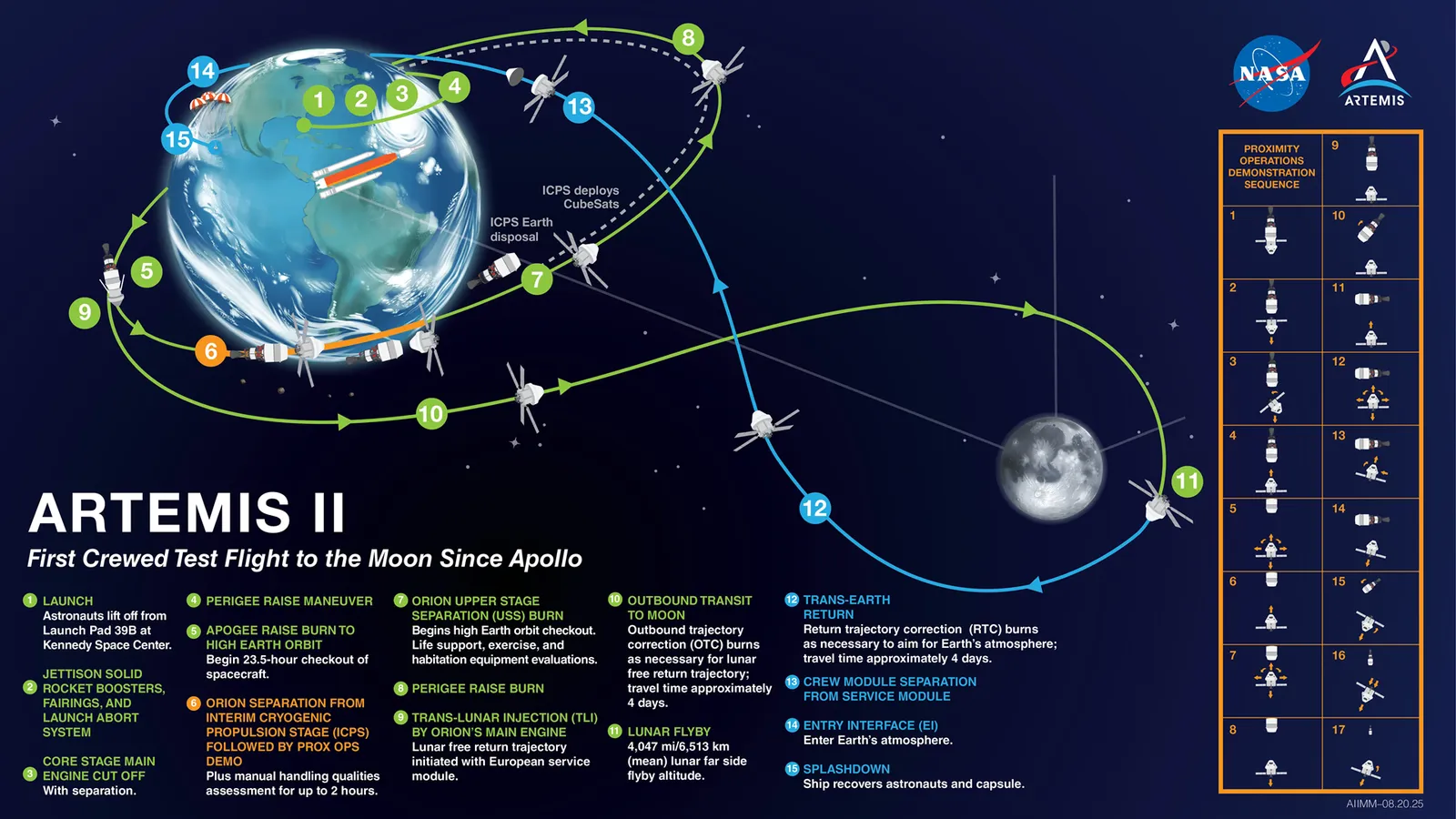
在第一级分离后,SLS 的主体与上段分开;ICPS 上段将 Orion 保持在高地球轨道约 23 小时,并在所有检查完成后与 Orion 分离,之后才真正进入月球转移段。预计于 2026 年 4 月 6 日晚上到达中途点。Artemis II 将在距离月球表面约 10,300 公里(10,300 km)处掠过,远超过先前 Apollo 13 约 400 公里(400 km)的纪录。其近日距离月表约 7,400 公里(7,400 km),发生于掠经月球背面时。飞船不进入月球轨道,而是掠过后利用月球重力弹弓返回地球,形成两个天体之间的「8」字形轨道。
在掠过月球后,Orion 将采取被动再入路径,实际上以自由落体方式回归地球,无需持续主动推进。即便推进或其他系统出现故障,轨道设计仍可确保可安全再入。再入将于 2026 年 4 月 11 日进行,距离发射时间为 9 天 13 小时,著水点在太平洋,由美国海军回收。
Liftoff of Artemis II happened at 6:35 pm ET on April 2, 2026, when an SLS rocket carried Orion with astronauts Reid Wiseman, Victor Glover, Christina Koch, and Jeremy Hansen. As of that date they became the first humans to go beyond low Earth orbit since Apollo 17 in 1972. The mission is designed as a proving flight: it will test systems needed for future lunar missions, especially radiation protection and deep-space communication, and its major engineering focus is the non-linear trajectory to and from the Moon.
After first-stage separation, the SLS upper segment and Orion diverged from flight structure; the ICPS upper stage kept Orion in high Earth orbit for about 23 hours, then separated after all checks were complete, and only then did lunar transfer effectively begin. The halfway point is expected on the evening of April 6. Artemis II will pass about 10,300 kilometers (10,300 km) beyond the lunar surface, far beyond the previous record of Apollo 13 at around 400 kilometers (400 km). Its closest lunar approach will be about 7,400 kilometers (7,400 km), during the far-side flyby. Instead of entering lunar orbit, the spacecraft will pass the Moon and use lunar gravity assist for return, creating a figure-eight trajectory between the two bodies.
After the lunar flyby, Orion will use a passive return profile, essentially falling back to Earth in free fall without sustained engine burns. Even if propulsion or other systems fail, the trajectory is designed to keep reentry conditions safe. The return splashdown is planned for April 11, about 9 days and 13 hours after launch, in the Pacific Ocean, where recovery by the U.S. Navy is expected.