中国在 AI 竞赛中的潜在优势不只在应用、模型和芯片,更在电力。其电网总装机已达 3800 吉瓦,超过美国的两倍,且仅去年就新增逾 500 吉瓦;未来 5 年新增装机预计为美国的 6 倍。中国数据中心电价约每千瓦时 3 美分,大约是许多美国数据中心的一半。随着 AI 数据中心向吉瓦级扩张,RAND 预计全球相关电力需求将从 2027 年的 68 吉瓦增至 2030 年的 327 吉瓦,因此“电子差距”正成为战略变量。
但中国尚未充分把廉价电力转化为算力优势,主要瓶颈是先进芯片。美国自 2019 年起收紧出口限制,使中国更难获得或制造 7 纳米及以下芯片。2025 年中国科技企业在 AI 基础设施上的投入估计为 240 亿美元,而美国超过 3500 亿美元,差距接近 15 倍。部分地方数据中心建设失当,利用率低至 20%;山西阳高一个被宣传为“算力县”的大型数据中心,适于训练 AI 的芯片占比甚至低于 0.1%。
趋势正在变化。过去两年中国已建成 5 吉瓦 AI 数据中心,UBS 预计到 2029 年还将再建 25 吉瓦,增量约为此前两年的 5 倍。SMIC 今年计划将 7 纳米芯片产能翻倍,Hua Hong 也开始生产 7 纳米芯片。中国还计划到 2028 年把西部低温、风光水资源丰富地区的数据中心连成全国统一算力池。若高端芯片国产化继续推进,廉价能源可能在 2020 年代后期足以部分抵消芯片劣势,并加速 AI 在实体经济中的部署。
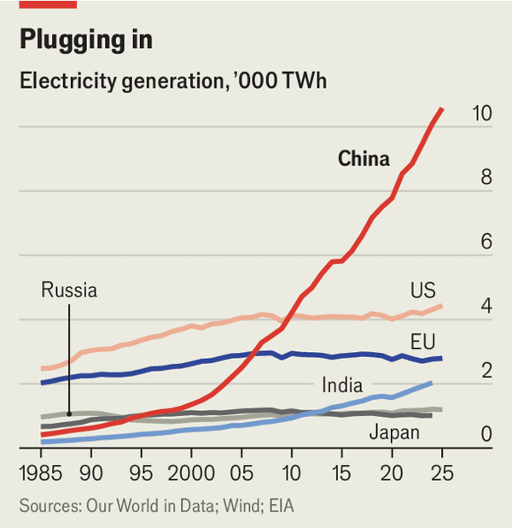
China’s potential advantage in the AI race lies not only in apps, models and chips, but in electricity. Its grid has reached 3,800GW of capacity, more than double America’s, after adding over 500GW last year alone; over the next 5 years it is expected to add 6 times as much capacity as America. Chinese data centres can secure power at about 3 cents per kWh, roughly half the rate many American centres pay. As AI data centres scale toward gigawatts, RAND projects global demand for such power will rise from 68GW in 2027 to 327GW in 2030, making the “electron gap” strategic.
Yet China has not fully converted cheap power into computing advantage, mainly because of advanced-chip shortages. Since 2019, tighter American export controls have made it harder for China to obtain or produce chips at 7nm or below. In 2025, Chinese tech firms were estimated to spend $24bn on AI infrastructure, versus more than $350bn by American firms, a gap of nearly 15-fold. Some locally backed data centres have been poorly managed, with utilisation rates as low as 20%; in Yanggao, a heavily promoted “computing county”, less than 0.1% of chips are capable of serious AI training.
The trend is shifting. China built 5GW of AI data centres over the past 2 years, and UBS expects another 25GW by 2029, an increase about 5 times as large. SMIC plans to double 7nm capacity this year, and Hua Hong has also begun producing 7nm chips. China also aims by 2028 to connect western data centres, where wind, solar, hydropower and cooler climates are abundant, into a national computing pool. If domestic high-end chip production keeps improving, cheap energy could partly offset chip weakness by the late 2020s and accelerate AI deployment across the real economy.