英国剑桥和美国马萨诸塞州剑桥代表了世界上两个最密集且最高产的创新引擎,由世界顶尖的学术研究推动。根据世界知识产权组织的数据,英国剑桥在创新密度上排名第二,而波士顿-剑桥排名第三,尽管数据提供商Dealroom在衡量企业价值和独角兽数量时颠倒了这一顺序。虽然这座英国城市在人均学术产出和专利申请方面表现优异,但其美国同名城市在研究成果商业化方面要有效得多,这得益于其430万人口的巨大规模,而大剑桥地区的人口仅为50万。
这两个生态系统面临着截然相反的结构性挑战:英国剑桥受到其中世纪基础设施和后期增长资本严重短缺的限制,迫使初创公司在扩张时寻求国外支持。相反,美国剑桥在疫情期间遭受了过度资本注入的困扰,这推高了租金,并使商业实验室空间到2024年几乎翻了一番,达到6300万平方英尺,最终导致2025年底空置率达到28%,且风险投资资金急剧收缩。这些互补的差异促成了更紧密的合作,许多英国生物技术公司建立了双重业务,以获取美国资本,同时将核心研究留在英国。
此外,投资模式正在发生变化,美国风险投资越来越多地流入英国,占英国初创公司所获资金的19%。为了弥合规模差距,这座英国城市正计划进行一项耗资30亿英镑的科学园扩建,提高临床试验速度,并深化与其他英国中心的联系。然而,两个剑桥都面临着来自创新地理格局转变的共同长期挑战,特别是来自中国,中国目前占全球临床试验的近三分之一,而十年前这一比例仅为6%。
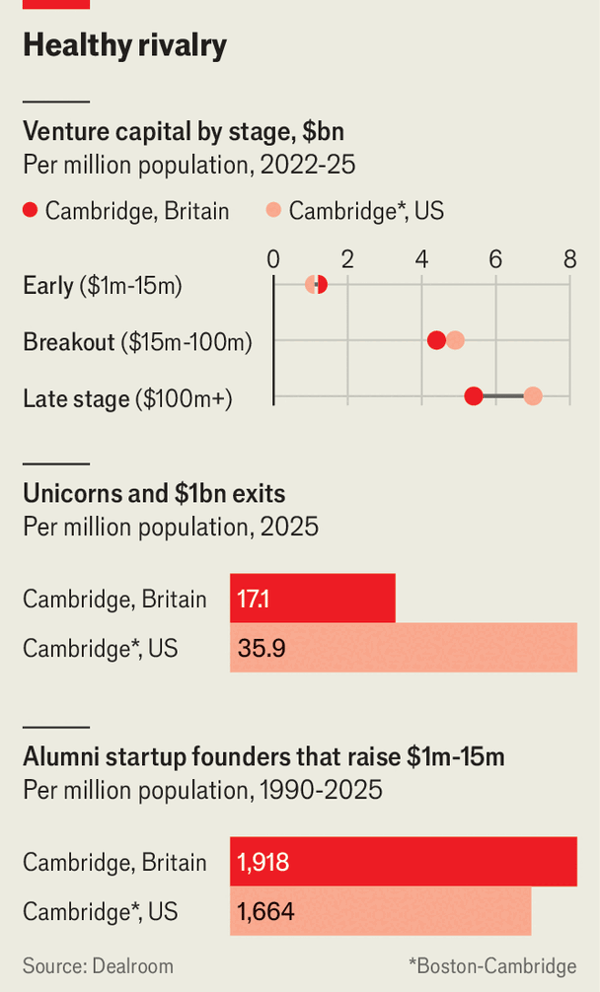
Cambridge, UK, and Cambridge, Massachusetts, represent two of the world’s most dense and productive innovation engines, driven by world-class academic research. According to the World Intellectual Property Organisation, the UK Cambridge ranks second and Boston-Cambridge ranks third in innovation density, though data provider Dealroom reverses this order when measuring enterprise value and unicorn count. While the British city excels in academic output and patents relative to its population, its American namesake commercializes research far more effectively, supported by its massive scale of 4.3 million people compared to greater Cambridge’s population of 500,000.
The two ecosystems face opposite structural challenges: the British Cambridge is constrained by its medieval infrastructure and a severe shortage of growth capital, forcing startups to look abroad as they scale. Conversely, the American Cambridge has suffered from excessive capital infusion during the pandemic, which inflated rents and nearly doubled lab space to 63 million square feet by 2024, culminating in a 28% vacancy rate by late 2025 and a sharp contraction in venture capital funding. These complementary differences have led to deeper collaboration, with many British biotech firms establishing dual presences to access American capital while keeping core research in the UK.
Furthermore, investment patterns are shifting, with American venture capital increasingly flowing into the UK, representing 19% of the capital received by British startups. To bridge the scaling gap, the British city is planning a major £3 billion science park expansion, enhancing clinical trial speeds, and deepening ties with other UK hubs. However, both Cambridges face a shared long-term challenge from the shifting geography of innovation, particularly from China, which now accounts for nearly a third of all global clinical trials, compared to just 6% a decade prior.
Source: Why Cambridge and Cambridge need each other
Subtitle: Two of the world’s most innovative cities have the same name and completely opposite problems. That is leading to closer collaboratio
Dateline: Jul 02, 2026 08:46 AM | Cambridge and Cambridge