欧盟既担忧中国廉价电动汽车的涌入(于10月12日宣布自12月起对中国混合动力电动汽车设定每年35万辆的进口配额,以将其市场份额控制在10%以下),也忌惮中国对关键矿产的垄断:为将废旧电池粉碎后富含锂、钴、镍的“黑粉”(black mass)留在本地处理,欧盟将从下月起限制黑粉出口,而禁止中国电动汽车但仍大量进口中国电池的美国已于8月全面禁止黑粉出口。然而,据国际能源署预测,到2050年黑粉可满足全球20%至30%的电池金属需求,中国正大力发展回收产业以保障资源安全并向“循环经济”转型。作为产生全球约15%的城市垃圾和超过四分之一工业废料的国家,中国在1980年代曾大量进口海外洋垃圾,并在2011年曝光出北京周边垃圾场提炼“地沟油”卖给餐馆的丑闻;随后中国于2013年向污染宣战并发布首份国家循环经济规划,2017年启动“国门利剑”行动停止大部分废塑料进口,2021年全面禁止固体废物进口,并在过去五年推广城市生活垃圾强制分类。
如今,中国发展回收业的动机已从环保转向资源安全:虽然中国掌控着全球大部分铝、铜、电池金属和稀土的精炼产能,但矿石大多依赖进口,因此中国在今年7月发布的2030年循环经济规划中计划到2030年通过回收每年供应5.1亿吨工业原材料,比目前水平增加约三分之一。除了扩大成熟的废钢、废铜、废铝回收及减少石油进口的塑料回收外,最棘手的是应对电子垃圾海啸——预计到2030年,中国每年将产生50万吨风力涡轮机废料、100万吨电动汽车电池废料和150万至200万吨太阳能电池板废料。凭借庞大的本土制造规模以及宁德时代(CATL)旗下全球最大电池回收商邦普循环(Brunp)等布局,中国已建立起全球85%的电池回收产能,但大量废旧电池仍流入非正规小商贩手中,且偏远地区的风电和光伏设备(含微量银和稀土钕)收集与提取难度极大。
为此,中国于2024年成立了国有企业中国资源循环集团以统筹清洁技术产品回收,在回收厂引入人工智能分拣,并在今年4月要求电池和车企为产品赋予全生命周期追踪的数字身份证及承担回收法律责任;目前回收已占中国稀土供应量的10%,几乎全为国有的稀土企业即便面对高昂成本也会在国家支持下推进。同时,为确保回收厂原料充足,中国悄然放宽了部分优质海外废料进口限制:2024年放宽废铜和废铝进口,去年允许进口电池黑粉,今年1月更将黑粉进口关税从6.5%下调至3%。深圳上市电池回收巨头格林美(GEM)副总经理张宇平指出,由于海外回收成本高昂且难以规模化,欧美限制废料出口的举措难以动摇中国的回收主导地位。
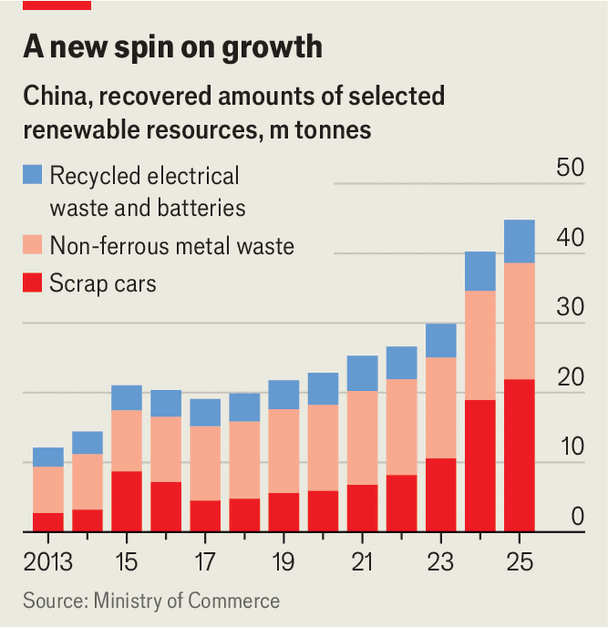
Worried about both cheap Chinese electric vehicles—prompting a European Union quota announced on October 12th of 350,000 hybrid-EV imports annually from December to keep their market share below 10%—and Beijing’s mineral dominance, the EU will restrict exports of battery “black mass” next month, following America’s total ban on black-mass exports in August. Yet with the International Energy Agency projecting black mass to meet 20-30% of global battery-metal demand by 2050, China is supercharging its circular economy. Producing roughly 15% of global municipal detritus and over 25% of industrial waste, China imported rich countries’ rubbish from the 1980s until toxic smog and a 2011 Beijing “gutter oil” documentary spurred a 2013 circular-economy plan, 2017’s “Operation National Sword” against plastic imports, a total solid-waste import ban in 2021, and mandatory urban rubbish sorting over the past five years.
Today, resource security drives Beijing’s July 2030 circular-economy plan: because China dominates global refining for aluminium, copper, battery metals, and rare earths but relies on imported ores, it aims to supply 510m tonnes of industrial materials annually through recycling by 2030, up about one-third from current levels. Beyond scaling up steel, copper, aluminium, and oil-saving plastic recycling, China must manage an expected annual wave by 2030 of 0.5m tonnes of wind-turbine waste, 1m tonnes of EV-battery waste, and 1.5-2m tonnes of solar-panel waste. Integrated domestic manufacturing—exemplified by battery giant CATL and its subsidiary Brunp, the world’s largest battery recycler—has given China 85% of global battery-recycling capacity, though informal scrap rings still divert many batteries and remote solar panels and wind turbines contain hard-to-extract trace amounts of silver and neodymium.
To overcome these hurdles, China established the state-owned China Resources Recycling Group in 2024, deployed artificial intelligence in sorting plants, and mandated lifecycle digital IDs and legal recycling responsibility for battery and EV makers in April; recycling already supplies 10% of China’s rare earths, backed by state-owned firms unconstrained by commercial viability. Meanwhile, to keep its plants fed, China eased import curbs on scrap copper and aluminium in 2024, permitted black-mass imports last year, and cut black-mass import duties from 6.5% to 3% in January. As GEM deputy general manager Zhang Yuping notes, high costs and scaling difficulties abroad mean Western export bans will struggle to dent China’s recycling dominance.
Source: China is turning trash into treasure on a vast scale
Subtitle: EV batteries, especially, will help it secure supplies of critical minerals
Dateline: Oct 15th 2026\n