如今中国增长最快的工业产品并非电动汽车、锂电池或人形机器人,而是面向业余爱好者的消费级3D打印机:今年上半年其出口额激增90%,在过去十年间,中国的全球市场份额从19%飙升至96%,彻底终结了西方企业的主导地位。伦敦市场情报公司Context的克里斯·康纳利指出,个人3D打印市场现由被称为“深圳四小龙”的创想三维(Creality)、纵维立方(Anycubic)、智能派(Elegoo)以及行业领头羊拓竹科技(Bambu Lab)称霸全球。尽管3D打印技术由美国人查克·赫尔于1983年发明,但长期以来昂贵且难用;如今中国产3D打印机普遍售价仅略高于500美元(西方同类入门级产品起售价是其两倍以上),不仅拥有苹果电脑般光滑的铝合金外观,还结合人工智能让用户只需用自然语言描述即可生成工具、零件或玩具的打印设计。
尽管价格战侵蚀了利润,但这些企业依然受到投资者热捧并获得中国政府的大力扶持:由全球最大无人机制造商大疆(DJI)前员工于2020年创立的拓竹科技据报非公开估值约达100亿美元,大疆自身也在去年投资了其竞争对手智能派,而创想三维则于今年5月在香港联交所上市,市值达120亿港元(15亿美元)。3D打印早在2015年启动的《中国制造2025》产业规划中就占据重要地位,中国官员将其视为摆脱对西方供应商依赖、自主生产航空航天、医疗保健和军事装备零部件的途径,并指示科研院所和国有企业进行采购。
不过,部分竞争对手指责中国企业从西方开源打印软件中获利,美国一家法院上个月裁定拓竹科技侵犯了一家美国公司的四项专利并判赔2760万美元;同时,由于西方企业忌惮将敏感设计输入中国设备(尽管英国政府承认英国国防部一直在用拓竹打印机),每台售价可达数百万美元的高端工业级3D打印机市场在海外仍主要由欧美企业主导。但中国供应商并未止步,而是正在国内外开创“3D打印农场”这一新型制造模式——今年中国已建成数座拥有多达5000台桌面级3D打印机、像工厂一样运作的设施,能够快速批量生产迎合奇特消费潮流的小饰品,以更高品质和更低成本取代昂贵缓慢的传统注塑成型工艺。
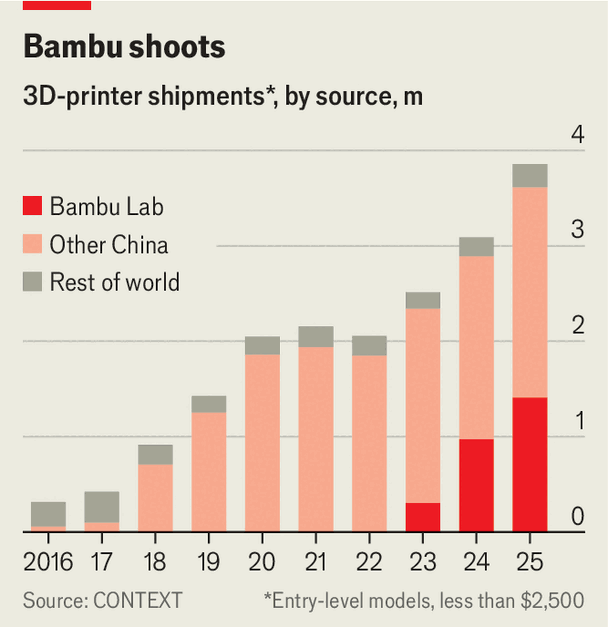
China’s fastest-growing industrial product today is the hobbyist 3D printer: exports surged by 90% in the first half of this year, and over the past decade China’s global market share has climbed from 19% to 96%, ending Western dominance. According to Chris Connery of London-based intelligence firm Context, the personal 3D-printing market is now ruled by the “four little dragons of Shenzhen”—Creality, Anycubic, Elegoo, and industry leader Bambu Lab. Invented by American Chuck Hull in 1983, 3D printers remained expensive and finicky until fierce Chinese competition and state support drove prices down to a little over $500—less than half the starting price of comparable Western entry-level machines—while adding sleek Apple-like aluminium finishes and artificial-intelligence tools that turn natural-language prompts into print designs.
Even as price wars squeeze margins, investors and policymakers are enthusiastic: founded in 2020 by alumni of drone giant DJI, Bambu Lab reportedly commands a $10bn private valuation, DJI itself invested in rival Elegoo last year, and Creality listed on the Hong Kong Stock Exchange in May with a market capitalisation of HK$12bn ($1.5bn). Featured since 2015 in Beijing’s “Made in China 2025” high-tech self-reliance plan, 3D printing is prized by officials for making aerospace, health-care, and military components without Western suppliers, prompting state directives for research institutes and state-owned firms to buy domestic machines.
Some rivals accuse Chinese makers of exploiting Western open-source software, and last month an American court ordered Bambu Lab to pay $27.6m in damages for infringing four American patents; moreover, outside China, security concerns over sensitive designs keep million-dollar industrial 3D printers largely in American and European hands (though Britain’s defence ministry admits to using Bambu printers). Undeterred, Chinese suppliers are pioneering “3D-printing farms”—factory-style facilities housing up to 5,000 desktop printers, several of which were built in China this year—to mass-produce trendy consumer trinkets faster, cheaper, and at higher quality than traditional injection-moulding.
Source: China has captured the market for hobbyist 3D printers
Subtitle: Amid Western wariness, it is struggling to do the same with high-end machines
Dateline: Oct 15th 2026\n