在日本汽车行业的一次公开场合中,Honda 首席执行官三边博弘表示,丰田年度结束的财政年度公司可能出现自1957年以来首次净亏损,并主动宣布其本人及副手减薪30%;他随即警告,日本汽车业“濒临生存边缘”。日产已进入第二年激进重组,计划到2028年关闭7家工厂,叠加美国25%汽车进口关税后,日本车企的全球市场份额已由2019年的31%降至去年的26%,其中中国销量自2019年以来已下滑约三分之一,东南亚市场份额也从2023年的68%降至2025年的57%。
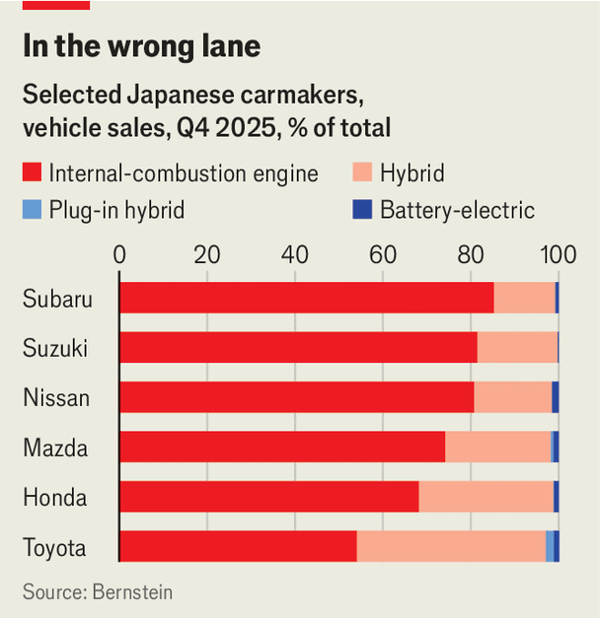
日本车企的核心困境在于电动化推进不足:虽然行业普遍偏向电动车转型,但日本主机厂仍以传统汽油车为主,日产更是高达80%,而混合动力仍被优先采用。与此同时,全球电动车(含插电式混合动力)占比已从2019年的3%升至去年的26%,在亚洲已达三分之一,新加坡去年电动车注册占比45%,泰国为20%;日本各厂商的人均固定成本同比十年前高出78%,工资抬升和就业制度僵化进一步挤压利润。2024年本田推出与通用联合的首款量产电动车,随后其与索尼的联合电动车项目终止,日产与Wayve合作改进ADAS,也反映出日本车企在软件能力上的补缺仍在进行中。
丰田是主要例外:其在全球混合动力市场占有率达40%,并在美国取消EV补贴后受益,随后与包括比亚迪、华为在内的中国伙伴共同为中国推出多款纯电车型,帮助其在中国维持6%份额(比亚迪为13%);公司预计到2027年形成更完整的全球电动车阵容。东京市场持续传出整合传闻,但2024年本田与日产拟组成全球第三大车企的合并谈判已破裂,丰田已持有Subaru 21%、Mazda 5%和Suzuki 5%股份,当前更偏好通过少数股权、联合采购标准化零部件以及电池供应链协同来提升议价力,而非大规模并购。
The warning signs were clear when Honda’s CEO said his company might post its first net loss since 1957 and cut pay by 30% for himself and his deputy, while also saying the Japanese auto industry was near survival danger. Nissan deepened the stress by entering a second year of restructuring with seven factory closures planned by 2028, while global share for Japanese makers slid from 31% in 2019 to 26% last year, China sales fell by one-third, and share in Southeast Asia dropped from 68% in 2023 to 57% in 2025.
The main weakness is slower electrification: conventional petrol vehicles still account for over half of Japanese sales and 80% at Nissan, as firms favored hybrids that fit existing production systems over plug-in EVs. At the same time, global EV (including plug-in hybrids) share rose from 3% in 2019 to 26% last year, with EVs now making up one-third of Asia sales, 45% in Singapore and 20% in Thailand; fixed costs per unit are 78% higher than a decade ago, and Honda’s first mass EV in 2024 with GM plus mixed results from partnerships such as Nissan–Wayve and the abandoned Honda–Sony deal showed Japan is still catching up on software capabilities.
Toyota remains the standout: it holds 40% of global hybrid market share, benefited from U.S. EV subsidy rollbacks, and expanded EV learning through China-specific models built with BYD and Huawei while holding 6% of China sales versus BYD’s 13%, with a broader global EV lineup planned for 2027. Speculation of consolidation intensified after the failed 2024 Honda-Nissan merger talks, but Toyota’s selective stakes—21% in Subaru and 5% in both Mazda and Suzuki—suggest a preference for targeted alliances such as joint procurement and battery supply-chain integration rather than costly full-scale acquisitions.
Source: Japan’s mighty carmakers are in serious trouble
Subtitle: They will need bold thinking to survive
Dateline: 4月 09, 2026 03:39 上午 | Tokyo