中国人形机器人产业正经历爆发式增长。8月17日宇树科技研发的机器人“超人”(Superman)跑出每秒12.66米的高速,两天后该公司在上海上市首日股价飙升460%(随后回落30%)。预计中国今年人形机器人销量将突破50,000台,同比增至三倍以上。然而,虽然硬件制造已基本成熟,基础大模型软件开发仍面临巨大瓶颈:当前机器人模型参数仅数十亿,要完美模拟人体机能需达数千亿参数,且极度依赖现实物理世界中的“真机数据”与穿戴传感设备采集的人体“第一人称视角数据”(egocentric data)。
为获取核心训练数据,中国正大规模建设专业实训中心。Interact Analysis数据显示,中国已有53座专用数据采集设施(多数建于近两年),另有34座在建或规划中(如上海在建容纳1000台机器人的基地);这类设施单台机器人造价高达10万元人民币(15,000美元),且每8小时冲咖啡动作仅能产生3小时有效数据,汇丰银行估算每小时训练成本高达500至700元人民币。据估计,开发通用日常任务机器人需累积1亿小时训练数据。约80%的实训中心获得政府支持,2026年上半年中国产人形机器人中高达70%(约13,000台)流向此类中心。
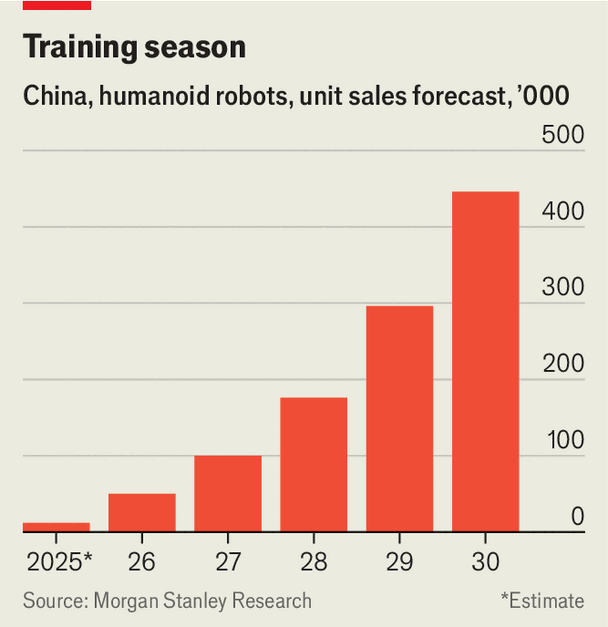
此外,京东等企业正通过补贴员工与社会劳动力采集动作数据,计划投入60万人并在两年内收集1000万小时真实场景数据。相比之下,特斯拉等美国竞品主要利用自有仓库或低成本视频及海外劳工穿戴设备进行训练。尽管摩根士丹利预测到2030年中国人形机器人年销量将达近450,000台,但短期内大量高成本设备仍缺乏实际商用价值,整个行业在大规模数据工程沉淀并实现真正商业化之前仍面临漫长的探索周期。
China’s humanoid robotics sector is experiencing rapid expansion, highlighted by Unitree’s robot "Superman" clocking 12.66 metres per second on August 17th, followed by a 460% initial surge during its Shanghai stock market debut (before sliding 30%). Chinese manufacturers expect to sell 50,000 humanoids this year, more than tripling last year's volume. However, while hardware is mature, software foundation models require hundreds of billions of parameters—far beyond today’s few billion—and depend on massive real-world physical training data rather than internet text, making "real-machine" teleoperation and sensor-glove "egocentric" human motion capture vital.
To amass high-quality data, China is rapidly scaling dedicated training facilities. Consultancies report 53 motion-capture centres currently operating across China—mostly built within the past two years—with another 34 planned or under construction, including a 1,000-robot hub in Shanghai. With robots costing roughly 100,000 yuan ($15,000) each and yielding only three usable hours per eight-hour shift, HSBC estimates training costs at 500–700 yuan per hour toward the 100m hours required for general dexterity. Approximately 80% of centres are state-backed, absorbing up to 70% (roughly 13,000 units) of domestic humanoid output in the first half of 2026.
Simultaneously, Chinese tech giants are mobilizing human labor: JD.com is funding 100,000 employees and 500,000 external participants to log motion data, aiming for 10m hours over two years. Conversely, American competitors like Tesla rely on internal factory testing, computer-vision video analysis, and lower-wage offshore workers wearing sensor kits. While Morgan Stanley projects Chinese humanoid sales will approach 450,000 units annually by 2030, current iterations remain commercially constrained and error-prone, requiring massive capital and extensive training data before viable widespread automation is achieved.
Source: China is training up thousands of humanoid robots
Subtitle: But its approach will come with enormous costs
Dateline: Aug 27th 2026