英国在植树造林方面取得了显著进展,在截至2026年4月的一年内新增林地超过13,000公顷,全国森林覆盖率目前每两年增长约1%。在英格兰西部的格洛斯特附近,林业局(Forestry England)在88公顷(217英亩)的原农田上种植了约127,000棵树苗,为拥有悠久历史的迪恩森林(Forest of Dean)完成了两个世纪以来的首次大规模扩建。该林区汇集了橡树、桤木等近40种不同树种,与1919年一战后为应对木材短缺而大面积种植的单一种类单一针叶林(如北美西加云杉)形成了鲜明对比。
历史上,英国长期处于森林覆盖率极低的水平。生态学家奥利弗·拉卡姆(Oliver Rackham)指出,11世纪编纂《末日审判书》时,英格兰林地覆盖率仅约15%(约为当今法德水平的一半);历经造船业消耗(一艘如“胜利号”大型战舰需消耗近6,000棵橡树)及两次世界大战的过度砍伐,到1924年英格兰森林覆盖率骤降至仅5%。如今在传统农业补贴削减及环境署碳汇资金支持下,土地所有者积极投身林业,例如威尔士政府要求所有获得补贴的农场必须在至少十分之一公顷的土地上植树。
现代林业管理追求碳吸收、物种栖息地保护与公众休闲等多重目标的平衡。为应对气候变暖,林业局采用来自法国等南方地区的耐热种子,并引入逐渐北移的“名誉本土物种”(如悬铃木槭)。针对20世纪栽种的成熟森林,对约100个“邦斯样地”(Bunce sites)的长期研究显示,树木与灌木的平均截面积已达到1971年的三倍,导致林下过度郁闭并危及喜阳植物。专家呼吁林地管理者效仿中世纪做法,通过选择性择伐打开林冠层,促进林内生物多样性与生态平衡。
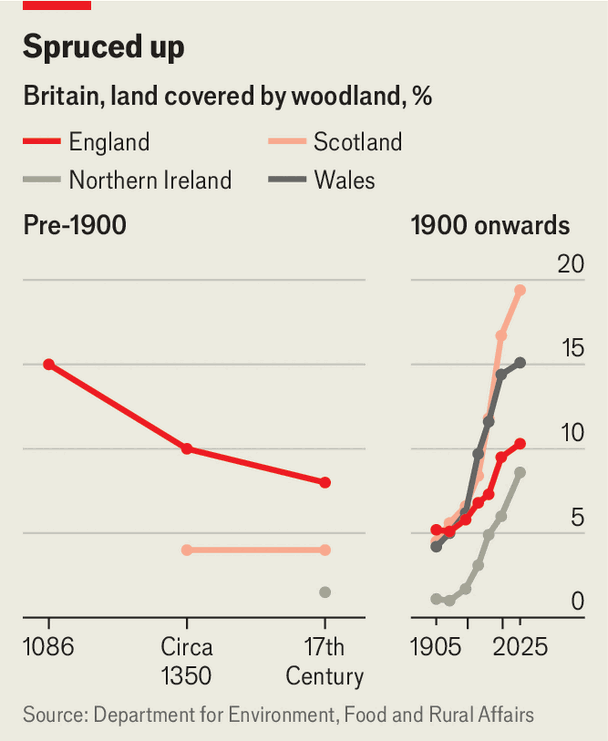
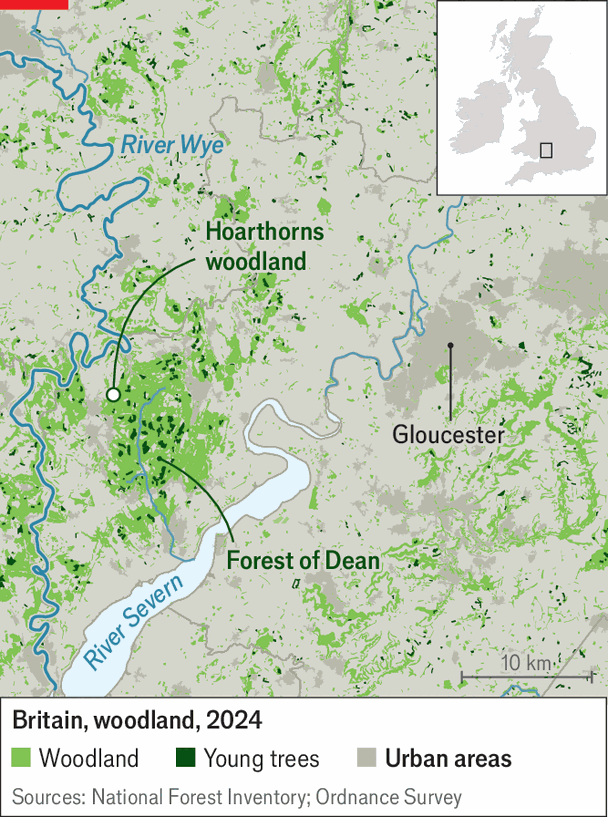
Britain has made significant strides in afforestation, creating more than 13,000 hectares of new woodland in the year to April 2026 and expanding its forested area by roughly 1% every two years. Near Gloucester, Forestry England planted approximately 127,000 saplings across an 88-hectare (217-acre) former farm, marking the first substantial addition to the ancient Forest of Dean in two centuries. This plantation features nearly 40 diverse species, primarily broadleaf varieties like oak and alder, contrasting sharply with the uniform, dense monocultures of non-native Sitka spruce established after the Forestry Commission's founding in 1919.
Historically, Britain experienced severe deforestation over centuries. Ecologist Oliver Rackham estimated that only 15% of England was forested during the 11th-century Domesday Book survey—roughly half the modern coverage in France or Germany. Centuries of clearing for agriculture, massive timber consumption for historic naval fleets (HMS Victory alone consumed roughly 6,000 oaks), and heavy wartime logging reduced forest cover across England and Great Britain to a mere 5% by 1924. Today, declining agricultural subsidies and carbon-offset funding incentivize tree planting, bolstered by mandates such as the Welsh government's requirement that subsidised farms dedicate at least 0.1 hectares to woodland.
Modern forestry balances carbon sequestration, habitat restoration for threatened bird species, and public recreation. To adapt to rapid global warming, foresters incorporate heat-tolerant seeds from southern regions like France alongside migrating "honorary native" species like sycamores. Concurrently, managing Britain's mature post-war forests has become crucial: long-term monitoring across roughly 100 Bunce sites reveals average tree cross-sectional areas have tripled since 1971, causing deep shade that crowds out sun-loving flora. Experts now advocate selective tree felling to open dense canopies, mimicking medieval woodland management to revive biodiversity.
Source: Trees are spreading in one of Europe’s least forested countries
Subtitle: Britain now needs to learn to cut them dow
Dateline: Aug 27th 2026