随着全球气候变暖加剧,空间制冷消耗了2025年全球10%的电力,且传统空调排放的高温与强温室效应制冷剂进一步恶化了城市“热岛效应”。伦敦双层巴士自2004年起将车顶涂成白色以反射阳光,但面对破纪录的高温仍难以招架。为此,伦敦大学学院(UCL)团队研发出一种新型辐射冷却涂层,可反射93%的太阳辐射,超越了普通商用白漆84%的反射率。由于地表物体向外辐射热量约100瓦/平方米,而太阳直射热量约为其十倍,当反射率突破90%的临界阈值时,物体便能在不消耗任何能源的情况下实现低于环境气温的“被动自冷却”,在马德里的实地测试中其表面温度较普通白漆低达8°C。
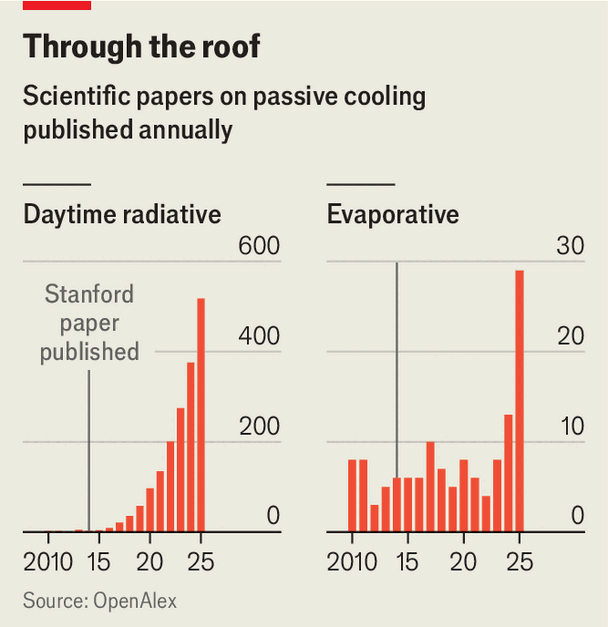
辐射冷却技术自2014年斯坦福大学团队证实其可行性以来,正逐步突破商业化瓶颈。早期的镜面金属涂层造价高昂且不利于建筑应用,而UCL团队创新性地将二氧化硅气凝胶微粒与聚合物混合,利用微粒对可见光的强散射作用实现高反射,同时借助微粒与聚合物中的化学键,将物体内部热量以9微米波长的红外线直接穿透大气窗口辐射至外太空。目前,荷兰阿克苏诺贝尔(AkzoNobel)以及香港创冷科技(i2Cool)等企业已相继推进市场化应用,后者涂层覆盖面积达85万平方米,累计减少了1.4万吨与空调用电相关的二氧化碳排放。
除了纯光学辐射冷却外,结合水分蒸发散热的新型复合材料展现出更大的低成本应用潜力。新加坡南洋理工大学团队开发出一种多孔水泥基涂层,其微米级孔隙能通过毛细作用吸收雨水并在受热时像人体排汗一样蒸发带走热量;添加盐分后,该材料甚至能直接吸收潮湿空气中的水汽。测试表明,这种多孔水泥涂层的降温效果比标准辐射涂层还要低5°C,可额外节省高达40%的空调节能,而成本仅为辐射冷却涂层的三十分之一。对于无力承担昂贵空调电力、近年来因极端高温致死人数激增63%的热带贫困地区而言,这种经济廉价的被动制冷技术意义尤为深远。
Space cooling accounted for 10% of global electricity consumption in 2025, driven by escalating temperatures that exacerbate urban heat-island effects through power-hungry, hydrofluorocarbon-reliant air-conditioning systems. In response, materials scientists are engineering passive daytime radiative cooling paints capable of dropping surface temperatures below ambient levels without external power inputs. While conventional white paint reflects 84% of solar irradiance, a newly developed coating by University College London (UCL) achieves 93% reflectance on London bus roofs. Because terrestrial objects radiate approximately 100 watts per square metre whereas solar influx reaches 1,000 watts, surpassing the 90% reflection threshold allows materials to shed more net thermal energy than they absorb, yielding surface temperature reductions of up to 8°C in experimental trials.
Radiative cooling has evolved rapidly since Stanford University researchers first demonstrated sub-ambient cooling under direct sunlight in 2014 using expensive silver and hafnium dioxide layers. The UCL group achieves comparable thermal performance at commercial scale by dispersing silica aerogel sponges into specialized polymers. The structural mismatch in refractive indices pinballs incoming shortwave solar radiation, while silicon-oxygen and carbon-oxygen molecular bonds selectively emit longwave infrared radiation at nine microns—precisely matching the transparent atmospheric spectral window that vents heat directly into deep space. Commercial enterprises like AkzoNobel and Hong Kong-based i2Cool are deploying analogous formulations, with i2Cool coating 850,000 square metres of real estate to avert 14,000 tonnes of cooling-related carbon dioxide.
Parallel innovations are augmenting optical reflection with biomimetic evaporative cooling at substantially lower production costs. Researchers at Nanyang Technological University in Singapore engineered a porous cement composite featuring micron-sized pores that absorb precipitation via capillary action, dissipating latent heat through sweat-like evaporation when heated. Hygroscopic salts embedded in the cement matrix allow the surface to continuously draw moisture from humid air even in arid conditions. In field tests, this evaporative cement operated 5°C cooler than standard radiative coatings, yielded up to 40% greater cooling energy savings, and required only one-thirtieth of the manufacturing cost, offering a scalable passive cooling solution for vulnerable populations across impoverished tropical regions where heat-related mortality has surged.
Source: How to cool buildings on the cheap
Subtitle: New paints promise to get rid of heat without using energy
Dateline: Sep 10th 2026