随着全球价格压力再度升温,此前多国央行期待的“软着陆”愿景遭遇重大挑战。2026年9月2日,新西兰央行宣布加息,澳大利亚今年已三次上调利率,日本央行于6月加息,韩国央行亦在7月与8月连续收紧货币政策。此外,欧洲央行预计将把存款利率上调至2.5%,而市场普遍预期美联储也将于9月16日跟进。在富裕经济体中,整体通胀已停止向2%的目标回落,并在近月出现反弹;8月份欧元区通胀率攀升至3.3%,创三年新高,即便以通胀极低著称的瑞士亦升至0.8%的两年高位,立陶宛通胀更从1月的3.1%飙升至近6%。
能源价格飙升是此轮通胀抬头的主要推手,但物价压力的扩散范围远不止于燃料领域。受伊朗战事影响,国际油气价格大幅上涨,欧洲天然气价格已超战前两倍,欧元区能源通胀率重返两位数,美国汽油平均售价也由1月的不足每加仑3美元涨至4美元以上。据《经济学人》测算,富裕国家剔除食品与能源的核心通胀年率从2026年初的2.7%反弹至2.9%。对23个发达经济体服务业价格的监测显示,尽管工资增速放缓,但三分之二的国家服务业通胀仍在上升,这既可能源于薪资统计失真,也反映出服务业生产率下滑导致企业难以消化人力成本。
尽管当前市场和消费者的通胀预期尚未显著脱锚——欧洲央行调查甚至显示消费者对未来一年的通胀预期有所缓和,但各国央行官员绝不愿重蹈2022年应对通胀迟缓的覆辙。斯洛文尼亚央行行长警告决策层不应等待通胀根深蒂固才采取行动,欧洲央行执委伊莎贝尔·施纳贝尔(Isabel Schnabel)亦强调不能坐等能源成本传导至薪资体系。瑞银集团(UBS)预计,尚未开启加息周期的瑞典乃至瑞士央行或将很快跟进,全球新一轮货币紧缩周期可能才刚刚拉开序幕。
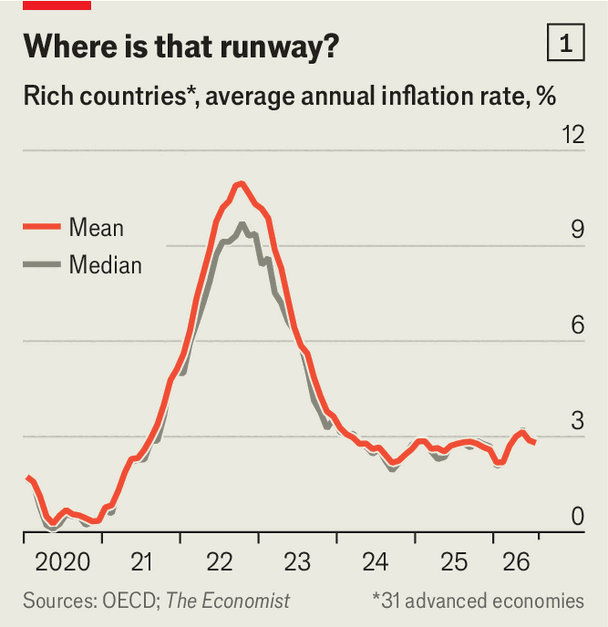
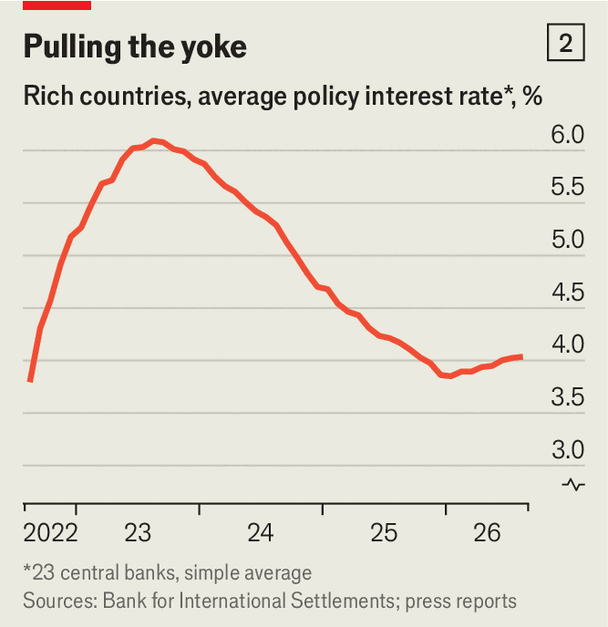
Central banks across advanced economies are recalibrating their monetary policy instruments as inflationary pressures resurface, jeopardising hopes of a painless soft landing. On September 2nd New Zealand hiked interest rates, Australia’s Reserve Bank enacted its third rate rise this year, the Bank of Japan tightened policy in June, and the Bank of Korea delivered consecutive increases in July and August. The European Central Bank was projected to raise its benchmark deposit rate to 2.5%, with financial markets widely anticipating a Federal Reserve hike on September 16th. Headline inflation across rich economies has stopped declining towards 2% targets, ticking up to 3.3% in the euro zone in August—a three-year peak—while Switzerland reached a two-year high of 0.8% and Lithuania surged near 6%.
Although energy costs driven by conflict in Iran remain the primary catalyst, underlying price pressures are broadening. European natural gas prices have more than doubled from pre-war benchmarks, propelling euro-zone energy inflation into double digits, while American retail petrol prices have climbed above $4 per gallon. The Economist estimates that rich-world core inflation, which excludes food and energy, rose from 2.7% in early 2026 to 2.9%. In a sample of 23 developed economies, services inflation accelerated across two-thirds of jurisdictions despite moderating wage growth, a dynamic likely driven by weak service-sector productivity growth that impedes firms from absorbing labour costs without raising end-consumer prices.
While long-term inflation expectations remain relatively well-anchored—with ECB consumer surveys showing modest declines in one-year outlooks—policymakers are unwilling to repeat the costly delays of 2022. Central bankers like Slovenia’s governor and ECB board member Isabel Schnabel stress that authorities cannot afford to wait until energy spikes fully feed into domestic wages before intervening. UBS projects that institutions that have so far refrained from tightening, including Sweden’s Riksbank and the Swiss National Bank, may soon follow suit, indicating that a renewed cycle of global monetary tightening has begun.
Source: Inflation is back around the world—as is the fight against it
Subtitle: Central banks are raising interest rates again
Dateline: Sep 10th 2026