围绕轨道人工智能数据中心的争论取决于成本曲线是否足够快地下移,而地面替代方案正变得更难建设:今年将投产的全球新增容量中有30%-50%可能延迟,高于2025年的26%。在这种压力下,SpaceX与xAI已瞄准一个最多由100万颗卫星组成的轨道设施,但按今天的价格,把载荷送入轨道仍需约1,500美元/千克(猎鹰重型)或3,400美元/千克(猎鹰9号),尽管SpaceX的内部成本约为这些价格的25%。
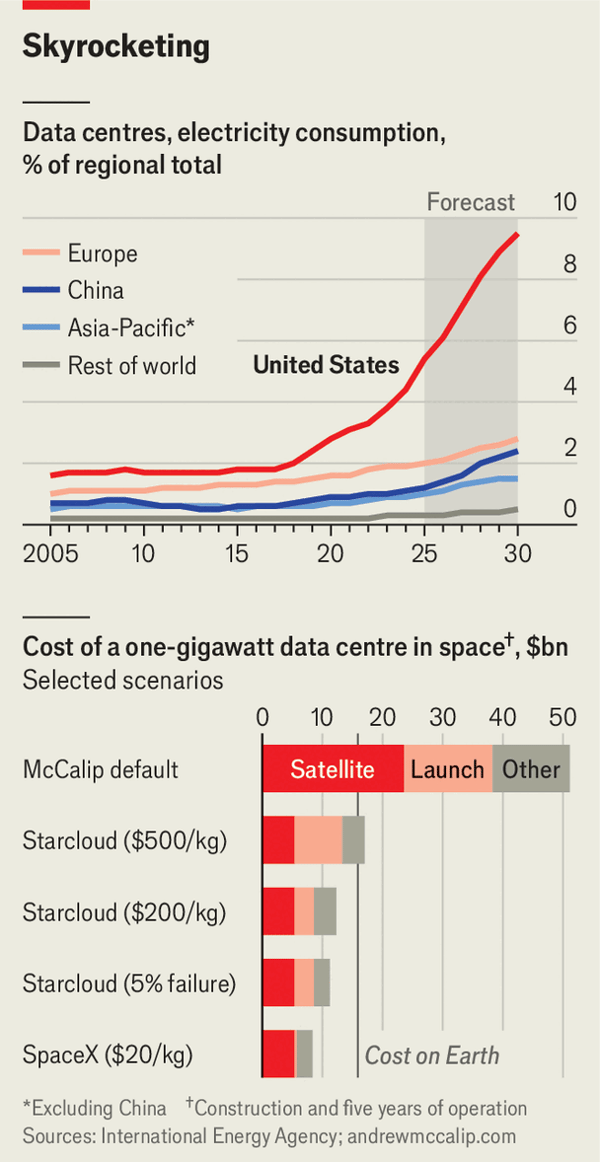
以1GW、运行五年为基准,麦卡利普的模型估算地面数据中心成本为159亿美元,而轨道版本在500美元/千克发射成本、37W/千克比功率、22美元/W卫星成本和98%日照轨道的条件下为511亿美元,另加双方都需要的150亿-300亿美元GPU成本。若改用Starcloud更乐观但并非离谱的假设,即70W/千克和5美元/W,轨道成本降至167亿美元,仅比地面高5%;若发射成本进一步降至200美元/千克,则降至121亿美元,若GPU年故障率从9%降至5%,则可进一步降至111亿美元。
可行性现在取决于少数关键未知数,而不是单一的物理障碍:Starcloud-1已在轨运行一块英伟达H100,训练NanoGPT并运行Gemma,结果表明GPU在太空中的表现好于预期,尽管该卫星因过热无法全天候运行。接下来的检验点是Starcloud-2的散热器,它据称将成为商业航天中最大的可展开散热器,单位千克散热能力是国际空间站散热器的10倍,以及计划于3月进行的Starship第12次试飞,因为完全可重复使用是把发射价格压到100-200美元/千克、从而使轨道数据中心在经济上可能胜出的核心。
The case for orbital AI data centres hinges on whether cost curves can fall fast enough, while terrestrial alternatives are getting harder to build: 30%-50% of global capacity due online this year could be delayed, up from 26% in 2025. Against that backdrop, SpaceX and xAI are targeting an orbital facility of up to 1m satellites, but payloads still cost about $1,500/kg on Falcon Heavy or $3,400/kg on Falcon 9 to reach orbit today, even though SpaceX’s internal cost is about 25% of those prices.
For a 1GW facility run over five years, McCalip’s model puts Earth-based cost at $15.9bn versus $51.1bn in orbit under assumptions of $500/kg launch cost, 37W/kg specific power, $22/W satellite cost, and 98% daylight orbits, excluding $15bn-$30bn of GPUs needed in either case. Using Starcloud’s more optimistic but not implausible assumptions of 70W/kg and $5/W cuts orbital cost to $16.7bn, only 5% above Earth, and if launch cost falls to $200/kg it drops to $12.1bn; if annual GPU failure rates fall from 9% to 5%, it falls further to $11.1bn.
Feasibility now rests on a few critical unknowns rather than a single physical barrier: Starcloud-1 has already flown an Nvidia H100 in orbit, trained NanoGPT, and ran Gemma, suggesting GPUs perform better in space than expected, though the satellite could not operate around the clock because it overheated. The next tests are Starcloud-2’s radiator, claimed to be the largest commercial deployable radiator in space and to deliver 10 times the ISS radiator’s heat dissipation per kilogram, and Starship’s 12th test flight expected in March, because full reusability is the key to pushing launch prices toward $100-$200/kg and making orbital data centres economically competitive.
Source: Data centres in space: less crazy than you think
Subtitle: They could be cheaper than ones on Earth, with the right technology
Dateline: 3月 05, 2026 07:21 上午