在里斯本,2017年至2024年间超过110万名移民的涌入将葡萄牙外国出生人口的比例从4%推升至14%,引发了公众对犯罪和融合问题的担忧。新来者中包括25万名主要为单身年轻男性的南亚人,其中许多人几乎不会说葡萄牙语。公众的不满情绪助力民粹主义右翼政党“够了”(Chega)在2025年议会选举中赢得了23%的选票。为了重建移民监管体系的公信力,2024年上台的路易斯·蒙特内格罗中右翼政府实施了更严格的签证规定,重建了边境部队,将入籍时间延长至7至10年,并限制了家庭团聚,同时为关键工人引入了快速签证。因此,年度净移民人数已从27万骤降至6万。尽管葡萄牙计划使多达80万名无证移民合法化,但政府对申请人进行逐一面谈,并已拒绝了4.5万人。
相比之下,西班牙社会党首相佩德罗·桑切斯违背了欧盟收紧管制的共识,强调人道主义价值观和经济增长。自2021年以来已有310万移民抵达西班牙,到2026年将外国出生人口推高至1030万,占总人口的20%以上,其中约一半是来自拉丁美洲的西班牙语使用者。今年早些时候,桑切斯宣布对无证移民实施大赦,吸引了120万份申请,远超政府预期的50万份。然而,这波移民潮使两国的公共服务不堪重负,导致里斯本学位短缺、马德里学校出现隔离现象以及创纪录的医疗手术等待名单。住房受到的冲击最为剧烈,加上7月下旬超过8万名移民涌入北非飞地休达(目前仍有1万人滞留),促使桑切斯宣布于11月29日提前举行大选。
西班牙支持移民的共识目前正在破裂,民调显示大多数人认为移民人数过多,反移民的民粹主义政党呼声党(Vox)在民调中的支持率已升至19%左右。商界团体和经济学家呼吁就接纳和融合能力展开根本性辩论,而葡萄牙官员则指出,此前宽松的规定使企业依赖廉价劳动力而非提高效率。随着民调显示右翼有望赢得西班牙即将到来的大选,政策转变似乎已成定局。保守派人民党领袖阿尔贝托·努涅斯·费霍提议采用积分制、设定移民配额并优先考虑拉丁美洲人,这与葡萄牙的做法如出一辙,表明伊比利亚半岛可能很快不再是欧洲收紧移民规范的例外。
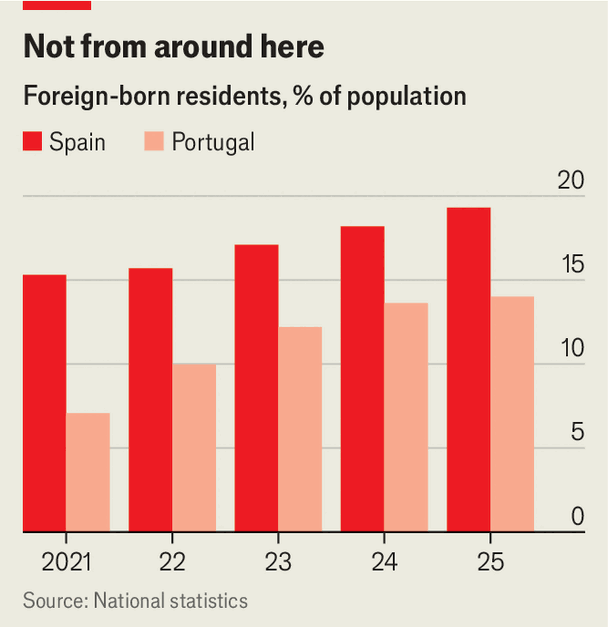
In Lisbon, an influx of over 1.1m immigrants between 2017 and 2024 pushed Portugal’s foreign-born population from 4% to 14% of the total, sparking public concern over crime and integration. The arrivals included 250,000 South Asians, mostly young single men who speak little Portuguese. Public discontent helped Chega, a populist right-wing party, win 23% of the vote in the 2025 parliamentary election. To rebuild the migration system's credibility, the centre-right government of Luis Montenegro, elected in 2024, enforced stricter visa rules, re-established a border force, extended citizenship residency requirements to between seven and ten years, and restricted family reunions while introducing fast-track visas for key workers. Consequently, annual net migration plummeted from 270,000 to 60,000. Although Portugal plans to regularise up to 800,000 undocumented migrants, it interviews applicants individually and has already rejected 45,000.
By contrast, Spain’s Socialist prime minister, Pedro Sánchez, has defied the European Union’s consensus on tighter controls, emphasizing humanitarian values and economic growth. Some 3.1m immigrants have arrived in Spain since 2021, driving the foreign-born population to 10.3m in 2026, or over 20% of the total, helped by the fact that roughly half are Spanish-speakers from Latin America. Earlier this year, Mr Sánchez announced an amnesty for undocumented migrants that drew 1.2m applications, more than double the expected 500,000. However, the surge has strained public services in both nations, causing school shortages in Lisbon, segregated schools in Madrid, and record waiting lists for medical operations. The sharpest impact has hit housing, which—alongside a late-July surge of over 80,000 migrants into the North African exclave of Ceuta, where 10,000 remain—prompted Mr Sánchez to call a snap election for November 29th.
Spain’s pro-immigration consensus is now fracturing, with polls showing a majority believe immigrant numbers are too high and the anti-immigrant populist party Vox rising to around 19% in the polls. Business groups and economists are calling for a fundamental debate on reception and integration capacities, while Portuguese officials note that previous lax rules allowed companies to rely on cheap labour rather than improving efficiency. With polls indicating a likely right-wing victory in Spain's upcoming election, a policy shift appears certain. Alberto Núñez Feijóo, leader of the conservative People’s Party, proposes a points system, immigration quotas, and priority for Latin Americans—mirroring Portugal's approach and signalling that Iberia may soon cease to be an exception to tightened European norms.
Source: Portugal has limited immigration, and Spain may follow
Subtitle: The wave of immigrants in both countries looks politically unsustainable
Dateline: Oct 15th 2026\n