利用 NASA/ESA/CSA 的詹姆斯·韦伯太空望远镜(Webb)与哈勃太空望远镜(Hubble)的联合观测,FEAST 国际团队研究了四个邻近星系──M51、M83、NGC 628 与 NGC 4449──中的年轻星团,涵盖不同演化阶段。研究旨在判定一个新生星团在从其诞生云中“脱离”并开始输出紫外线之前,母云可持续多久;韦伯的红外线成像揭示了先前隐藏的系统,而哈勃提供了完全外露星团的光学对照。
该团队共编目了近 9000 个星团,包含深度包裹、部分外露与完全外露三类,这在四个星系中平均约为每个星系 2250 个。根据韦伯光谱估算每个星团的质量与年龄,最具质量的星团约在 5 百万年内完全清除周围气体;较低质量星团通常在 7 到 8 百万年时才从摇篮中走出。因此,较高质量端的星团似乎能更快瓦解其母云,并更早在宿主星系内启动更强、以紫外线为主导的回馈。
这一量化结果为先前难以重现星团形成与出现时序的星形成与恒星回馈模拟提供关键约束。另一个直接影响是行星形成:越快驱散气体,围绕恒星的原行星盘越早暴露于其他新生恒星的强紫外线,导致可再吸积的气体与尘埃成长窗口缩短。也就是说,最重的星团不仅主导星系的紫外线亮度,还率先推动回馈循环,从而塑造后续恒星与行星形成可发生的时空位置。
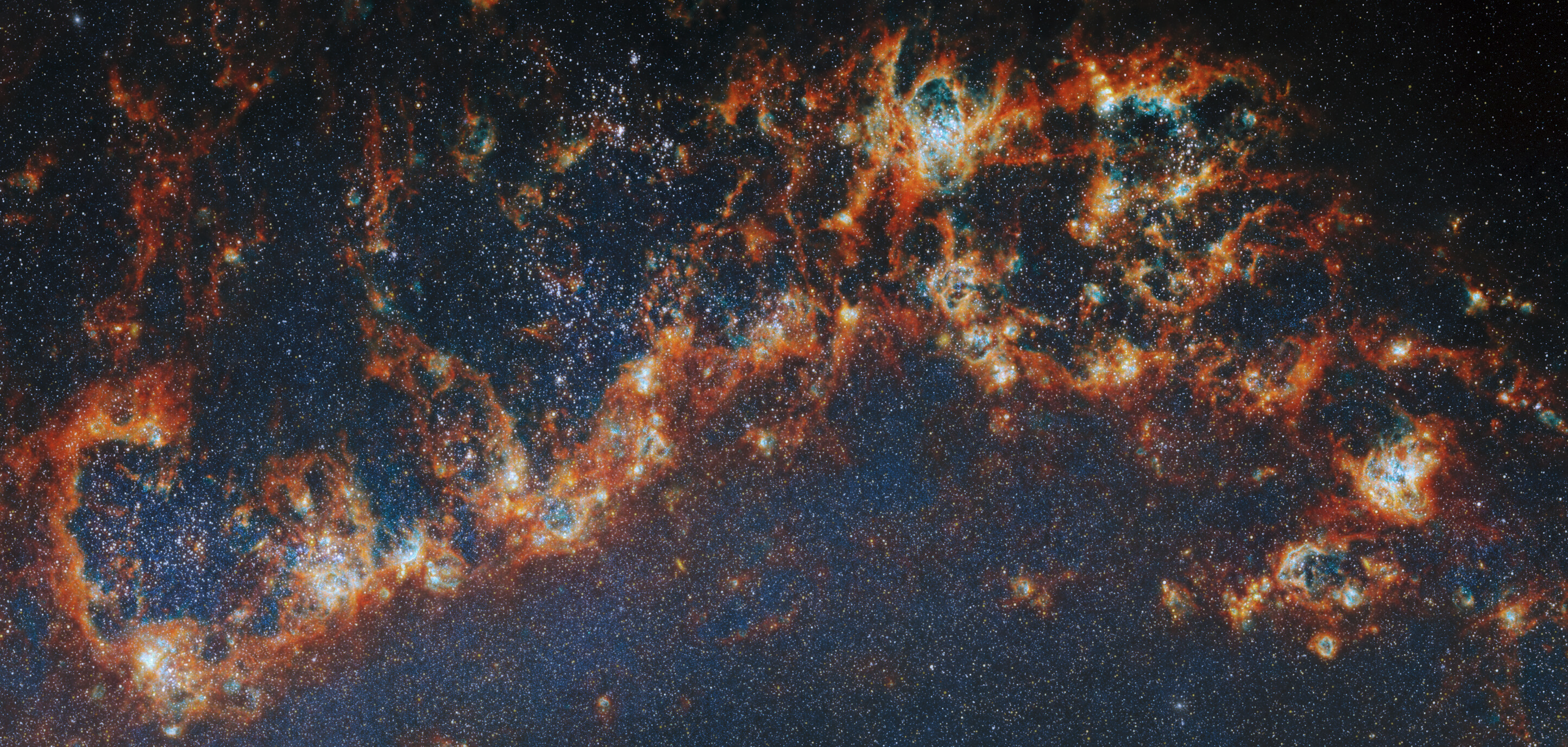
Using combined observations from NASA/ESA/CSA James Webb Space Telescope and Hubble Space Telescope, the international FEAST team studied young star clusters in four nearby galaxies—M51, M83, NGC 628, and NGC 4449—covering multiple evolutionary stages. The goal was to determine how long a cluster remains in its natal cloud before it emerges and begins ultraviolet emission. JWST infrared imaging now reveals systems formerly hidden in dust, while Hubble provides optical confirmation of fully visible clusters.
The team catalogued nearly 9,000 clusters, including deeply embedded, partially emerged, and fully emerged systems, averaging about 2,250 per galaxy across the four. From JWST spectra they estimated mass and age, finding that the most massive clusters clear their natal gas in about 5 million years, whereas lower-mass clusters typically emerge at 7 to 8 million years. So the high-mass end appears to disperse natal gas more rapidly and trigger stronger, earlier ultraviolet-driven feedback in their host galaxies.
This provides a strong quantitative constraint for models of star formation and stellar feedback that previously struggled to reproduce cluster emergence timing. It also affects planet-formation theory: faster gas dispersal exposes protoplanetary discs to harsher external ultraviolet radiation sooner, reducing opportunities for further gas accretion and dust growth. In short, massive clusters not only dominate galactic ultraviolet luminosity, they also lead the feedback cycle, helping set when and where later star and planet formation is most likely to occur.