随着人工智能繁荣催生庞大财富,美国慈善界正迎来历史上最大规模的单次捐赠浪潮。OpenAI和Anthropic两家AI实验室预计在首次公开募股(IPO)中估值可能分别超过1万亿美元,累计将释放约4300亿美元的慈善资金,规模相当于两个马歇尔计划或25个福特基金会。其中,Anthropic的七位联合创始人承诺捐出80%的财富(约1100亿美元),员工捐赠顾问基金(DAF)预计达600亿美元;持有26%股权的OpenAI基金会预计拥有2600亿美元捐赠资金。按年计算,AI行业预计每年支出约205亿美元,将使这波捐赠占GDP的比例达到1.3%,远超1990至2018年互联网浪潮时期的0.8%(2300亿美元)。
与传统工业或互联网时代的慈善家不同,这批AI新贵深受“有效利他主义”(EA)运动的影响,强调数据驱动与回报最大化。资金主要流向全球公共卫生、重大科学研究与动物福利等量化成效明显的领域,例如三家机构近期联合捐资5亿美元研发感冒流感疫苗;但文化遗产保护或女性赋权等非量化领域则相对被忽视。更显著的是,巨额资金正被反哺至AI自身领域,包括防范人类灭绝等“生存危机”以及AI价值对齐研究,例如向成立仅一个月的AI对齐机构Resolution注资1.6亿美元,以及OpenAI基金会向采用其技术的社区组织捐赠5000万美元。
然而,这一前所未有的慈善潮也面临执行与治理层面的三重挑战。首先,AI安全与灭绝风险研究缺乏明确的反事实衡量标准,难以验证实际成效,且存在为科技行业购买公关商誉的嫌疑;其次,非营利组织普遍面临官僚化与激励不足的弊病,迫使机构通过大幅涨薪(如加薪30%)来吸纳顶级技术人才;最后,全美DAF账户中已有3260亿美元沉淀资金,存在资金囤积延宕支出的风险。不过,在财富急剧膨胀和乐观技术前景的驱动下,捐赠正加速落地,部分机构今年上半年的支出已达到去年全年的10亿美元,力求在AI彻底重塑世界前迅速挽救生命并推动人类繁荣。
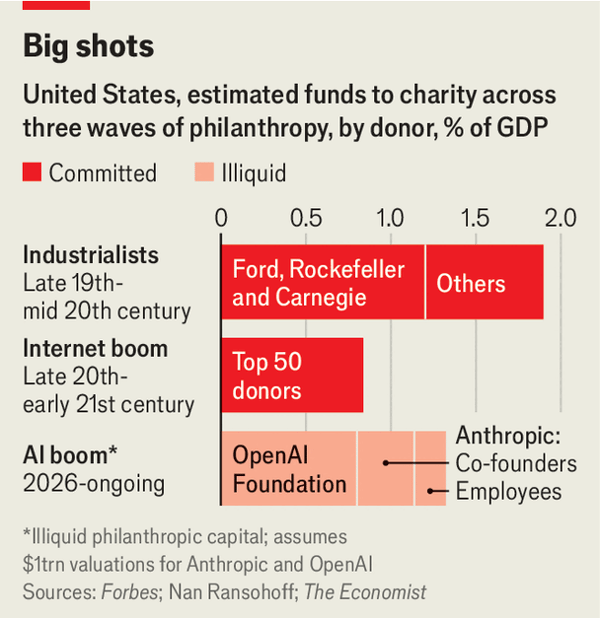
The unprecedented boom in artificial intelligence is driving the largest single philanthropic surge in history, potentially unlocking an estimated $430bn in charitable commitments from the impending IPOs of OpenAI and Anthropic—each projected to achieve valuations exceeding $1trn. This financial wave equates to two Marshall Plans or 25 Ford Foundations. Anthropic's seven co-founders have pledged 80% of their wealth (roughly $110bn), complemented by $60bn in employee donor-advised funds (DAFs), while the OpenAI Foundation controls an estimated $260bn. Conservatively deploying $20.5bn annually, this influx will represent 1.3% of US GDP, surpassing the 0.8% ($230bn) generated during the internet era between 1990 and 2018.
Distinct from previous philanthropic eras, AI donors heavily embrace the "Effective Altruism" (EA) framework, prioritizing hyper-rational, evidence-based interventions in global health, scientific advancement, and animal welfare over traditional cultural endowments. Recent commitments include a $500m joint initiative targeting universal cold and flu vaccines. Crucially, vast capital is directed back into the technology itself to counter existential risks and foster AI alignment; for example, Coefficient Giving allocated $160m to AI alignment startup Resolution, while the OpenAI Foundation disbursed $50m to community groups utilizing its software.
Nevertheless, this philanthropic windfall confronts severe structural challenges. Evaluating safe AI research lacks measurable counterfactuals, raising concerns that non-EA funding may serve as corporate public relations rather than empirical problem-solving. Furthermore, non-profit operational inefficiencies and competition for elite talent have compelled grantmakers to raise technical wages by up to 30%. Finally, capital deployment risks stagnation within corporate DAF vehicles—which currently hold $326bn nationwide in unspent assets—though founders and employees are accelerating liquidity to scale global interventions before superintelligence transforms socio-economic paradigms.
Source: Silicon Valley’s AI boom is remaking American charity
Subtitle: AI founders pledge to give away hundreds of billions of dollars. How will they be spent?
Dateline: 8月 13, 2026 03:44 上午 | SAN FRANCISCO