欧洲性传播感染(STI)近年来呈现剧烈反弹趋势。欧洲疾病预防控制中心(ECDC)发布的最新数据显示,2024年欧洲淋病病例数达到约10万例,较2015年增加了两倍以上;同期梅毒病例数增加了一倍以上,达到约4.6万例;衣原体感染率在2022年见顶后已回落至2015年水平。特别令人担忧的是先天性梅毒(母婴传播)的激增,在2023年至2024年间欧洲病例数翻倍至140例,并在保加利亚、匈牙利和葡萄牙形成聚集。世界卫生组织(WHO)指出,这不仅是疫情后筛查恢复的结果,更反映了实际传播强度的本质上升。
造成感染回升的潜在因素包括安全套使用率下降以及防艾滋病药物PrEP普及带来的行为改变。世卫组织对欧洲近25万名15岁青少年进行的调查显示,报告的安全套使用率显著下滑。在人群结构上,2023至2024年间15至24岁年轻男性的淋病发生率有所下降,而20至34岁群体的梅毒发生率上升了15%。在男男性行为群体中梅毒传播维持高位的同时,异性恋群体的感染率亦在显著上升。地域上,法国、意大利等国淋病增幅明显,而部分监测能力不足的国家则存在严重漏报(如1900万人口的罗马尼亚在2024年仅报告24例衣原体病例)。
欧洲应对性传播感染面临监测数据缺失与抗生素耐药性的双重挑战。目前仅有三分之一的欧洲国家能提供重点高危群体的详细检测与传播途径数据。此外,淋病耐药菌株的扩散限制了治疗选择,迫使荷兰等国取消针对无症状人群的常规衣原体筛查以控制抗生素滥用。在母婴阻断方面,虽多数欧盟国家在孕早期进行梅毒筛查,但不到一半的国家会在孕晚期或分娩时对高危孕妇进行复查。社会污名化加剧了男男性行为者、移民等群体的就医障碍,不过匈牙利先天性梅毒病例从2020年的3例激增至2024年的91例后倒逼了全面筛查体系的升级,表明及时的危机响应仍具防控成效。
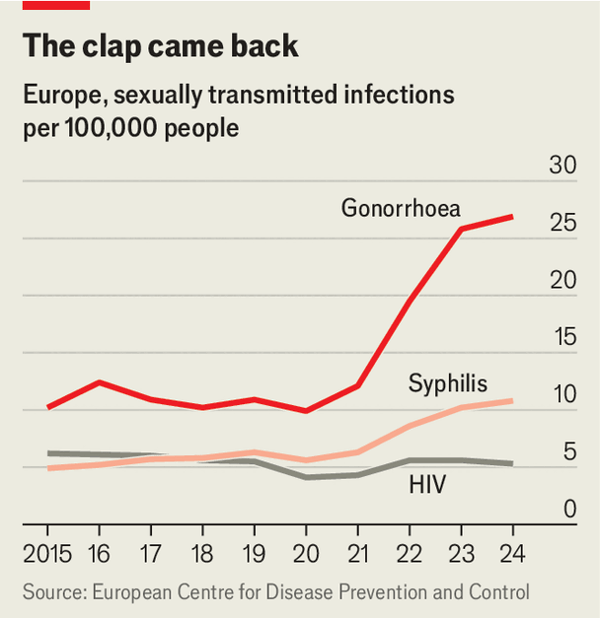
Sexually transmitted infections (STIs) are experiencing a dramatic resurgence across Europe. According to the European Centre for Disease Prevention and Control (ECDC), approximately 100,000 gonorrhoea cases were recorded in 2024, more than tripling 2015 figures, while syphilis cases doubled to roughly 46,000. Chlamydia peaked in 2022 before receding to 2015 baselines. Most alarming is the resurgence of congenital syphilis transmitted from mothers to infants, which doubled across Europe between 2023 and 2024 to reach 140 cases, with severe regional clusters in Bulgaria, Hungary, and Portugal. Public health officials confirm that these trajectories reflect genuine transmission acceleration rather than mere diagnostic catch-up.
Several behavioral factors contribute to this epidemiology, including diminished barrier contraceptive use and risk compensation associated with HIV pre-exposure prophylaxis (PrEP). A WHO study encompassing nearly 250,000 15-year-olds identified substantial drops in condom compliance. Demographic tracking across 2023–2024 shows that while gonorrhoea decreased among men aged 15–24, syphilis rates rose by 15% among women, with the sharpest overall increases occurring among adults aged 20 to 34. Syphilis transmission has accelerated within both heterosexual demographics and men who have sex with men. Geographic variations remain stark, with rapid gonorrhoea growth in France and Italy alongside acute reporting deficits in under-resourced systems like Romania, which recorded only 24 chlamydia cases in 2024.
Public health containment is hindered by fragmented surveillance and mounting antimicrobial resistance. Only one-third of European nations systematically report testing rates across high-risk groups or delineate transmission categories. The emergence of drug-resistant gonorrhoea strains complicates clinical management, prompting countries like the Netherlands to discontinue asymptomatic chlamydia screening to curb antibiotic overuse. Furthermore, while most EU states mandate first-trimester syphilis testing, fewer than 50% re-test high-risk mothers during the third trimester or delivery. Persistent stigma impedes vulnerable populations—such as sex workers and migrants—from accessing healthcare, although acute infection spikes, such as Hungary’s congenital syphilis cases rising from 3 in 2020 to 91 in 2024, have successfully triggered vital screening reforms.
Source: Sexually transmitted infections are surging in Europe
Subtitle: To restrain them, countries must increase testing and reduce stigma
Dateline: 8月 13, 2026 05:00 上午