面对美国限制Anthropic等先进AI模型出境,以及中国考虑限制外国人使用其领先AI模型的双重地缘政治压力,各国政府正大力投资“主权AI”以减少技术依赖。新美国安全中心(CNAS)估计,在美中之外,由国家支持的AI项目在2024至2025年间增长了五倍,政府宣布的投资额已突破700亿美元。然而,由于绝大多数国家仍将依赖美国的芯片和中国的开源模型,实现完全的主权AI将异常艰难。Mistral AI的阿尔图尔·门施估计,未来5到10年内,欧盟每年在AI代币上的支出将达到1万亿欧元(约合1.1万亿美元),占其当前劳动力成本的十分之一,这些资金多将流向美国云巨头。
在硬件层,英伟达控制着全球三分之二的AI算力,其余部分也主要由谷歌、AMD和亚马逊等美国公司占据。相比之下,中国最先进的AI芯片之一华为升腾910C的性能仅为英伟达最新产品的五分之一,且中国芯片产能供不应求。此外,电力供应是另一大硬件限制,一个典型的AI数据中心用电量相当于10万户家庭,最大型的可达20倍;像挪威、沙特和阿联酋等拥有丰富电力资源的国家因此成为数据中心建设的热门地,而欧洲则因电网拥堵和高昂电价面临重重困难。
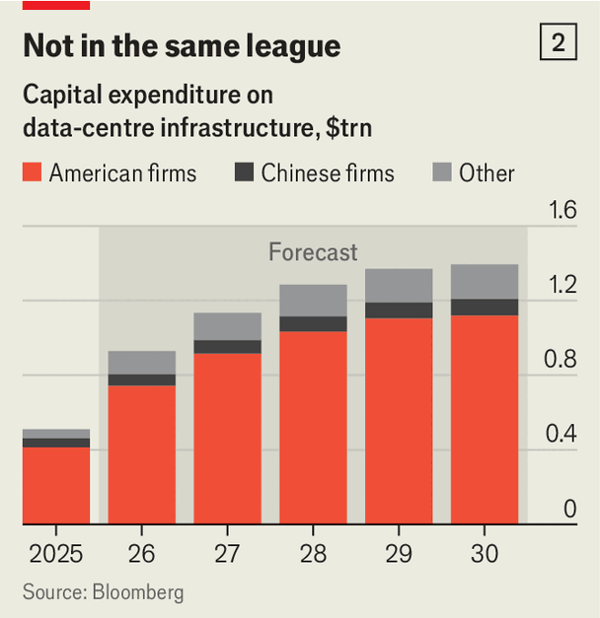
为了在软件层获得自主权,许多项目转向了开源模型。在OpenRouter上,中国开源模型的使用量已超过美国模型,Z.ai发布的GLM-5.2在测评网站Artificial Analysis上迅速攀升至第四位。然而,中国同样在考虑限制尖端开源模型的出口。在资金方面,沙特与阿联酋计划投资超过100亿美元,阿联酋已争取到美国取消先进芯片出口控制并计划每年采购50万张芯片;法国正通过招商引资(如软银承诺投资高达850亿美元在法建设欧洲最大AI设施)支持Mistral,英国推出了5亿英镑的主权AI基金,而印度则拨出约10亿美元专注于本土语言模型。Gartner估计,2026至2030年间,美中之外的国家将新增超过50吉瓦的数据中心容量,需要超过2万亿美元的投资,但这远超非美中企业约8000亿美元的资本支出预期,这意味着缺口仍需靠投资额高达1.5万亿美元的美国云巨头填补,主权AI依然难以摆脱对美国的依赖。
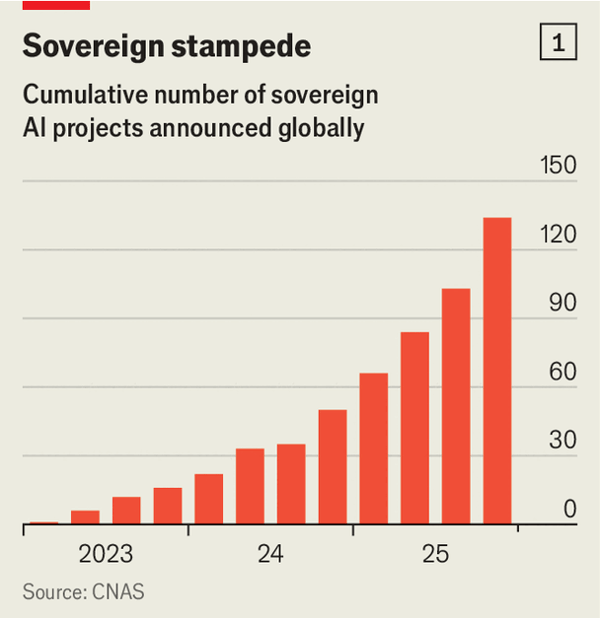
Faced with American and Chinese export restrictions on advanced AI technologies, foreign governments are pursuing "sovereign AI" to secure domestic infrastructure. Tallying by the Center for a New American Security (CNAS) shows state-backed AI initiatives outside America and China grew fivefold during 2024-2025, drawing over $70bn in announced investments. Despite this, absolute independence remains elusive, as most countries will still depend on American hardware and Chinese open-source models. Arthur Mensch of Mistral AI estimates the EU could spend €1trn ($1.1trn) annually on AI tokens within ten years—equal to 10% of its current labor bill—flowing mostly to American cloud providers.
At the hardware layer, Nvidia commands two-thirds of global AI compute, with Google, AMD, and Amazon holding most of the rest. China's top chips, such as Huawei's Ascend 910C, deliver only a fifth of Nvidia's performance, and suffer from capacity shortages. Infrastructure also demands massive electricity; a standard AI data center uses as much power as 100,000 households, and large ones consume 20 times more. Consequently, power-rich nations like Norway, Saudi Arabia, and the UAE are prime data-center hubs, while European grids remain highly congested and costly.
Software autonomy relies heavily on open-source models, where Chinese models like Z.ai's GLM-5.2 (ranked fourth on Artificial Analysis) are outperforming US rivals on OpenRouter. However, Alibaba's Joe Tsai warns that China could also restrict access, mirroring US export rules. Financing models vary globally: Saudi Arabia and the UAE plan to invest over $100bn, with the UAE aiming for 500,000 chips annually. France is backing Mistral via SoftBank's $85bn facility, Britain has established a £500m ($670m) fund, and India has committed $1bn. Gartner estimates non-US/China data-center expansion needs $2trn for 50GW of capacity by 2030, far exceeding the non-superpower budget of $800bn, leaving US tech giants to bridge the gap.
Source: Sovereign AI, independent of America and China, is a pipe dream
Subtitle: But a degree of protection from coercion remains possible
Dateline: Jul 16, 2026 04:58 AM