中国货轮“迪拜之塔”号(Dubai Tower)于8月15日从宁波港启航,正式开启经由北冰洋“北方海航道”(NSR)连接亚欧的首条定期班轮服务;中资船东乐舱物流(Sea Legend)预计这趟5000公里的航程仅需约20天即可抵达英国费利克斯托港,航行时间仅为传统苏伊士运河航线的一半,同时完全规避了红海胡塞武装和霍尔木兹海峡冲突的地缘风险;与此同时,日本正修订北极政策,韩国泛星轮船(PanStar)亦定于8月22日开启为期18天的釜山至费利克斯托试航;气候变暖推动北极海冰范围以每十年超12%的速度衰退(8月中旬海冰面积为550万平方公里,远低于1981-2010年中位数),而燃油占航运总成本的十分之七,北极低温更有利于保护电池和光伏组件等温控敏感型高科技货物。
然而,北方海航道面临显著的运营成本与环境安全制约:现阶段无冰通航窗口仅限于8月至10月,乐舱物流在此窗口内仅计划安排7艘船舶执行8个航次,而其余月份运营需高价租用稀缺的强化破冰船并支付昂贵的俄罗斯核动力破冰船护航费;安联保险(Allianz)报告指出北极恶劣天气与应急设施匮乏导致机械故障占过去十年事故的近半数,其保费比好望角航线高出40%;此外,北极严寒导致溢油清理极端困难,冷水环境中远距离传播的船舶低频噪音亦严重破坏鲸类与海象的繁育栖息地。
地缘政治壁垒与货运规模差距同样极为悬殊:北极八国中七国为西方民主国家,西方对中俄北极军事化合作及对俄制裁的担忧令国际主流航运巨头对该航道望而却步;2025年北方海航道过境货运总量仅为320万吨(主要为中俄间油气运输),相比苏伊士运河4.64亿吨的庞大规模微不足道;荷兰克林根达尔研究所等智库认为其短期内仍属局部资源通道,但随着中国计划到2028年将通航期扩至4个月并逐步积累极地航行经验,北方海航道在中东动荡与极地升温(北极升温速度为全球均速3倍)背景下,正成为中国至关重要的战略季节性走廊。
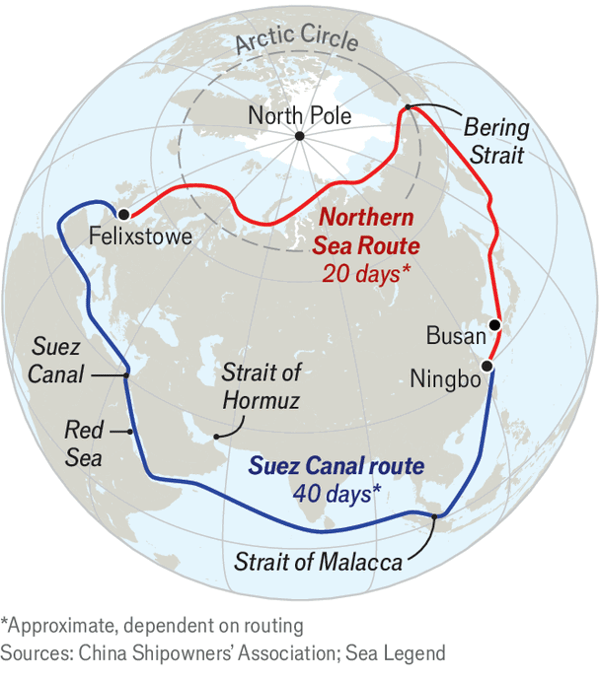
On August 15th, Chinese container ship Dubai Tower departed Ningbo to inaugurate the first scheduled Asia-Europe Arctic cargo service via the Northern Sea Route (NSR), targeting a 20-day transit over 5,000km to Britain's Felixstowe—cutting conventional Suez Canal transit time by half while bypassing Middle Eastern choke points. As Arctic summer sea-ice extent shrinks by over 12% per decade (covering 5.5m sq km in mid-August), the route yields substantial carbon and fuel savings—which comprise seven-tenths of voyage costs—while cold polar temperatures protect heat-sensitive battery and solar shipments without requiring active refrigeration. Concurrently, South Korea's PanStar scheduled an 18-day trial run from Busan, while Japan actively revised its Arctic strategy.
Nevertheless, Arctic shipping confronts severe economic and operational constraints: commercial navigation is currently restricted to an August-October ice-free window, during which operator Sea Legend plans only eight voyages across seven vessels. Year-round voyages require scarce ice-strengthened hulls and costly Russian nuclear icebreaker escorts. Allianz warns that remote conditions and repair deficits drive machinery failures accounting for nearly half of Arctic maritime casualties, pushing NSR insurance premiums 40% above Cape of Good Hope routes. Environmentally, cold waters prevent effective fuel-spill cleanup while low-frequency acoustic pollution threatens vulnerable marine mammal breeding corridors.
Geopolitically, Western scrutiny over Sino-Russian strategic alignment and sanctions compliance severely discourages international carriers: in 2025, total NSR transit cargo reached just 3.2m tonnes—overwhelmingly bilateral Sino-Russian energy trades—dwarfed by the Suez Canal’s 464m tonnes. While the Clingendael Institute views the route primarily as a selective corridor for Arctic natural resources, Sea Legend aims to expand navigational access to four months by 2028. Amid persistent Middle Eastern tensions and Arctic warming occurring three times faster than global averages, Asian carriers are building critical polar navigational expertise that will anchor future strategic supply chains.
Source: The promise and the pitfalls of China’s new Arctic shipping route
Subtitle: The Northern Sea Route is a pricey and risky alternative to the Suez Canal
Dateline: 8月 20, 2026 05:59 上午