核融合技术透过融合原子核将质量转化为巨大能量,借此推动涡轮机发电,但数十年来因难以创造并维持高达一亿摄氏度的高温与高压环境,加上庞大的能源需求,一直难以走出实验室阶段。然而,随著美国劳伦斯利佛摩国家实验室的国家点火设施于2022年达成净能量增益里程碑,以及超导磁铁的发展降低了反应炉运行所需的电力,该领域正吸引创纪录的资金投入。尽管外界对于技术进展与未来发电成本是否被过度炒作仍存有疑虑,但怀特认为,在全球面临能源需求上升与能源安全隐忧之际,业界开始讨论如何满足核融合能源的价格目标,本身就是该领域的一项全新启示。
在具体进展方面,英国原子能管理局于八月宣布,科学家在牛津郡卡勒姆(Culham)的 Mast Upgrade 核融合装置内部达到的压力取得了突破,其子公司英国核融合能源(UK Fusion Energy)则计划在2040年前,于诺丁汉郡西伯顿(West Burton)的一处前燃煤电厂原址开发原型核融合发电厂。此外,研究团队也致力于解决核融合反应以外的挑战,包括开发用于维护反应炉以减少停机时间的机器人技术,以及回收再利用稀缺的氚燃料。同时,科学家正运用人工智慧(AI)分析数十亿种不同合金的排列组合,寻找能承受反应炉内部极端条件的材料,怀特称这些工具的应用具有革命性意义。
Professor Dennis Whyte, the new chief executive of the UK Atomic Energy Authority (UKAEA), stated that western nations and their allies are in an emerging race with China to develop nuclear fusion energy. Whyte previously led the nuclear science and engineering department at the Massachusetts Institute of Technology and co-founded the private nuclear fusion company Commonwealth Fusion Systems, which is backed by Bill Gates's investment fund Breakthrough Energy Ventures. He noted that while the UK has world-leading fusion programmes, China has rapidly built up an impressive set of technological and supply chain capabilities in a surprisingly short period of time. Whyte emphasized that once this nascent technology becomes commercially and economically viable, it will unlock massive energy in a fundamentally different way—releasing roughly 10 million times more energy per kilogramme of fuel compared with burning fossil fuels—making it arguably one of the most important geopolitical events ever.
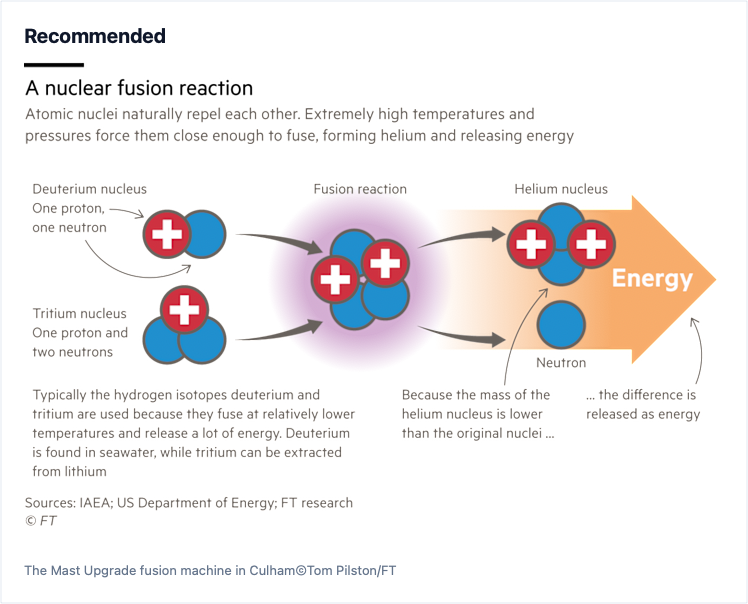
Nuclear fusion involves fusing nuclei to convert mass into vast amounts of energy to drive electricity-producing turbines, yet for decades it has struggled to move beyond laboratory stages due to the immense energy demand and difficulty of creating and sustaining temperatures of 100 million degrees Celsius and high pressures. Following recent breakthroughs, such as the 2022 net energy gain milestone achieved by the US National Ignition Facility at the Lawrence Livermore National Laboratory and the development of superconducting magnets that reduce the electricity needed to run reactors, the technology is now attracting record funding. Although optimism is tempered by questions over whether progress and future electricity prices are being overhyped, Whyte argued that the mere fact the field is discussing how to meet price points for fusion energy is a new revelation, especially as nations grapple with rising energy demand and energy security concerns.
Regarding specific advancements, the UKAEA announced in August that scientists achieved pressure breakthroughs inside its Mast Upgrade fusion machine in Culham, Oxfordshire, while its subsidiary UK Fusion Energy aims to develop a prototype fusion power plant by 2040 at a former coal-fired power plant site in West Burton, Nottinghamshire. Furthermore, the UKAEA is addressing challenges beyond the fusion reaction itself, including separate programmes to develop robotics for reactor maintenance to reduce downtime and to reuse scarce tritium fuel. Scientists are also leveraging artificial intelligence (AI) to help solve technological hurdles, such as parsing billions of permutations of different alloy types to find materials capable of surviving the extreme conditions inside the reactor, an application of tools that Whyte described as revolutionary.