然而,AI 生成论文的写作品质与学术传播规范引发了数学界剧烈反弹。包括 25 位菲尔兹奖得主及数千名学者联署公开声明,谴责科技公司将解决数学问题作为商业基准测试的做法与学术初衷严重脱节;许多资深学者亦批评 AI 论文充斥难以阅读的冗长论述,不仅缺乏清晰的论证沟通,更剥夺了人类在深入思索与搏斗过程中产生洞见和延伸数学方法的宝贵价值。
面对机器推理带来的急速变革,数学社群正处于接纳与抵制的关键转折点。尽管部分青年学者提出全面抵制或对研究流程的异化表达忧虑,但前沿模型已逐渐成为不可或缺的研究辅助工具;这促使学界更加倚重 Lean 等形式化验证工具来保障定理的正确性,并重新审视论文署名、同行评审体系以及身为数学家在 AI 时代的本质角色与存在意义。
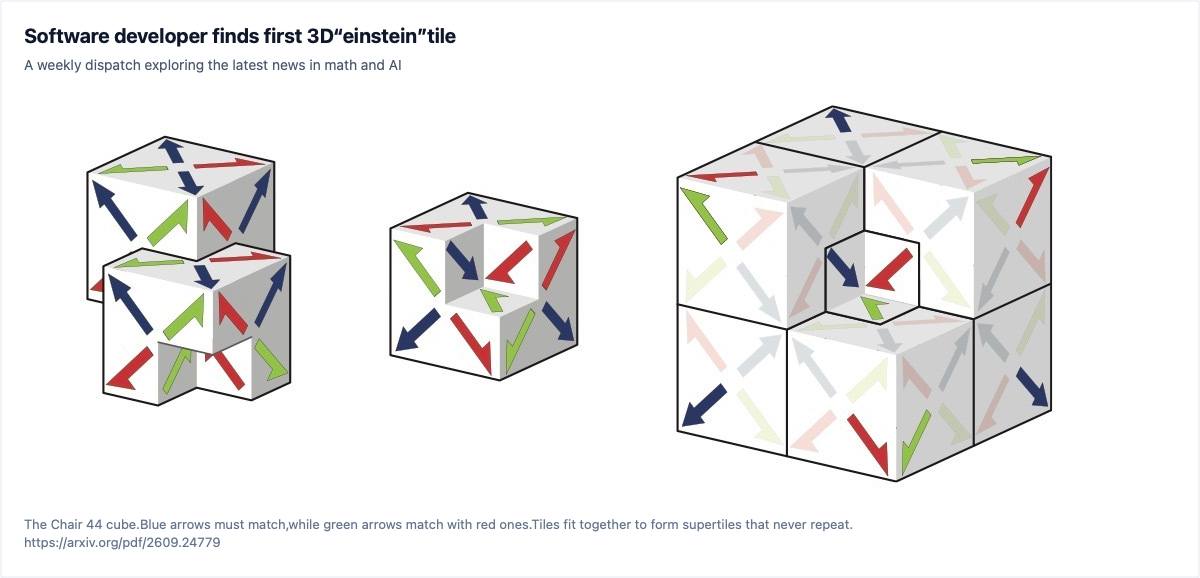
Recently, artificial intelligence has achieved a wave of major breakthroughs in mathematical research, such as a software developer using an LLM to discover the first 3D aperiodic monotile 'Chair44', researchers employing Claude to resolve the complex structure on the six-dimensional sphere unresolved since 1947, and OpenAI's autonomous agents claiming to have found a singularity in the Navier-Stokes equations. These milestones demonstrate the formidable computational power of AI in solving long-standing geometric and analytical challenges, rapidly expanding the frontier of machine-assisted proofs.
However, the writing quality of AI-generated papers and existing scientific publishing standards have triggered substantial backlash from the mathematical community. A polemic signed by 25 Fields Medalists and thousands of researchers condemned AI companies for using math problems as benchmark tests, warning of severe misalignment between commercial goals and academic values; senior mathematicians also criticized AI manuscripts for unreadable and overly long prose that lacks clear communication and diminishes the profound human intellectual process that yields vital methods and conceptual insights.
Confronted with the rapid transformation driven by mechanical reasoning, the mathematical community now stands at a pivotal juncture between acceptance and resistance. Although some early-career researchers have called for total boycotts or voiced distress over how research practices are being altered, frontier models are increasingly entrenched as indispensable tools; this shift has prompted greater reliance on formalization tools like Lean to guarantee rigor, while forcing practitioners to renegotiate authorship conventions, peer review, and what it fundamentally means to be a mathematician.