尽管女性目前占据了美国大学毕业生总数的五分之三以及受过高等教育的劳动者的半数以上,但传统的大家庭养家糊口模式依然根深蒂固。2024年的数据显示,在双收入家庭中,仅有30%的美国妻子收入高于丈夫。虽然在2022年的调查中,只有10%的美国人认为女性收入高于丈夫必然引发问题(德国为16%,中国为27%),但在实际生活中,夫妻双方对这种经济结构的排斥依然显著。芝加哥大学经济学家玛丽安·伯特兰(Marianne Bertrand)的研究表明,妻子的收入比例在达到50%临界点时会出现骤降,表明人们仍在刻意遵循传统的性别规范。甚至法国的一项近期研究显示,女性承担家庭75%收入的夫妻分居概率比收入相当的夫妻高出30%。
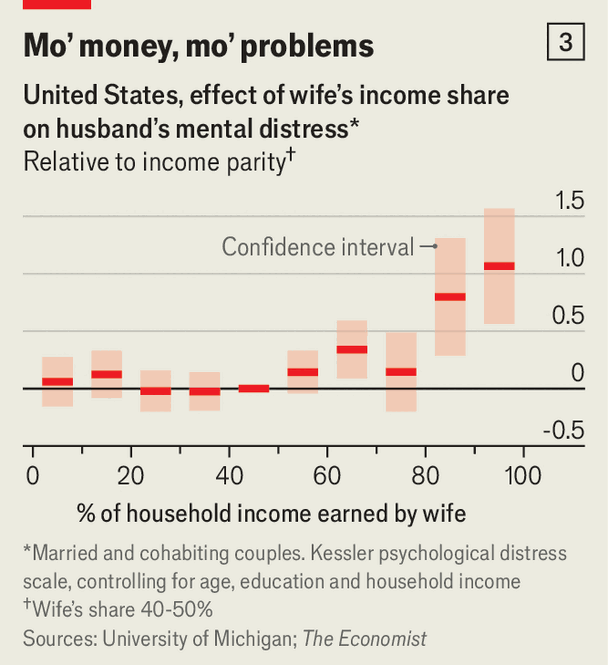
针对学者关于该统计断层可能源于共同经营企业等异常数据的质疑,《经济学人》梳理了美国社区调查(ACS)17年的数据,证实即使排除自雇及同行业夫妻,50%收入临界点处的断层依然清晰存在。违反养家模式伴随着巨大的心理成本。对美国动态 panel 研究(PSID)数据的分析显示,在控制了年龄、教育水平和家庭总收入后,妻子作为主要经济支柱的丈夫报告“严重心理痛苦”的概率是普通人的约1.5倍;当妻子收入占比达到或超过70%时,这一风险飙升至2.5倍。值得注意的是,对比2001-11年与2013-23年两个时间段,这种心理压力与收入结构的关系几乎没有任何减弱。
这种经济不平衡带来的负面影响并不局限于丈夫。收入高于丈夫的妻子普遍报告对婚姻关系的满意度更低。堪萨斯大学的米斯蒂·海格内斯(Misty Heggeness)指出,无论妻子是否是家庭的经济支柱,绝大部分家务和家庭事务依旧落在中国和西方女性的肩上。尽管求婚、同居等许多传统婚姻习俗已经随着时代演变发生改变,但由男性承担主要经济来源的观念依然极其顽固。正如泰勒·斯威夫特(Taylor Swift)虽然年收入远超其丈夫特拉维斯·凯尔斯(Travis Kelce)(后者年收入达5000万美元但也仅占两人总收入的五分之一),但这种女性主导经济收入的婚姻在现实社会中依然非常罕见。
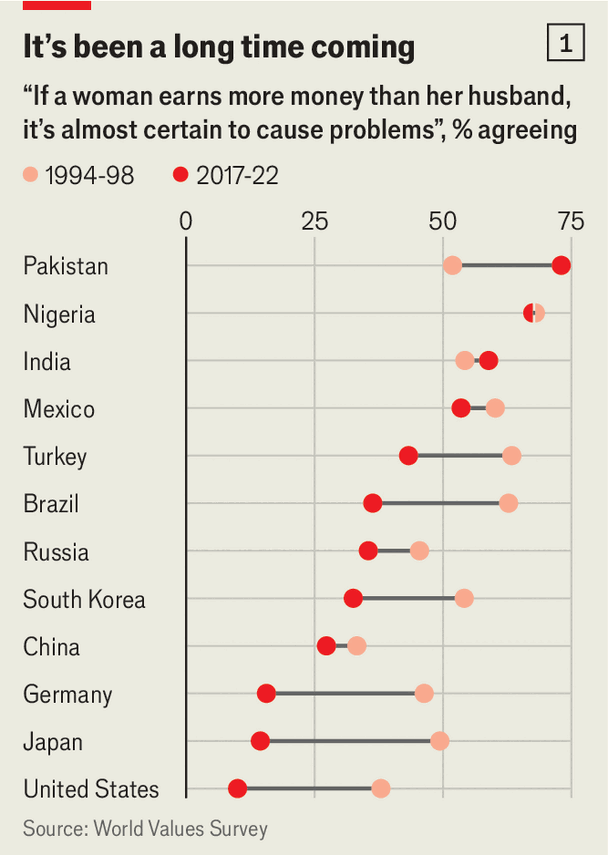
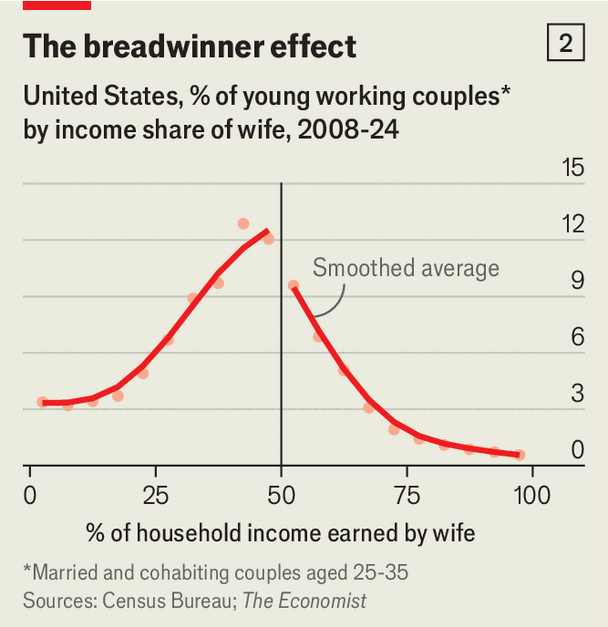
Although women now account for three-fifths of American college graduates and over half of college-educated workers, traditional breadwinning norms remain surprisingly resilient. In 2024, only 30% of American wives in dual-income couples earned more than their husbands. While survey data from 2022 showed that only 10% of Americans believed a wife out-earning her husband causes problems—compared to 16% in Germany and 27% in China—real-world behavior paints a starkly different picture. Economists led by Marianne Bertrand revealed a sharp drop in the distribution of household income right at the 50% threshold where wives begin out-earning husbands. Furthermore, a French study indicated that couples in which women earn roughly 75% of household income are about 30% more likely to separate than those with equal earnings.
Addressing criticisms that this statistical "cliff" might stem from shared business ownership, an analysis by The Economist of 17 years of American Community Survey data confirmed that the sharp break at 50% persists even after excluding self-employed couples or spouses working in identical industries. Straying from traditional gender roles carries substantial psychological costs for men. Utilizing Panel Study of Income Dynamics data, the analysis found that husbands whose wives are primary earners are roughly 1.5 times as likely to experience serious psychological distress after controlling for age, education, and household income. For husbands whose wives generate 70% or more of family income, this distress risk jumps to 2.5 times. Comparison between 2001–11 and 2013–23 demonstrates that this link has remained unchanged over time.
The psychological toll of non-traditional earning dynamics extends to women as well. Primary-earner wives consistently report lower relationship satisfaction. As Misty Heggeness from the University of Kansas emphasizes, domestic responsibilities continue to fall disproportionately on women regardless of whether they are the primary breadwinner. While modern dating and marital conventions have shifted significantly over recent decades, the expectation for husbands to be the main financial provider has proven exceptionally durable. Even high-profile cases like pop icon Taylor Swift—who vastly out-earns her football star husband Travis Kelce despite his $50m annual income comprising just a fifth of their combined earnings—remain rare exceptions to persistent societal norms.
Source: Wives who out-earn their husbands remain rare in America
Subtitle: [[IMAGE]]
Dateline: Jul 23rd 2026