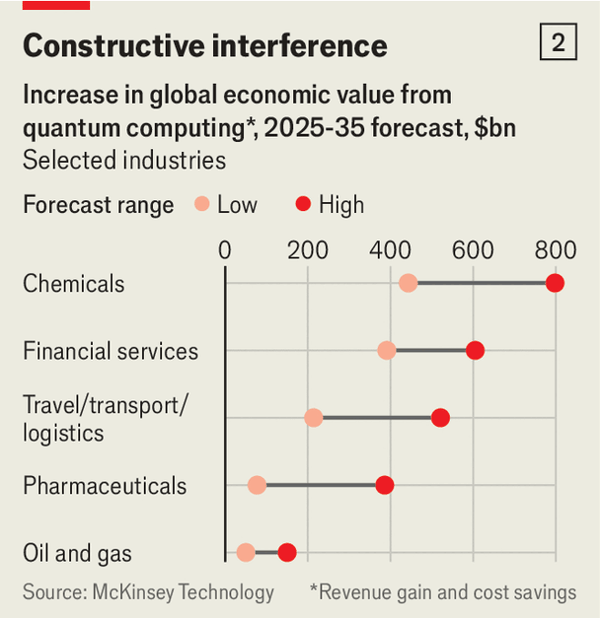
量子计算领域正迎来爆发式资本涌入与技术突破。麦肯锡报告显示,2025年量子初创企业的投资额达到了126亿美元,比前一年增长了六倍。IonQ和Rigetti两家上市公司的市值自上市以来分别增长了七倍和四倍。美国政府于2025年5月宣布对包括Rigetti、GlobalFoundries和Quantinuum在内的九家量子计算公司进行20亿美元的股权投资,其中Quantinuum在6月上市时融资约17亿美元。在技术端,谷歌发布了“Willow”量子处理器,IBM则计划在2029年构建包含200个逻辑量子比特的容错量子计算机。麦肯锡预测,量子计算将在化学和医药等领域创造巨大的商业价值。
量子计算机利用叠加与纠缠等量子力学特性,能够在某些特定数学问题上实现指数级提速。然而,德克萨斯大学奥斯汀分校的计算机科学家斯科特·阿伦森(Scott Aaronson)指出,对于90%的传统计算任务,量子计算机相比经典计算机并不具备优势。量子计算的核心突破集中在破译密码和模拟量子力学本身两大领域。谷歌研究人员发现,仅需1,200个逻辑量子比特即可在数分钟内破译保护加密货币的密码系统;而初创公司Oratomic提出的新型纠错技术表明,攻击现行加密体系可能仅需数万个物理量子比特,而非此前预期的数十万个。美国标准机构建议各界在2035年前完成向后量子密码学的迁移,而谷歌已计划在2029年前完成内部升级。
除了密码学威胁,量子计算机在分子与材料科学模拟方面展现出建设性前景。经典计算机采用的密度泛函理论(DFT)在预测硅半导体等材料时存在局限,无法精准模拟复杂的分子相互作用。2024年,谷歌在Willow芯片上利用101个物理量子比特成功创建了1个逻辑量子比特,并维持稳定约1小时;密兰的Algorithmiq、克利夫兰诊所与IBM联合团队凭借量子-经典混合模拟抗癌药物电子相互作用获得了200万美元奖金。尽管量子近似优化算法(QAOA)和蒙特卡洛模拟在金融资产定价与投资组合优化中的实际优势仍有待证实,但量子硬件的持续进步正加速推动工业级应用落地。
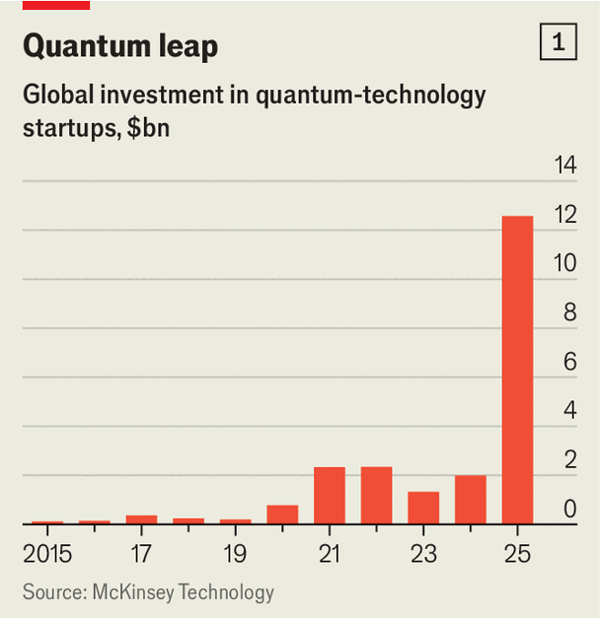
Quantum computing is experiencing a surge in venture capital and government backing. McKinsey reports that investment in quantum startups reached $12.6bn in 2025, a six-fold increase over the previous year. Market capitalizations for listed firms IonQ and Rigetti have expanded seven-fold and four-fold since their market debuts, respectively. In May 2025, the U.S. government committed $2bn in equity stakes across nine quantum firms, including Rigetti, GlobalFoundries, and Quantinuum, which raised $1.7bn in its June public offering. On the technical front, Google unveiled its "Willow" processor, while IBM announced roadmap target to construct a fault-tolerant quantum computer incorporating 200 logical qubits by 2029.
Leveraging superposition and entanglement, quantum systems deliver exponential speedups for specialized mathematical structures, though computer scientist Scott Aaronson notes that quantum architectures offer zero advantage over classical computers for 90% of routine tasks. Primary breakthroughs center on cryptography and molecular simulation. Google researchers demonstrated that a system with 1,200 logical qubits could break cryptocurrency encryption protocols within minutes, while Oratomic showed that refined error correction could compromise current cryptographic standards using tens of thousands of physical qubits rather than hundreds of thousands. Consequently, while U.S. standards bodies target universal post-quantum migration by 2035, Google plans internal completion by 2029.
Beyond cryptographic decryption, quantum platforms offer constructive utility in molecular chemistry and materials design. Conventional approximations like Density-Functional Theory (DFT) fail to model complex electronic interactions accurately. In 2024, Google demonstrated quantum error correction by linking 101 physical qubits on a Willow chip to create a single logical qubit stable for nearly one hour. Furthermore, a research coalition including Algorithmiq, Cleveland Clinic, and IBM won a $2m prize for deploying hybrid quantum-classical algorithms to model light-activated anti-cancer drugs. While applications like the Quantum Approximate Optimization Algorithm (QAOA) in financial portfolio management remain under empirical evaluation, hardware scale-up continues to unlock practical quantum utility.
Source: Quantum computers promise mathematical superpowers
Subtitle: But like all superpowers, they will have their limits
Dateline: 7月 30, 2026 05:37 上午