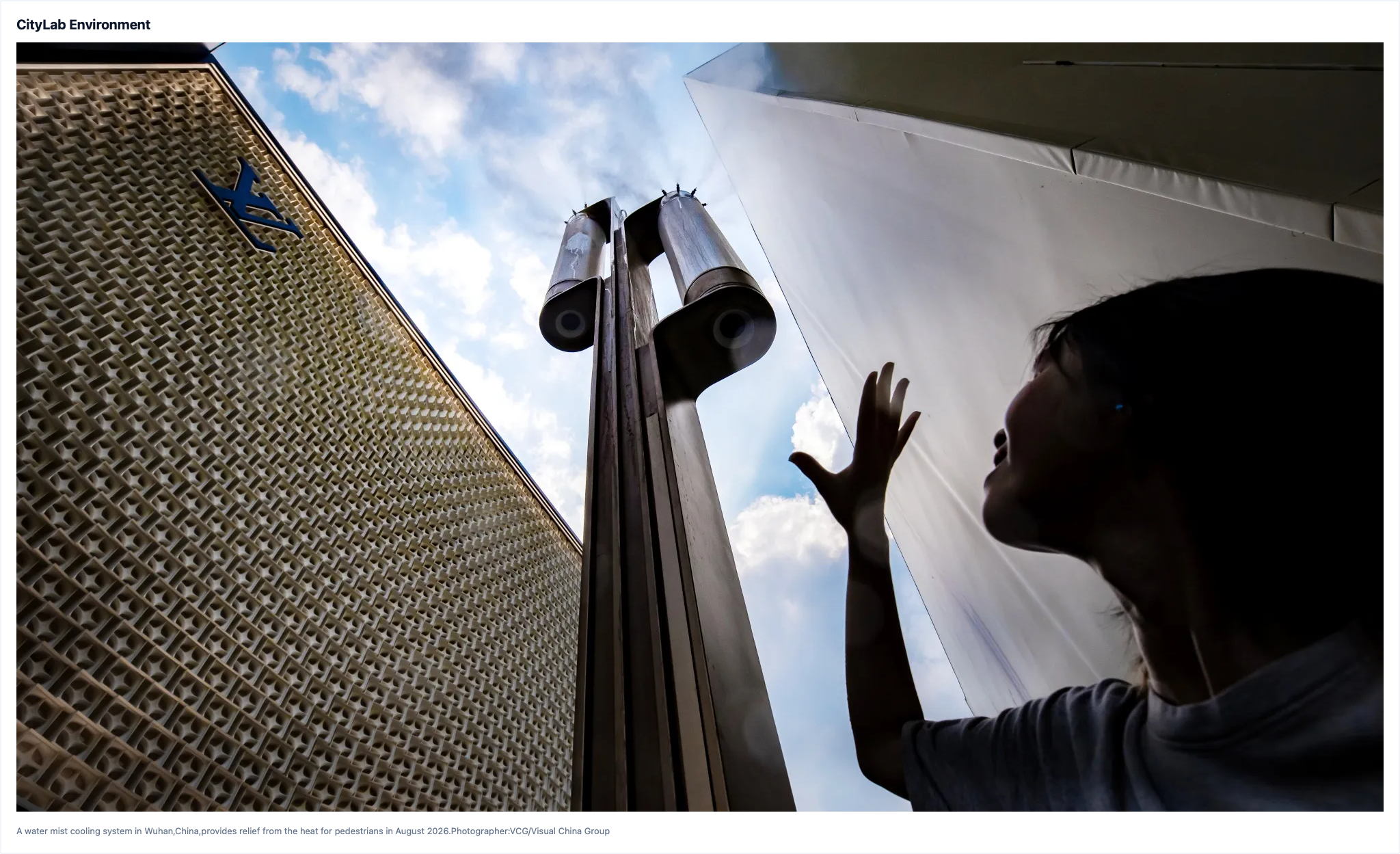
除了下降风塔这类蒸发冷却技术外,全球城市亦在探索更多调控局部大气的降温手段。例如中国多座城市广泛设置喷雾系统,中东传统建筑则借鉴捕风塔与喷泉原理;为了解决淡水资源匮乏的难题,研究人员甚至著手试验利用离岸风力涡轮机将海水喷洒至大气中,并由海风吹向沿海城市提供冷空气。与此同时,部分新创公司也尝试在上空释放碳酸钙粉尘或水雾,试图在局部区域阻挡强烈阳光以削弱尖峰高温,但这类地球工程手段也引发了环保与法规上的争议。
在各类新型城市冷却策略中,海洋云增亮(Marine Cloud Brightening)与天空增亮等太阳辐射管理技术备受关注。研究团队尝试喷洒极微小的盐水雾粒,让水分蒸发后留下的盐微粒作为凝结核,提升低层海洋云层或无云天空的反射率,借此降低沿海都会区的气温。然而,专家指出这类技术对大气与气候条件的要求极高,较适合洛杉矶等具备稳定海洋边界层的干凉沿海地区,对潮湿不稳定的热带城市效果有限,且长期使用盐水喷雾仍须面对潜在的腐蚀风险与气象连锁效应。
Facing intensifying summer heatwaves and the urban heat island effect, Spanish inventor Jesus Areso Salinas developed a cooling apparatus called a katabatic tower. The system works by nebulizing water into fine droplets at the top of a fabric tube, where rapid evaporation in dry air absorbs ambient heat into latent heat, causing the cooled, denser air to tumble downward and create a siphoning effect that lowered temperatures by more than 20°C in trials. Salinas is now adapting this concept for greenhouses, orchards, and urban plazas to provide relief and establish comfortable microclimates across large outdoor spaces.
Beyond katabatic towers and conventional evaporative cooling, cities worldwide are exploring a variety of localized atmospheric interventions. Chinese metropolises have widely deployed misting systems, while Middle Eastern architectural traditions inspire passive solutions using fountains and wind towers; to address freshwater scarcity, researchers are testing offshore wind turbines fitted with nozzles to blow cooled seawater plumes into coastal cities. Concurrently, geoengineering startups are investigating the dispersal of fine calcium carbonate dust or mist upwind of urban centers to shave off peak daytime temperatures, though such practices continue to provoke regulatory pushback and environmental concerns.
Among emerging cooling technologies, marine cloud brightening and sky brightening have attracted significant interest as targeted solar radiation management tools. By dispersing sub-micron saltwater mist, the resulting microscopic salt crystals act as condensation nuclei that make low-lying marine clouds or clear skies more reflective, thereby deflecting sunlight away from coastal urban areas. However, experts emphasize that these methods require specific stable meteorological conditions—making them potentially viable for cities like Los Angeles but largely ineffective for humid tropical climates—while also presenting potential drawbacks such as equipment corrosion from salty air and broader atmospheric trade-offs.