这项任务的主要科学目标之一是评估暗物质与暗能量对数十亿恒星及星系分布的影响,这两者构成了宇宙的绝大部分。此外,罗曼望远镜预计将利用多种技术发现高达十万颗系外行星,并配备先进的日冕仪以阻挡恒星眩光,实现系外行星的直接成像。(关键数字:100,000)
该项目有著不同寻常的历史,其主体由美国国家侦察局剩余的间谍卫星改装而成,并且罕见地在预算内提前完成。罗曼望远镜将发射至距离地球一百五十万公里的第二拉格朗日点运行,科学家们期待其无与伦比的巡天能力能在未来几年带来意想不到的重大天文发现。(关键数字:1.5)
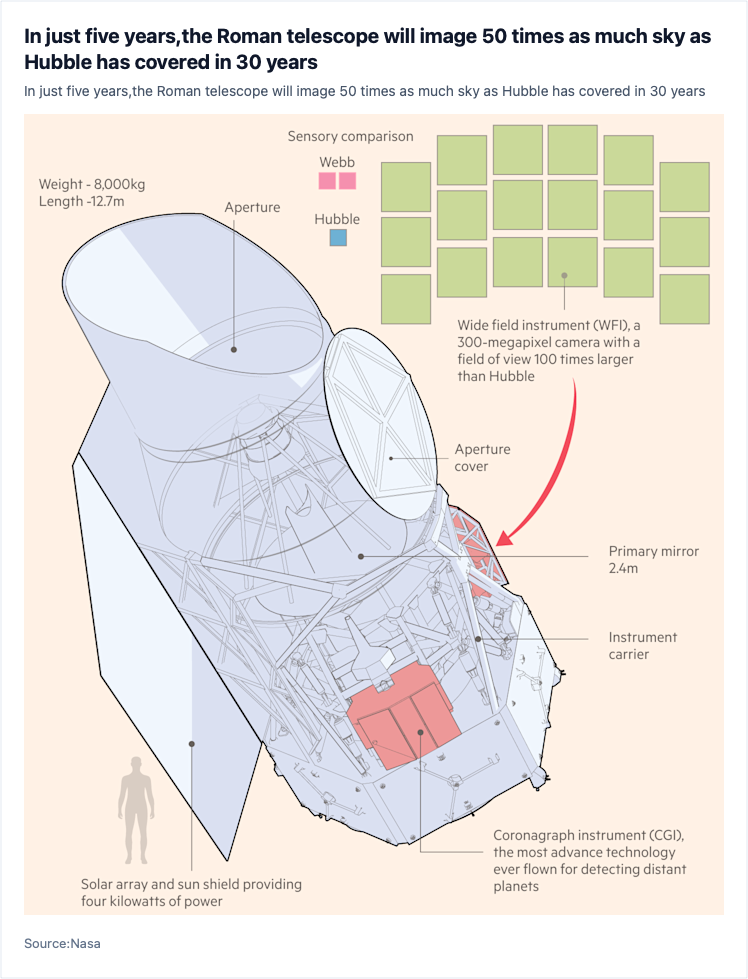
NASA is set to launch the $4.3 billion Roman Space Telescope, named after its first chief astronomer, Nancy Grace Roman. The observatory boasts an exceptionally wide field of view, enabling it to scan massive areas of the sky in infrared light, covering 200 times more area than the Hubble Space Telescope in a single image and operating at vastly superior speeds.
A primary scientific goal of the mission is to study the effects of dark energy and dark matter on the distribution of billions of stars and galaxies, which together make up the vast majority of the universe. Additionally, Roman is expected to discover up to 100,000 exoplanets using various techniques, featuring a state-of-the-art coronagraph that blocks starlight to allow for direct imaging of distant worlds.
The project has a unique origin story, having been repurposed from a surplus spy satellite donated by the National Reconnaissance Office, and has impressively remained under budget and ahead of schedule. Destined for the second Lagrange point 1.5 million kilometers from Earth, scientists eagerly anticipate that its unprecedented sky surveys will lead to unexpected and groundbreaking astronomical discoveries.