尽管日本常被视为均质富足的社会,但儿童贫困仍是一项严峻的结构性挑战:官方统计显示,2024年有11%的儿童生活在相对贫困中。相对贫困是指家庭可支配收入低于全国中位数277万日元(约合1.75万美元)的一半;虽然该比例较2012年16%的峰值有所回落,但告别通缩后物价上涨正对贫困家庭造成重创。自2020年以来食品价格飙升约30%,使低收入家庭在学校暑期停发营养午餐且缺乏空调的环境下,面临营养匮乏与生计维艰的双重困境。
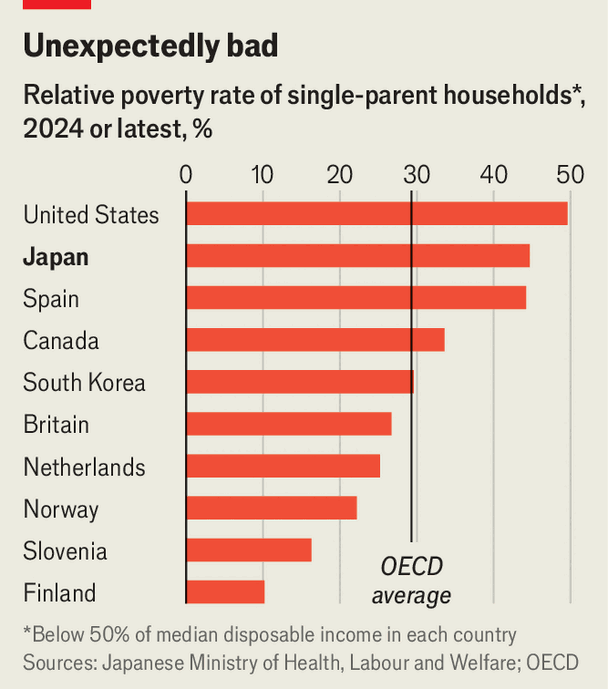
这一困境在单亲家庭中表现得尤为突出,其相对贫困率高达44.7%,位居经合组织(OECD)富裕国家前列。令人瞩目的是,这种极高贫困率是在近90%的单亲母亲均参与工作的情况下发生的,根源在于日本劳动力市场的“双轨制”将女性大量锁定在薪资低廉且缺乏保障的非正规岗位上,且男女薪酬差距悬殊。此外,虽然约90%的离婚案件中母亲享有抚养权,但约70%的单亲母亲从未收到过前夫的抚养费;为此,日本政府于今年4月成为七国集团(G7)中最后一个修改法律引入共同监护权的成员国。
通胀加剧促使受助家庭人均每日伙食支出跌破500日元,已逼近绝对贫困标准;日本社会随之流行起“父母扭蛋”(oya-gacha)一词,反映出年轻一代对出身决定命运的阶层固化焦虑。然而,公共财政救助机制严重滞后,过低的救济收入门槛抑制了母亲延长工时的积极性,加之强烈的社会耻感与冷漠的官僚审查,导致符合条件的贫困家庭中仅约20%真正领取了低保。因此,诸如三好市推出的匿名餐券便当等地方援助,必须通过隐蔽机制保护贫困群体的尊严,折射出日本底层贫困大多在公众视线之外隐秘蔓延的现实。
Despite Japan’s reputation as an egalitarian and prosperous society, child deprivation remains a severe structural challenge, with official data indicating that 11% of children lived in relative poverty in 2024. Defined as households subsisting on less than half the national median disposable income of ¥2.77m ($17,500), this rate has declined from a 2012 peak of 16% but is now exacerbated by the termination of decades of deflation. Since 2020, domestic grocery and food prices have escalated by approximately 30%, disproportionately squeezing low-income families whose children lose access to subsidized school nutrition and climate-controlled facilities during extended summer school vacations.
The crisis is acutely concentrated among single-mother households, where Japan’s relative poverty rate reaches 44.7%—one of the highest levels recorded among OECD member states. This vulnerability persists despite an exceptional labor force participation rate, with nearly 90% of single mothers employed. Japan’s two-track labor structure funnels women predominantly into irregular, low-wage positions characterized by negligible employment security and persistent gender wage gaps. Furthermore, while mothers secure primary custody in roughly 90% of divorces, approximately 70% receive no financial child support from former spouses, prompting the government in April to become the final G7 member to introduce legal joint custody frameworks.
Deepening inflation has pushed nutrition budgets among vulnerable cohorts below ¥500 per person daily, approximating absolute poverty levels according to academic assessments. Societal perceptions increasingly reflect disillusionment through terms like oya-gacha, expressing fatalism regarding family socioeconomic origins. However, public assistance remains underutilized, with only an estimated 20% of qualifying households claiming welfare entitlements due to bureaucratic obstacles, restrictive income ceilings that penalize extra work hours, and intense social stigma. Consequently, local municipal initiatives, such as discreet subsidized bento programs in Miyoshi, must employ anonymized payment mechanisms to deliver relief without exposing recipients to pervasive cultural marginalization.
Source: Why relative poverty is stubbornly high for Japanese childre
Subtitle: Inflation is making matters worse
Dateline: Sep 24th 2026\n