美国电价近几年涨幅超过整体通胀,但把账单上涨主要归咎于人工智能并不符合数据:弗吉尼亚州阿什本这个仅有4.5万人口的小镇拥有约150座数据中心,用电量大致相当于拥有160万人口的费城。高盛预计,未来几年数据中心将占美国总用电需求增量的近一半,但即便在乐观预测下,它们到2030年也只占总需求的约五分之一,而目前还不到十分之一。
研究表明,至2024年的五年里,推动电价上涨的主因是电网升级以及发电设备和铜等原材料成本上升,而不是数据中心负荷。2024年,配电变压器需求比供应高出10%,电力变压器缺口达30%,关键电网设备的交付等待时间也从2021年的50周拉长到120周或更久。
这些压力在2021年初就已出现,比ChatGPT引爆人工智能热潮早了近两年,而且还在扩大:爱迪生电力协会预计,成员企业在2025至2029年的累计资本开支将达1.1万亿美元,高于此前五年的7650亿美元,其中一半以上的输配电投资将用于更换老旧设备并增强其应对极端天气的能力,加州大型公用事业公司在2019至2023年间仅野火风险缓解就花了270亿美元。与此同时,科技公司也可能压低价格而不是推高价格,因为它们在增加自有电源和灵活负荷管理;Alphabet在2025年12月向Intersect Power投资50亿美元,PG&E估计新增1吉瓦负荷最多可使电费下降2%,而一些在2019至2024年负荷高增长的州,经通胀调整后电价反而下降。
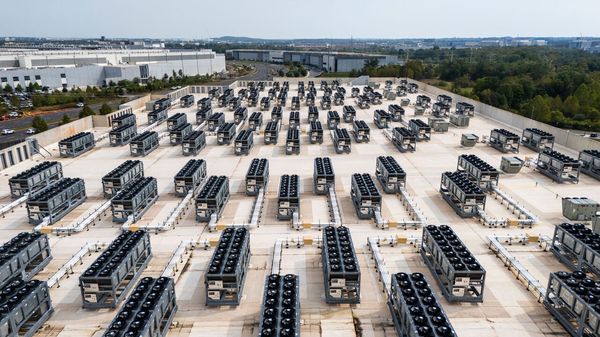
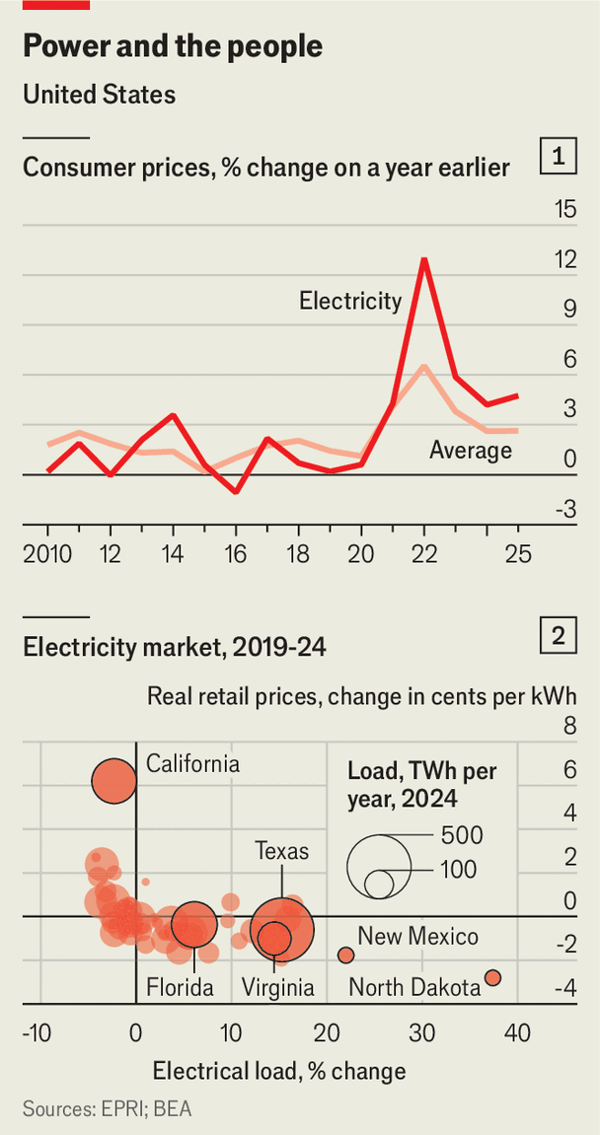
American power bills have risen faster than overall inflation in recent years, but the data do not support blaming AI as the main cause: Ashburn, Virginia, a town of 45,000, has about 150 data centres that use roughly as much electricity as Philadelphia, a city of 1.6m. Goldman Sachs estimates that data centres will account for nearly half of America’s demand growth in coming years, yet even bullish forecasts put them at only about one-fifth of total demand by 2030, versus less than one-tenth today.
Studies indicate that the main drivers of rate increases in the five years to 2024 were grid upgrades and higher costs for generation equipment and raw materials such as copper, not data-centre load. In 2024, demand exceeded supply by 10% for distribution transformers and 30% for power transformers, while waiting times for essential grid equipment stretched from 50 weeks in 2021 to 120 weeks or more.
Those pressures began in early 2021, nearly two years before ChatGPT accelerated the AI boom, and they are still intensifying: the Edison Electric Institute expects member utilities’ cumulative capital spending to reach $1.1trn in 2025-29, up from $765bn in the previous five years, with more than half of transmission and distribution spending going to replacing ageing equipment and hardening grids against extreme weather, while big Californian utilities alone spent $27bn on wildfire mitigation from 2019 to 2023. At the same time, tech firms may lower rather than raise prices by adding their own supply and flexible demand; Alphabet paid $5bn for Intersect Power in December 2025, PG&E estimates that an added gigawatt of load could cut bills by up to 2%, and some states with high load growth from 2019 to 2024 still recorded inflation-adjusted price declines.
Source: Americans’ electricity bills are up. Don’t blame AI
Subtitle: Were it not for data centres, prices might be even higher
Dateline: 3月 05, 2026 05:05 上午 | Ashburn, Virginia