日本的能源转向反映了核能从高峰到停摆再到有限回归的剧烈逆转:到2010年,日本有54座在运反应堆,提供约25%的电力,且政府原本目标是到2030年将这一比例提高到约50%。在2011年3月11日福岛灾难后,全体机组停运,日本转向节能、太阳能以及进口液化天然气和煤炭;作为几乎全部石油、天然气和煤炭都依赖进口的国家,在经合组织中,只有卢森堡对进口能源的依赖更高。
现在政策又在转向,但数字显示出紧张关系。最新能源计划设想可再生能源在2040年占发电量的40%到50%,高于去年的约25%,而劳伦斯伯克利国家实验室的研究人员估计,到2035年可再生能源本可可靠地提供70%;然而在2024年,新的风电和太阳能建设降至17年来最弱速度,且三项大型海上风电项目被放弃。
核能复兴面临同样严苛的算术约束。核能在去年占电力结构的不足10%,目标是在2040年达到20%;日本目前有15座在运反应堆,另有3座已获得安全许可但仍闲置,18座仍在等待批准,这意味着几乎全部21座符合条件的反应堆都必须上线,同时许多建于1970年代至1990年代的机组即使在法定寿命从40年延长到60年后,仍将在2040年代至2050年代退役。
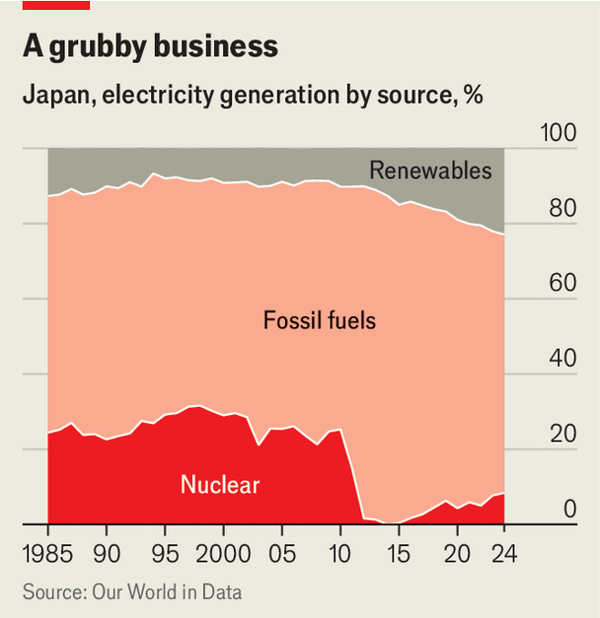
Japan’s energy shift shows a sharp reversal from nuclear dominance to shutdown and then to a constrained comeback: by 2010, Japan had 54 operational reactors supplying about 25% of electricity, and the government had aimed to raise that share to around 50% by 2030. After the Fukushima disaster on March 11th 2011, the entire fleet closed, and Japan pivoted to efficiency, solar and imported LNG and coal; as a country that imports virtually all of its oil, gas and coal, only Luxembourg is more dependent on imported energy within the OECD.
Policy is now swinging again, but the numbers show strain. The latest energy plan projects renewables at 40% to 50% of generation by 2040, up from roughly 25% last year, while researchers at Lawrence Berkeley National Laboratory estimate renewables could reliably supply 70% by 2035; yet in 2024 new wind and solar construction fell to its weakest pace in 17 years, and three big offshore wind projects were abandoned.
Nuclear revival faces equally severe arithmetic. Nuclear provided under 10% of the power mix last year and is targeted to reach 20% in 2040; Japan has 15 operating reactors, another 3 cleared for safety but still idle, and 18 still awaiting approval, meaning nearly all 21 eligible reactors must come online, even as many plants built in the 1970s-1990s will still age out in the 2040s-2050s despite a legal lifetime extension from 40 to 60 years.
Source: Fifteen years after Fukushima, Japan faces an energy dilemma
Subtitle: Restarting the world’s largest nuclear plant will not resolve its problems
Dateline: 3月 05, 2026 07:21 上午 | KASHIWAZAKI and TOKYO