日本战后曾孕育出索尼、本田以及软银等商业巨头,但在近几十年中已失去培育全球影响力初创企业的能力。全球1400家估值超10亿美元的独角兽企业中,日本仅占6家且至今未诞生估值超百亿美元的“十角兽”(decacorn),按人均独角兽数量不仅落后于韩国和澳大利亚,其风投融资规模亦显落后:尽管日本风投募资额从2015年的10亿美元升至2025年的约60亿美元,但经济规模仅为日本一半的澳大利亚去年便筹集了50亿美元,且软银等本土巨头将绝大部分资本投向了海外。
日本初创生态面临三大核心阻碍。首先是中后期风险资本严重匮乏,日本在低于1500万美元的早期融资中位列全球前十,但后期融资仅排第16位。其次是企业过早上市,疫情以来日本57%退出的初创企业选择IPO(相比之下美国为23%,英国仅13%),使得上市沦为类似于“B轮融资”的流动性妥协,导致2025年底东京证券交易所Growth板上市中位数市值仅为微不足道的100亿日元(约6100万美元)。第三是社会对创业的文化偏见,全球创业观察数据显示仅24%的日本人认为创业是理想职业(全球平均为67%),来自社会的偏见进一步迫使创始人通过匆忙上市来寻求正名。
当前日本初创生态正在出现积极转机。在人工智能热潮带动下,Sakana AI去年以2.6亿美元估值成为日本最有价值的独角兽。政府于2022年设立创业担当大臣并动用公共资金扶持,经济产业省近期亦出台指引鼓励并购退出。同时,东京证券交易所收紧退市规则,要求上市5年后市值未达100亿日元的企业退市(该规则将于2030年生效),推动IPO从终点转变为成长的起点,助力新一代创业者重塑日本的全球竞争力。
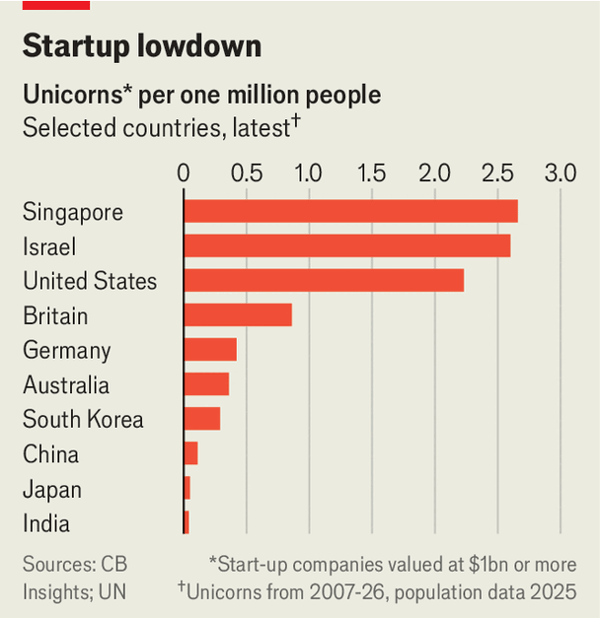
Despite post-war foundations that birthed global conglomerates like Sony, Honda, and SoftBank, Japan has severely lagged in modern startup creation. Of roughly 1,400 global unicorns valued above $1bn, only six originated in Japan, with zero "decacorns" exceeding $10bn valuations. Although domestic venture capital deployments rose from $1bn across fewer than 500 deals in 2015 to $6bn in 2025, Japan underperforms smaller economies like Australia, which raised $5bn with half the GDP. SoftBank and domestic capital allocators still channel the vast majority of late-stage growth funds into foreign enterprises rather than domestic founders.
Structural bottlenecks severely constrain ecosystem maturation. While Japan ranks among the top ten globally for early-stage funding under $15m, it drops to 16th for late-stage financing. Consequently, lack of secondary M&A markets forces 57% of venture exits through premature IPOs—compared to 23% in America and 13% in Britain—effectively treating public listings as Series B funding rounds. This dynamic culminated in a meager ¥10bn ($61m) median market capitalisation for TSE Growth market debuts in 2025. Furthermore, cultural risk aversion limits entrepreneurial appetite, with only 24% of Japanese viewing startup founding as a desirable career, against a 67% global baseline.
Encouraging policy and market shifts are currently underway. Propelled by generative AI, Sakana AI achieved a $2.6bn valuation last year, becoming Japan’s premier unicorn. The government established dedicated ministerial portfolios in 2022 and published new guidelines in May 2025 to stimulate corporate acquisitions. Crucially, the Tokyo Stock Exchange is reforming listing standards by requiring firms to maintain a ¥10bn market cap within five years of listing, taking effect in 2030, aiming to transform IPOs into launchpads for sustainable scale rather than premature endpoints.
Source: Japan’s downbeat startups need a lift
Subtitle: Can past success ever be rekindled?
Dateline: 8月 13, 2026 03:43 上午 | TOKYO