英伟达与亚马逊、谷歌、Meta及微软等超大规模云服务商之间的关系正发生深刻转变。8月10日,英伟达宣布与包括贝莱德和高盛在内的华尔街六大巨头建立合作伙伴关系,拟撬动超过5000亿美元的资本池,以具有吸引力的利率向小型AI实验室及企业提供融资,以抵消单座大型数据中心高达500亿美元的建设重负。英伟达将算力作为贷款抵押品,并为高达25%的项目成本提供兜底担保以保障资产价值,通过金融创新为其AI硬件销售开拓多元客户群。
与此同时,传统云巨头正加速推进自研芯片以摆脱对英伟达的依赖。伯恩斯坦机构估计,在搭载售价2.5万美元的英伟达H100芯片的服务器机架中,芯片支出占总成本的四分之三;而自研芯片成本仅为其五分之一至三分之一,在特定算力负载下性价比更高。亚马逊的自研芯片年化收入已达250亿美元,谷歌亦联合黑石集团建立基于自研TPU的云算力租赁业务。彭博行业研究预测,全球AI芯片出货量将从今年的约1500万颗增长至2030年的2800万颗,届时自研芯片占比将达49%,而英伟达的份额将降至40%,对其超高利润率形成实质压力。
然而,英伟达首席执行官黄仁勋强调,通用GPU在应对机器人、自动驾驶等新兴AI多模态工作负载方面具备专用定制芯片所没有的灵活性。面对竞争,英伟达将芯片迭代周期缩短至每年一次,仅上季度研发投入就突破60亿美元,使耗时2至3年、耗资10亿至30亿美元的自研项目难以企及;加之台积电等代工厂先进产能的稀缺性,进一步限制了定制芯片的扩张。除推动主权AI和新兴云之外,英伟达还通过算力租赁分成与传闻中高达3500亿美元的数据中心租赁方案全方位赋能生态,继续巩固其全球算力霸权。
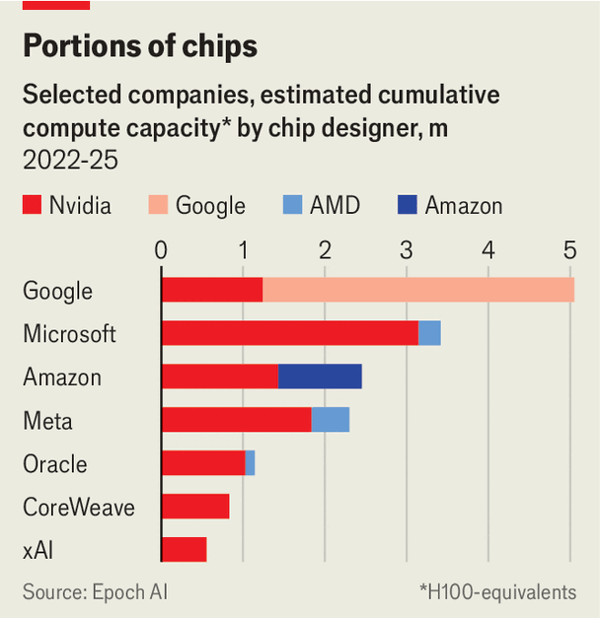
The symbiotic relationship between Nvidia and hyperscalers—Amazon, Google, Meta, and Microsoft—is evolving into competitive coexistence. On August 10th, Nvidia partnered with six prominent Wall Street institutions, including BlackRock and Goldman Sachs, to mobilize over $500bn for AI infrastructure development. Designed to finance smaller enterprises and AI labs facing steep borrowing costs against $50bn mega-datacenter price tags, the framework treats compute processors as collateral. To mitigate collateral depreciation over 4-5 year hardware lifespans, Nvidia backstops up to 25% of project costs, executing sophisticated financial structuring to expand its customer pipeline.
Concurrently, cloud titans are aggressive in developing proprietary silicon to compress capital expenditures. Bernstein estimates that Nvidia H100 processors—priced at $25,000 each—account for 75% of server rack costs, whereas custom ASICs cost only a fifth to a third as much while delivering superior unit economics for specialized algorithmic training. Amazon's custom-chip division generates $25bn in annualized revenue, while Google collaborates with Blackstone on TPU-powered cloud platforms. Bloomberg Intelligence forecasts global AI chip shipments to increase from 15m units this year to 28m by 2030, with custom silicon capturing 49% market volume against Nvidia's 40%, compressing GPU pricing premiums.
Nevertheless, Nvidia CEO Jensen Huang asserts that standard GPUs offer unmatched architectural adaptability across emerging frontiers such as robotics and autonomous systems, where specialized ASICs struggle. Nvidia now operates on an accelerated annual product cadence supported by over $6bn in quarterly R&D expenditure—dwarfing competitor budgets of $1bn-$3bn over multi-year cycles—while semiconductor foundry constraints at TSMC restrict hyperscalers' production capacity. Expanding beyond legacy cloud providers into sovereign AI and neoclouds, Nvidia reinforces ecosystem dominance through structured compute-revenue-sharing agreements and prospective multi-hundred-billion-dollar datacenter leasebacks.
Source: Nvidia’s great silicon showdow
Subtitle: The chipmaker’s biggest customers want a piece of its business. It is fighting back with a $500bn deal
Dateline: 8月 13, 2026 03:43 上午