大约十年前,习近平提出把中国建设成“航天强国”的梦想;此后中国把探测车送上火星,并建成地球轨道上两座在运空间站之一。如今中国约600家航天企业仍缺乏类似美国SpaceX那样的“巨头”,且在2025年中国近100次入轨发射中民营企业仅承担16次;相比之下,美国约180次发射中SpaceX完成160多次。
全球航天经济在过去十年从3000亿美元增长到约6000亿美元,并预计到2035年再扩大三倍;但中国多数发射仍依赖国企CASC的“长征”系列,运送1千克货物到近地轨道(LEO)平均约6万元人民币(8600美元)。SpaceX的猎鹰9号把每千克送入LEO的成本约降至三分之一;2025年12月CASC与蓝箭航天分别测试可复用火箭(长征12A、朱雀三号)时一级回收前爆炸但二级仍成功入轨,而2026年天兵科技预计测试可复用的天龙三号。
更便宜的可复用火箭将推动LEO“巨型星座”:国网预计1.3万颗,“千帆”预计1.5万颗,但目前两者各约100颗;对比之下,Starlink已超过9000颗。Starlink称全球用户800万、约三分之一在美国,但中国既有宽带覆盖与支付能力限制、又面临海外疑虑而出现需求“先有鸡还是先有蛋”的难题;尽管如此,空客在12月签约“千帆”机上联网、吉利推进数十颗导航卫星、华为和小米加入卫星通话功能,同时中国航天局在11月新设商业航天部门并发布两年支持计划与国家基金,并在12月13日出现“危险接近”的指控与反指控使安全议题升温。
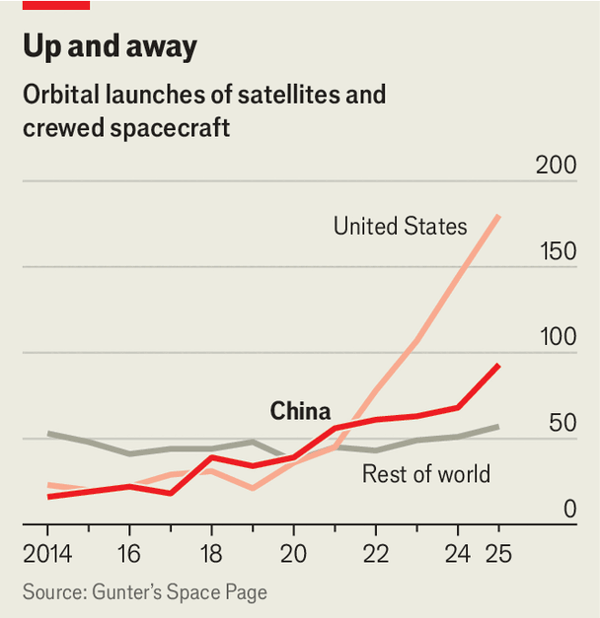
Around a decade ago, Xi Jinping said he dreamed of making China a “space power”; since then China has put a rover on Mars and built one of the two operational space stations in Earth orbit. Yet China’s roughly 600 space firms still lack a SpaceX-scale giant, and in 2025 private companies carried out only 16 of China’s nearly 100 orbital launches, versus about 180 US launches with SpaceX handling over 160.
The global space economy grew from $300bn to about $600bn over the past decade and is projected to triple again by 2035, but most Chinese launches still rely on CASC’s Long March rockets, priced at about 60,000 yuan ($8,600) per kilogram to low-earth orbit (LEO). SpaceX’s Falcon 9 is roughly one-third that cost; in December 2025 CASC and LandSpace tested reusable rockets (Long-March 12A and Zhuque-3) whose first stages exploded before recovery while second stages still reached orbit, and Space Pioneer is expected to test its reusable Tianlong-3 in 2026.
Cheaper reusability would accelerate LEO megaconstellations: Guowang targets 13,000 satellites and “Thousand Sails” 15,000, but both have only around 100 each today, compared with Starlink’s 9,000-plus. Starlink says it has 8m subscribers worldwide, about a third in America, while China faces a demand “chicken-and-egg” amid strong terrestrial internet and foreign wariness; still, Airbus signed a December deal for “Thousand Sails”, Geely is launching several dozen navigation satellites, Huawei and Xiaomi added satellite-calling, and China’s space agency created a commercial-space department in November with a two-year plan and national fund, as security claims sharpened around a Dec 13 “dangerously close” incident.
Source: The big ambitions of China’s private space industry
Subtitle: Chinese firms race to catch up with SpaceX
Dateline: 1月 15, 2026 07:52 上午 | Beijing