印度正把此次峰会当作跻身人工智能超级大国的展示窗口,但核心数字显示其仍处于追赶阶段:在斯坦福“AI活力”中排第3,却在其他一些指标上甚至进不了前10。生态规模也偏小,知情人士称全国熟练AI研究员不足300人,而研发投入仅占GDP的0.7%,资本供给仍然稀缺。
与此同时,需求侧体量极其突出:印度拥有9亿互联网用户,人均每天上网7小时,这使其成为全球模型训练数据与商业化不可忽视的市场。采用率同样领先,一项调查显示约90%的印度企业在使用AI,高于全球62%,并且在2月16日Anthropic在班加罗尔设点、2月19日莫迪与OpenAI和Anthropic负责人同台的节点上,竞争明显升温。
印度的差异化趋势是“应用优先、成本优先”而非前沿模型竞赛:其语音与本地语言场景已出现可验证突破,且教育与医疗等用例快速扩张。代表性信号包括一场印巴T20比赛约4.5亿观众中的头部广告位被ChatGPT拿下、Supernova达到100万月活,以及有创业公司声称视频模型构建成本可做到中国近邻竞品的五分之一,指向“超高性价比”路线。
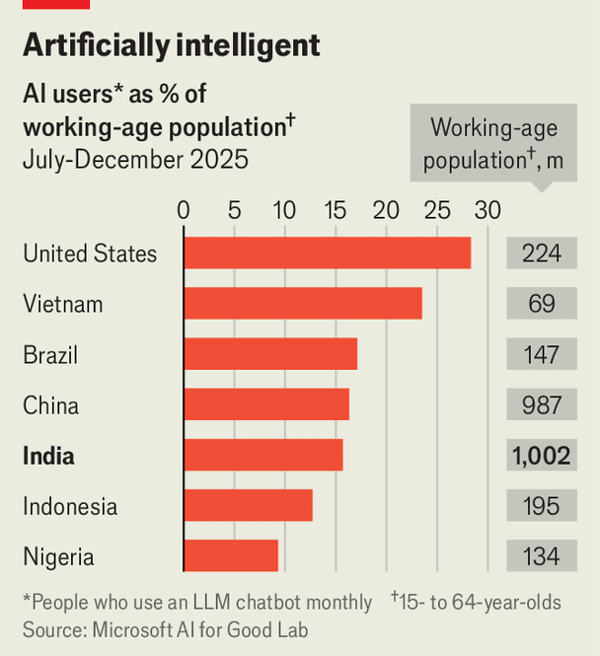
India is using the summit to project AI-superpower status, but the core numbers show a catch-up position: it ranks 3rd in Stanford’s “AI vibrancy” while missing the top 10 on some other measures. The ecosystem is still small, with insiders estimating fewer than 300 skilled AI researchers and government R&D spending at only 0.7% of GDP, alongside scarce risk capital.
At the same time, demand-side scale is massive: India has 900 million internet users who spend about seven hours online per day, making it an unavoidable market for training data and commercialization. Adoption is also high, with one survey showing nearly 90% of Indian firms using AI versus 62% globally, and competitive intensity rose around Anthropic’s February 16 Bangalore office launch and Modi’s February 19 appearance with OpenAI and Anthropic leaders.
India’s distinctive trend is application-first and cost-first rather than frontier-model competition: voice and local-language use cases are producing measurable gains, while education and healthcare deployments are expanding quickly. Signals include ChatGPT buying prime ads in an India-Pakistan T20 match watched by about 450 million people, Supernova reaching 1 million monthly users, and a startup claim of video-model build costs at one-fifth of the nearest Chinese rival, pointing to an ultra-affordability path.
Source: The flaws in India’s AI plans
Subtitle: Despite hosting a global summit, it is a bystander in the race to develop frontier models
Dateline: 2月 19, 2026 04:18 上午 | DELHI