美国大型科技公司正在裁员:甲骨文裁掉数千人,Block裁减超过4,000个岗位,几乎占其员工的一半,亚马逊和Meta也在缩减编制;从2022年至2025年,亚马逊、Meta和另外五家同行的薪资总量几乎没有增长,旧金山自2023年初起的总就业也下降了3%。行业观点把这归因于所谓代际式人工智能浪潮,认为像Anthropic模型进步迅速使许多技术岗位可被替代,同时美国数据显示技术行业在全部就业中的占比从2022年底的2.5%降到2.3%,并出现约50万“缺失”技术岗位,“网页搜索门户和其他信息服务”就业较2022年12月少7%。
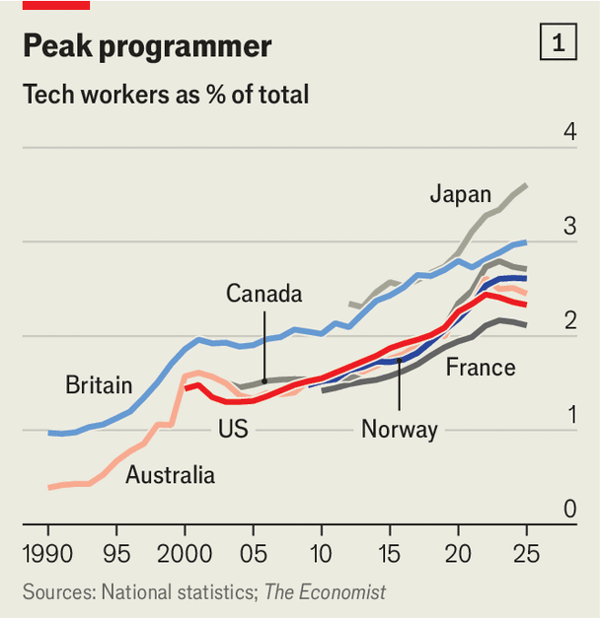
我们对美国、澳大利亚、英国、加拿大、法国、日本和挪威的比较数据表明,技术就业在2022年前快速上升,自OpenAI在2022年11月发布ChatGPT后在总体上停滞或下滑,但不能简单等同于AI直接导致。更重要的是,2025年2月Anthropic发布Claude Code前,早期AI工具尚未成熟,AI在技术层面替代软件工程师的主张在时间上并不充分支撑当时的招聘放缓。
旧金山湾区仅约25%的企业日常规律使用AI;全国水平更低。英国央行研究者伊凡·约特佐夫等对美澳英德三年调查显示,AI对就业影响“几乎为零”,这说明短期结构性就业变化与AI采用并非同一因果方向。历史上2000年代技术份额同样长期几乎不变,互联网泡沫破裂与高利率抬升了“外包和投资降温”效应;如今疫情后招聘过热、2022年后利率上升、2023年IT投资明显放缓,以及2021—2024年云计算与数据存储服务进口翻倍,使得这轮调整更像是老规律重演。
Big U.S. tech firms are cutting jobs: Oracle fired thousands, Block cut more than 4,000 positions—nearly half its workforce—and Amazon and Meta also reduced headcount; payroll growth across Amazon, Meta, and five peers was essentially flat from 2022 to 2025, while total employment in San Francisco fell 3% since early 2023. The narrative inside the industry attributes this to a generational AI wave and to faster models such as Anthropic’s, arguing many tech roles are now redundant, but U.S. employment data also show technology’s share of total jobs slipping from 2.5% in late 2022 to 2.3% and about 500,000 missing tech jobs, with web-search and information services down 7% versus December 2022.
Cross-country data for the United States, Australia, Britain, Canada, France, Japan, and Norway show tech employment surged before 2022 and has since stagnated or fallen after ChatGPT’s November 2022 launch, though that timing alone is not proof of AI-caused demand loss. The key timing point is February 2025, when Anthropic released Claude Code; before that, AI tools were still too immature for broad software-engineer substitution, so hiring softness is hard to attribute mainly to AI.
Only about 25% of San Francisco-area firms use AI regularly in daily operations, and national adoption is lower; a Bank of England-linked survey across the U.S., Australia, Britain, and Germany found AI’s employment impact “essentially zero” over three years. In this sense, today’s slowdown resembles the 2000s: post-dot-com overhang, rate-driven capex restraint, and stronger outsourcing all reappeared as pandemic-driven hiring cooled, interest rates rose after 2022, IT investment slowed in 2023, and cloud/data-storage service imports doubled from 2021 to 2024, while software-related occupation shares still edged up from 3.6% in November 2022 to 3.7%.
Source: The tech jobs bust is real. Don’t blame AI (yet)
Subtitle: Why technology firms are shedding workers
Dateline: 4月 16, 2026 04:16 上午 | San Francisco