该讨论以“北极解冻”的安全叙事为引子,转向一份2023年“气候修复”宣言,主张通过稳定冰川与冰盖、抽除二氧化碳、并通过减少入射阳光来冷却地表,以避免海冰完全消失或海洋环流发生灾难性变化等“临界点”。在赫尔辛基的讨论中,平流层气溶胶注入(SAI)被描述为在平流层喷洒二氧化硫形成反射性颗粒,而更“温和”的海洋云增亮(MCB)则是在对流层添加超细海盐颗粒以使云滴更小、更密、寿命更长、反射率更高,但目前尚无能输送所需超细盐雾的硬件。
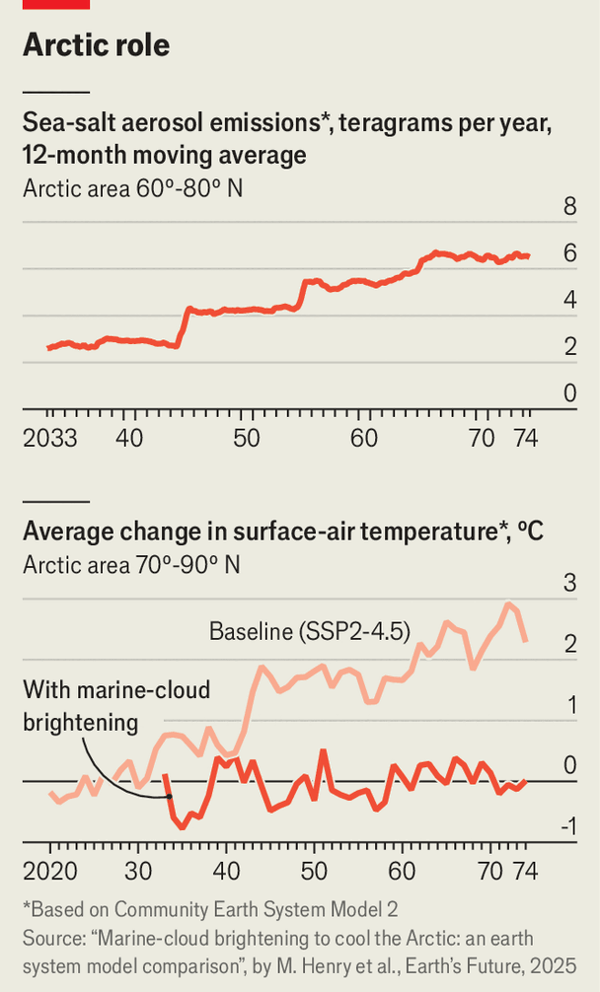
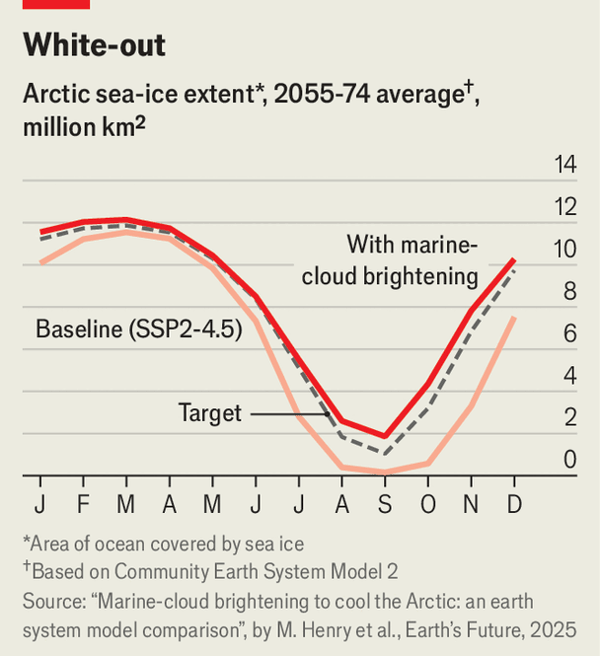
三套地球系统模型在温室气体以“相对现实”的方式上升的同时,向北极所有开阔水域上空喷洒虚拟海盐气溶胶,三者均显示MCB在原理上可维持海冰覆盖且区外影响最小,区域性在此被视为降低副作用的优势。相比之下,在60°N进行SAI虽能降温却会显著损害臭氧层、在中高纬沉降硫酸盐,并通过冷却北半球推动“热带辐合带”(ITCZ)位移从而改变热带降雨与干旱格局;模型提出在60°S进行对冲注入以“加倍努力”可使ITCZ保持原位,但也把其位置从地球物理状态变成地缘政治责任。
技术可行性上,热带对流层顶约在20km,而到60°N/60°S高度降低到民航客机可进入平流层;然而最佳做法被认为是低纬与高纬同时铺撒以近乎均匀覆盖全球,这需要专用飞机且成本达数亿美元、甚至可能数十亿美元。研究还称使用在13km飞行的喷气式飞机每年注入1200万吨二氧化硫(60°N与60°S各一半)可将全球平均气温降低0.6°C,但若能在30°N与30°S注入则可用一半硫达到同等降温并减少污染与臭氧风险,而极地SAI还可能与《远距离跨界空气污染公约》(CLRTAP)及其哥德堡议定书的领土硫排放上限相冲突。
The discussion pivots from an “Arctic thaw” security claim to a 2023 “climate repair” manifesto urging glacier/ice-sheet stabilization, CO₂ removal, and surface cooling by reducing incoming sunlight to avoid “tipping points” like total sea-ice loss or catastrophic ocean-circulation change. In Helsinki, stratospheric aerosol injection (SAI) is framed as spraying SO₂ into the stratosphere to form reflective particles, while the seemingly more benign marine-cloud brightening (MCB) adds ultrafine sea-salt particles to the troposphere to make clouds longer-lived and more reflective, though no hardware yet delivers the required fineness.
Three Earth-system models, with greenhouse gases rising in a “reasonably realistic” way, spray virtual sea-salt aerosols over all Arctic open water and all three keep sea-ice cover persisting with minimal effects outside the region, making regionality look like a side-effect advantage. By contrast, SAI at 60°N cools the Arctic but likely causes significant ozone damage, deposits sulphate across mid/high latitudes, and shifts the intertropical convergence zone (ITCZ) by cooling the Northern Hemisphere, altering tropical rainfall and drought; counterbalancing injections at 60°S double the effort to hold the ITCZ in place but turn its position into a geopolitical responsibility.
Feasibility hinges on altitude: the tropical tropopause sits around 20 km, but by 60°N/60°S it drops low enough for airliners to reach the stratosphere; the widely favored approach still spreads aerosols at both low and high latitudes, requiring purpose-built aircraft costing hundreds of millions, maybe billions, of dollars. One estimate says jets at 13 km injecting 12 million tonnes of SO₂ per year (half at 60°N, half at 60°S) could cut global average temperature by 0.6°C, yet the same cooling could be achieved with half the sulphur if injected at 30°N and 30°S—reducing pollution and ozone risk—while polar-only SAI may also conflict with CLRTAP’s Gothenburg Protocol limits on territorial sulphur emissions.
Source: Should the Arctic be refrozen?
Subtitle: It is possible. But as an end in itself, it is not advisable
Dateline: 1月 29, 2026 08:14 上午