欧洲光伏装机的高速增长正遭遇瓶颈。2025年欧盟新增光伏发电装机容量为67.2吉瓦(GW),较上年基本持平,今年除意大利外几乎所有主要欧盟国家的新增部署均将出现下滑。核心制约在于电网承载力不足:在晴好天气下光伏发电激增导致电网严重过载,促使负电价现象急剧攀升——2026年上半年德国和西班牙的负电价小时数较2024年同期分别激增33%和237%。欧盟预计到2030年需要达到150吉瓦的储能电池规模,但截至2025年底全欧实际安装量仅有37吉瓦。
在全欧光伏增长停滞的背景下,罗马尼亚异军突起,成为欧洲储能与光伏协同发展的典范。2022年俄乌冲突引发能源危机后,高电价和补贴促使罗马尼亚约33万“产消者”(安装光伏的发电设备用户)涌现,2025年该国光伏装机逆势增长45%。随着发电量大增,罗马尼亚政府果断将政策重心转向储能:取消了储能税,并在5月将7600万欧元(约合8900万美元)的光伏补贴专项转移给电池系统。到2026年上半年,该国已有约三分之一的产消者配套安装了储能电池。
罗马尼亚还开创性地推行光储同场布局与电网准入改革,以消除远距离输电瓶颈。最具代表性的是奥格雷泽尼(Ogrezeni)项目,该电站规划配置762兆瓦光伏和1吉瓦时(GWh)储能电池,将于2027年并网成为欧洲最大的光储混合电站之一。负责发放补贴的AFM机构全面叫停单纯光伏补贴而专项支持储能,并大幅提高了电网接入申请的押金门槛,彻底清除了排队投机的虚假申请。罗马尼亚从“盲目铺设光伏板”向“发电与储能并重”的转型,为欧洲能源基建成熟期提供了标准样板。
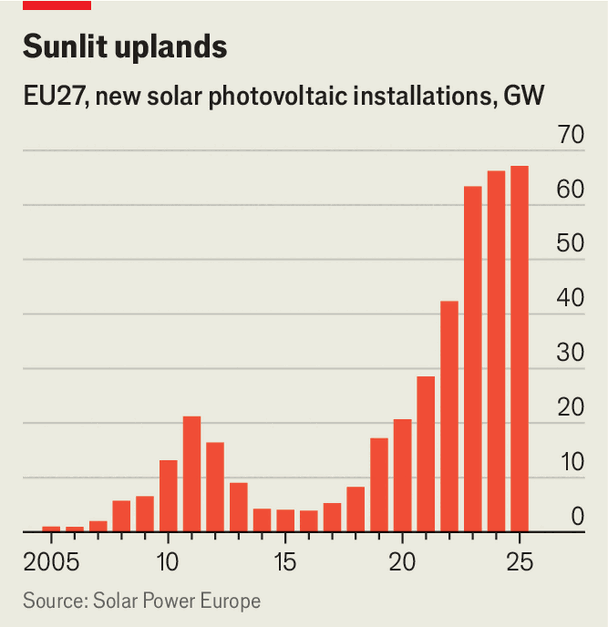
Europe’s solar deployment is plateauing due to acute grid congestion. In 2025 the European Union added 67.2 gigawatts (GW) of new solar capacity—virtually flat year on year—with new installations projected to drop in every major member state this year except Italy. During peak generation hours, overloaded grids frequently force operators to disconnect or pay consumers to take excess power, driving negative-price hours in the first half of 2026 up by 33% in Germany and 237% in Spain compared to H1 2024. While the EU requires 150GW of battery storage by 2030, only 37GW was operational by late 2025.
Amid continent-wide stagnation, Romania has emerged as an unexpected leader by integrating storage early into its renewable buildout. Following energy price spikes from the 2022 Ukraine war, generous subsidies spurred 330,000 domestic "prosumers" to install solar panels, driving a 45% installation surge in 2025. To prevent grid paralysis, the Romanian government eliminated storage taxes and redirected €76m ($89m) of solar subsidies directly toward batteries in May. By the first half of 2026, roughly one-third of Romanian prosumers had installed integrated battery systems.
Furthermore, Romania is pioneering onsite utility-scale battery integration and rigorous grid reforms to prevent interconnection backlogs. The flagship Ogrezeni development combines 762 megawatts of solar capacity with a 1-gigawatt-hour battery system, scheduled to become one of Europe's largest hybrid facilities upon commissioning in 2027. Renewable agency AFM replaced standalone solar grants with battery subsidies and raised grid-application deposit requirements to eliminate speculative filings. Romania’s balanced approach offers a compelling blueprint for European nations transitioning from raw solar deployment to resilient grid architecture.
Source: Europe’s new renewable-energy champion is a surprise
Subtitle: Romania is leading the EU in combining solar power and batteries
Dateline: Aug 27th 2026