美国在汽车制造领域的统治地位已显著下降,其在全球汽车产量中的份额从1950年的四分之三降至如今的仅八分之一,而“三巨头”在国内的市场份额也从1965年的90%以上骤降至40%左右。通用汽车的全球销量从2004年的840万辆降至去年的620万辆,而斯泰兰蒂斯在美国130万辆的销量则不足其2004年水平的一半。
为了保护国内汽车制造商,美国在2024年对中国电动汽车征收了100%的关税,而中国电动汽车已经夺取了欧洲近10%的市场份额。与此同时,缩减电动汽车计划使福特损失了200亿美元,斯泰兰蒂斯损失了260亿美元,通用汽车在去年的资产减记和损失中也承受了80亿美元的打击。
尽管保护主义壁垒提供了暂时的喘息机会,且斯泰兰蒂斯计划将其360亿欧元(420亿美元)预算的60%投资于北美,但中国竞争对手已经开始进入邻近市场,在墨西哥获得了15%的份额,并与加拿大达成了一项每年进口49,000辆汽车的协议。福特计划通过在2027年前推出一款售价3万美元的小型电动皮卡来应对这一威胁。
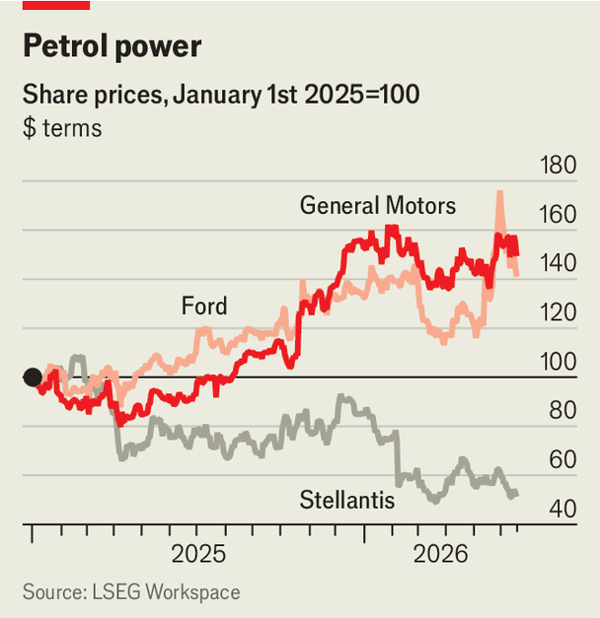
America's dominance in carmaking has significantly declined, with its share of global vehicle production dropping from three-quarters in 1950 to barely an eighth today, while the "Big Three" saw their domestic market share plummet from over 90% in 1965 to around 40%. General Motors' global sales fell from 8.4 million in 2004 to 6.2 million last year, while Stellantis's US sales of 1.3 million were less than half of its 2004 level.
To insulate domestic automakers, the US imposed a 100% tariff on Chinese electric vehicles (EVs) in 2024, which have already captured nearly 10% of the European market. Meanwhile, scaling back EV plans cost Ford $20 billion, Stellantis $26 billion, and General Motors $8 billion in write-downs and hits last year.
Although protectionist walls offer temporary relief and Stellantis plans to invest 60% of a €36 billion ($42 billion) budget in North America, Chinese competitors are already entering adjacent markets, securing a 15% share in Mexico and a 49,000-vehicle import agreement with Canada. Ford plans to counter this threat by launching a $30,000 small electric pickup by 2027.
Source: America’s carmakers cannot escape Chinese EVs for ever
Subtitle: Can they stay relevant?
Dateline: 6月 18, 2026 03:46 上午 | DETROIT