《经济学人》权威的语气偶尔会招致批评,称其预测是如此一致地错误,以至于可以作为反向指标。例如,该刊在1999年预测油价可能会跌至每桶5美元,结果在接下来的十年中油价上涨了十倍。2013年,它错误地宣告了全球石油需求的顶峰,而今年4月,它对战争引发油价飙升的警告之后,油价却下跌了约三分之一。为了客观地评估这些指责,《经济学人》使用GPT-5.5人工智能模型分析了本世纪以来发表的全部约7000篇社论。AI识别出大约1400篇包含可证伪预测的社论,并对它们的反向程度和准确性进行了评分。
AI的评估结果显示,《经济学人》的预测通常比批评者所声称的更为准确。虽然与传统观点高度一致的预测自然被证明是正确的,而极度反向的预测准确率较低,但该刊在广泛的中游地带实现了高于半数的准确率。反向程度得分高达七分(满分十分)的预测——例如2013年对比特币生命力的正确预测——通常是正确的。从历史上看,该刊在2003年成功警告了美国房地产泡沫、汽车制造商的困境以及即将到来的2007-09年全球金融危机,尽管它也曾发出过虚假警报,例如在2011年预测会出现“双底”衰退。
在科技和全球事务方面,其预测记录喜忧参半。该刊在2002年正确地指出智能手机是计算的未来,在2008年指出流媒体将吞噬DVD,并在2011年预言中国制造的汽车将席卷西方;然而,它对廉价生物乙醇、分布式电网和增强现实的预测被证明为时过早。在政治方面,它成功预测了德德·克鲁兹(Ted Cruz)在2016年的失败以及弗拉基米尔·普京在2003年的专制走向,但未能预料到唐纳德·特朗普的获胜。在新冠疫情期间,它在2020年2月之前就正确地拉响了全球大流行的警报,并在2022年预料到了随后利率的快速飙升,尽管它对紧接着发生衰退的预期因经济实现“软着陆”而落空。
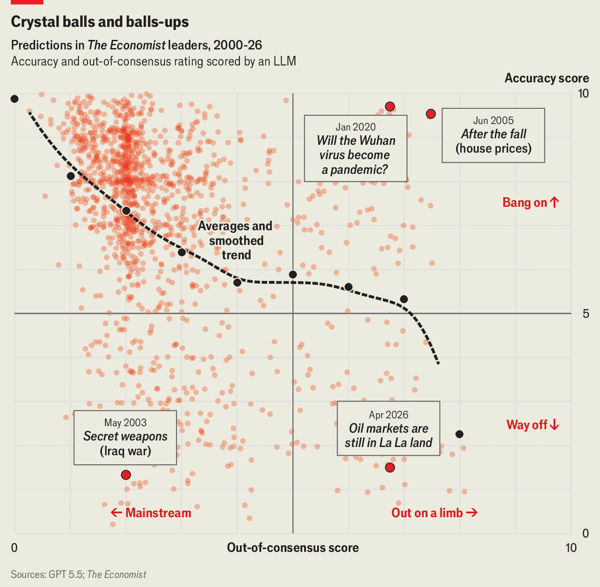
The Economist's authoritative tone has occasionally been met with criticism that its forecasts are so consistently incorrect they serve as a contrarian indicator. For instance, in 1999 the publication predicted oil prices could drop to $5 a barrel, right before a tenfold increase over the next decade. In 2013, it incorrectly called a peak in global oil demand, and in April, its warning of a war-induced oil spike was followed by a one-third decline in prices. To evaluate these claims objectively, The Economist analyzed all 7,000 of its millenarian leaders using the GPT-5.5 artificial intelligence model. The AI identified roughly 1,400 leaders containing falsifiable predictions, grading their contrarianism and accuracy.
The AI assessment revealed that The Economist's predictions are generally more accurate than critics suggest. While calls closely aligned with conventional wisdom naturally proved correct, and extremely contrarian predictions were less accurate, the publication achieved better-than-even odds of accuracy in the broad middle ground. Leaders with a contrarianism score of up to seven out of ten—such as a correct 2013 forecast on Bitcoin's longevity—were generally correct. Historically, the publication successfully warned of the U.S. housing bubble in 2003, carmaker distress, and the impending 2007–09 global financial crisis, though it also had false alarms like predicting a double-dip recession in 2011.
In technology and global affairs, the forecasting record is mixed. The Economist correctly identified smartphones as the future of computing in 2002, streaming overtaking DVDs in 2008, and the rise of Chinese cars in the West in 2011, while its predictions on cheap bioethanol, distributed grids, and augmented reality proved premature. In politics, it successfully predicted Ted Cruz's defeat in 2016 and Vladimir Putin's autocratic direction in 2003, but failed to anticipate Donald Trump's victory. During the COVID-19 pandemic, it correctly sounded the alarm on a global pandemic by February 2020 and anticipated the subsequent rapid interest rate hikes in 2022, though its expectation of an immediate recession was avoided by a "soft landing."
Source: Is The Economist always wrong?
Subtitle: We used artificial intelligence to test the accuracy of our forecasts
Dateline: Jul 02, 2026 06:22 AM