在阿萨德政权统治时期,精神类药物芬乙茶碱(Captagon)成为叙利亚最大的出口产品,导致其沦为一个毒品国家。这种药丸每颗的生产成本仅为几美分,但在沙特阿拉伯却能卖到25美元,全球总交易额可能高达100亿美元。根据联合国的报告,在2019年至2025年期间,全球多达80%的查获毒品均源于叙利亚。新任总统阿赫迈德·沙拉拉为争取国际认可和重建资金,展开了严厉打击,在执政首年便缴获了超过5亿颗药丸,拆除了16个工业化实验室。
尽管政府声称已消灭毒品生产,但过去一年又缴获了超过8000万颗药丸。阿萨德弟弟领导的第四装甲师残余势力逃往南部由德鲁兹民兵控制的苏韦达省,并在那里新建了12至15个实验室。这些毒品主要通过与约旦接壤的360公里边境线走私至海湾地区。自去年7月以来,边境拦截量增加了近四倍;今年1月,两国成立联合安全委员会,而约旦在5月对苏韦达省的生产设施进行了第五轮空袭。此外,黎巴嫩真主党也将此作为重要资金来源,过去六个月叙利亚当局缴获的芬乙茶碱中有四分之一来自黎巴嫩。
目前,芬乙茶碱的生产网络正在全球范围内去中心化和扩散。除了在科威特和埃及发现实验室外,苏丹在去年2月查获了一家每小时可生产约10万颗药丸的工厂,也门胡塞武装也在去年6月被查获企图走私150万颗药丸,而印度当局则在今年5月首次突袭了遍布全国的生产网络。尽管该药物会导致严重的心脏和大脑损伤,但中东地区的需求依然极其旺盛。由于供应受阻导致芬乙茶碱价格上涨,消费者已开始转向使用危害性更强的冰毒。
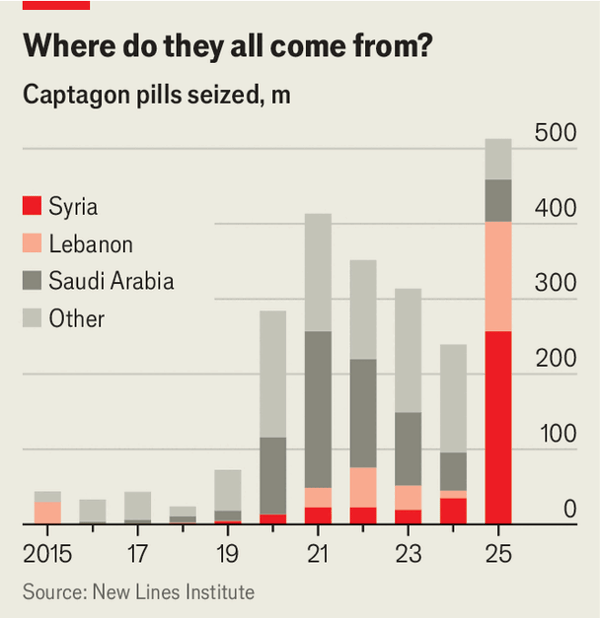
Under the Assad regime, Syria transformed into a narco-state with Captagon becoming its largest export. The drug is highly lucrative, costing only cents to produce but retailing for up to $25 per pill in Saudi Arabia, fueling a global trade valued at up to $10 billion. The UN reports that between 2019 and 2025, up to 80% of global Captagon seizures originated in Syria. Seeking international legitimacy and reconstruction funding, Syria’s new president, Ahmed al-Sharaa, launched a crackdown, seizing over 500 million pills and dismantling 16 industrial laboratories in his first year.
Despite official declarations that production has ceased, authorities have seized over 80 million pills in the past year. Production has shifted to Sweida, a southern province where remnants of Assad’s elite Fourth Armoured Division operate 12 to 15 labs. Smuggling into Jordan remains the primary route to the Gulf, prompting a four-fold increase in border drug seizures since July last year, the creation of a joint security committee in January, and Jordan's fifth round of air strikes in Sweida in May. Meanwhile, Lebanon's Hizbullah has also ramped up production, accounting for 25% of the Captagon seized by Syrian authorities over the past six months.
Furthermore, Captagon production is decentralizing globally. Labs have been discovered in Kuwait, Egypt, and Sudan—where a factory producing 100,000 pills per hour was seized in February last year—while Yemen's Houthi rebels saw 1.5 million pills intercepted in June last year. Even India raided a major domestic production network this May. Despite severe health risks, including heart and brain damage, Middle Eastern demand for cheap synthetic stimulants remains high. Supply disruptions are driving up prices, causing users to dangerously transition to even more destructive crystal methamphetamine.
Source: Ahmed al-Sharaa is quashing Syria’s vast captagon trade
Subtitle: But pills that cost cents to produce still sell for $25
Dateline: Jul 09, 2026 05:22 AM