瑞士东部邮政巴士与百度旗下的萝卜快跑合作,让中国自动驾驶出租车技术走出国门。根据EqualOcean的数据,已有超过70家中国实体人工智能企业在海外拓展业务,另有约20家正在筹备中,在海外扩张速度上将Waymo等美国竞争对手甩在身后。然而,中国企业积极出海的重要原因在于国内市场盈利艰难。虽然在国内实现了规模化并降低了硬件成本,但由于失业工人涌入出租车行业导致运力过剩、车费低廉,例如武汉10公里的里程仅需23元人民币(约3.40美元),而在瑞士圣加仑同等行程运费高达44瑞士法郎(约54美元),这种巨大的套利空间推动企业转向海外。
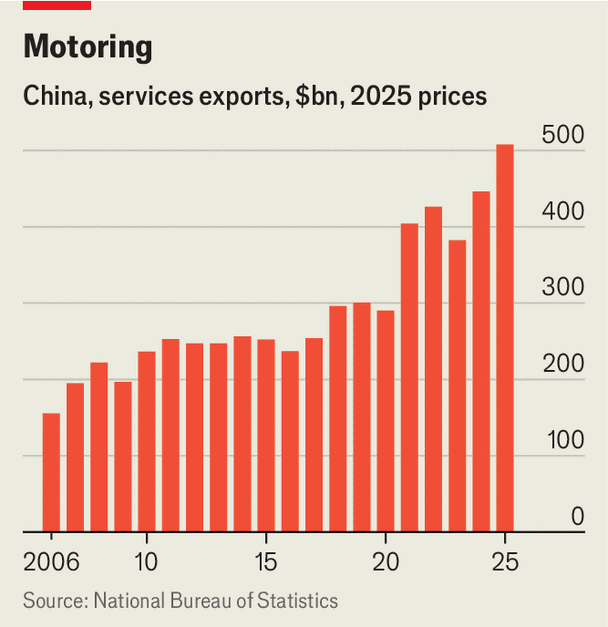
除了价格因素外,国内对人工智能可能取代人工就业的担忧也促使企业和政府寻求海外市场。中国政府迫切希望扩大人工智能出口,但同时也高度关注社会稳定,避免因AI替代岗位引发不安,因此国内监管机构在发放自动驾驶牌照方面趋于谨慎,甚至有法院判决企业因AI解雇员工赔偿。中国企业通过将人工智能服务导出海外,能够有效化解国内技术快速扩张所带来的经济与社会成本。与此同时,中国服务出口总额在2015年至2025年间翻倍达到每年5100亿美元,增长速度远超货物出口,AI正成为其中的核心驱动力。
出海不仅能为企业创造利润、缓解国内就业矛盾,还能助力中国输出行业技术标准。长期以来,全球科技标准主要由西方国家主导,但在无人驾驶出租车等前沿AI服务领域,许多国家尚属空白。中国企业率先在当地落地机器人出租车,便顺理成章地制定了事实上的行业标准。随着美国同行未来试图拓展海外市场,它们可能不得不调整产品以符合中国已确立的科技标准。最高领导人也明确支持开源系统,将中国定位为全球人工智能公共产品的提供者。
Swiss public-transport operator PostBus has partnered with Baidu’s Apollo Go, bringing Chinese autonomous taxi technology to eastern Switzerland. According to research firm EqualOcean, over 70 Chinese physical artificial-intelligence companies have established operations abroad and roughly 20 more are preparing to do so, outpacing American rivals like Waymo in international expansion. However, this aggressive overseas push is largely driven by challenging domestic market conditions. Although Chinese firms scaled operations and lowered hardware costs at home, intense competition and a glut of cab drivers—driven by unemployed workers entering the field—have kept domestic fares low. For instance, a ten-kilometre taxi ride costs just 23 yuan ($3.40) in Wuhan compared to SFr44 ($54) in St Gallen, Switzerland, creating strong financial arbitrage incentives to expand overseas.
Beyond pricing dynamics, concerns surrounding AI-driven job displacement within China further accelerate this foreign push. The Chinese government aims to boost AI exports while maintaining social stability and preventing unrest. Consequently, local regulators have slowed self-driving fleet licences, and courts have ruled against firms replacing human workers with AI. Exporting AI services allows Chinese firms to externalise the economic and social costs of rapid technology adoption. Moreover, China's total service exports doubled to $510bn annually between 2015 and 2025, significantly outstripping goods export growth, with AI cloud computing, chatbots, and autonomous vehicles expected to form an increasingly prominent share of this expansion.
Expanding abroad helps Chinese firms generate profits and mitigates domestic labor friction while simultaneously enabling China to establish global technical standards. Western nations have historically dictated technological protocols, but standard frameworks for AI services like robotaxis remain unformed in many regions. As Chinese companies pioneer local deployments, they establish de facto industry standards. Consequently, American competitors seeking future international expansion may be forced to adapt to frameworks already shaped by Chinese pioneers. Chinese leadership has endorsed open-weight systems, positioning the nation as a key global provider of AI public goods.
Source: Robotaxis offer an early test case
Subtitle: [[IMAGE]]
Dateline: Jul 23rd 2026