衡量全球经济体量的传统指标是其年度总收入,即全球国内生产总值(GDP),目前约为120万亿美元。然而,如果要评估全球层面的真实财富总量,就需要统计包括房地产、矿产、机械、基础设施和知识产权在内的“实物资产”。根据麦肯锡全球研究院(MGI)于2025年7月23日发布的最新全球资产负债表报告,2025年全球财富总额突破了600万亿美元大关,达到全球年收入的5.1倍。
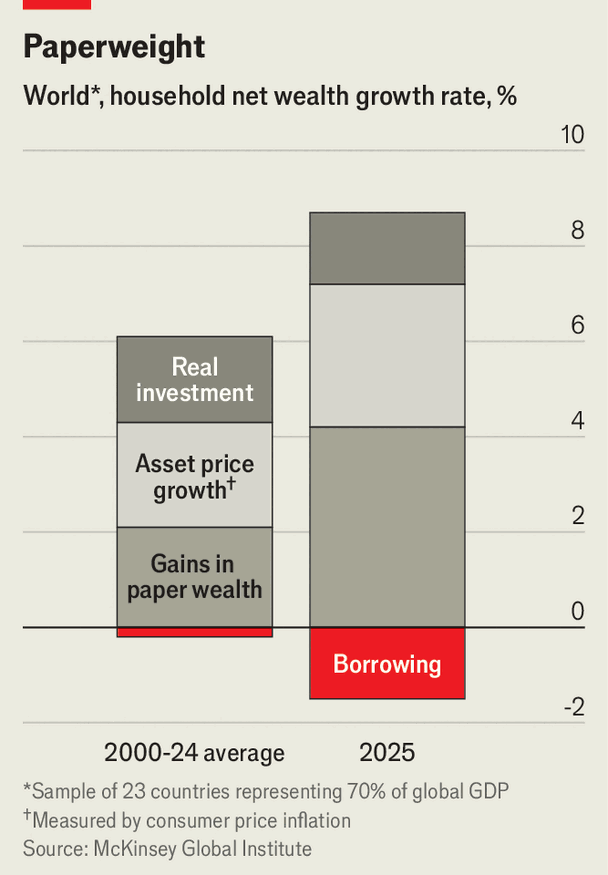
尽管这一整体资产规模与2024年相比变化不大,但内部结构却发生了剧烈变动。全球家庭财富大幅攀升40万亿美元,达到了570万亿美元。令人担忧的是,这些财富增长很少来自于能够提升生产力的实物资产的积累,而是主要源于现有资产价格超过通胀率的上涨。MGI将这种现象称为“纸面财富”的扩张。例如,美国股票总市值目前已超过美国年度GDP的3.7倍,远高于1999年互联网泡沫时期不足2倍的水平。
MGI指出,全球资产负债表与实体经济基础之间已严重失衡。由于股票在宏观层面同时代表家庭资产与企业负债,其净值始终为零,无法直接增加真实财富。恢复经济均衡可能依赖于更快的GDP增长或更高的通胀,但也存在两种潜在风险:一是高资产价格伴随高储蓄率与低迷增长;二是股价大幅暴跌直接抹去纸面财富。无论是上涨还是下跌,股票暴跌都将对投资者和发行企业造成严重冲击。
The standard measure of global economic scale is annual output, represented by global GDP, which currently stands at approximately $120trn. Assessing total global wealth, however, requires accounting for "real" assets—such as real estate, minerals, machinery, infrastructure, and intellectual property—that combine with labor to generate output. According to the latest global balance-sheet report from the McKinsey Global Institute (MGI) published on July 23rd, total planetary wealth exceeded $600trn in 2025, amounting to 5.1 times global annual income.
While the total global figure remained largely stable compared to 2024, significant internal shifts occurred across sector balance sheets. Household wealth surged by $40trn to reach $570trn. Crucially, very little of this expansion stemmed from the accumulation of new productive real assets; instead, the vast majority was driven by asset price appreciation exceeding inflation. MGI categorizes this as "paper wealth." Notably, American equities are now valued at more than 3.7 times US annual GDP, a sharp increase from less than twice GDP during the 1999 dot-com bubble.
MGI highlights that the global balance sheet is now fundamentally "out of kilter" with underlying economic reality. Because financial equities represent household assets matched by corporate liabilities, they net to zero at the global level and do not add to real wealth. Rebalancing could theoretically occur through accelerated GDP growth or elevated inflation. Alternatively, asset prices could stay elevated alongside weak economic growth, or stock values could plunge, destroying paper wealth and imposing severe distress on both asset holders and corporate issuers.
Source: Restoring balance could be painful
Subtitle: [[IMAGE]]
Dateline: Jul 23rd 2026