美国的人工智能热潮正在推动数据中心基础设施空前扩张,预计在2026至2030年间,全球投资将达到3万亿美元。亚马逊、谷歌、Meta、微软和甲骨文等科技巨头正在投入7500亿美元,将服务器集群从传统的沿海区域转移到“硅谷腹地”和南部各邦。因此,美国的AI计算容量预计将从目前的不足12吉瓦(GW)增长到2030年的五倍。Meta计划于2026年启用的俄亥俄州“普罗米修斯”(Prometheus)项目便是一个典型,该项目将配备价值300亿美元的半导体,并消耗整整1吉瓦的电力。
然而,这一巨大的扩张面临着严重的公众抵制和区域电网限制。在2026年第一季度,地方的反对导致了20个总价值420亿美元(代表3.5吉瓦容量)的项目被取消,使过去三年的取消总额达到了850亿美元。对环境影响、美观和电费成本的担忧广泛存在:俄亥俄州四分之三的民主党人和三分之二的共和党人反对在当地建设数据中心。电网也承受着巨大压力,目前有高达1000吉瓦的并网申请处于待办状态,这几乎与整个美国电网1250吉瓦的容量持平。为了防止消费者电价飙升,俄亥俄州强制要求运营商无论是否使用,都必须为至少85%的申请电网容量付费。
为了确保美国在对抗中国时的技术领先地位,能源部长克里斯·赖特正将简化数据中心许可作为首要任务。能源部估计,到2030年,美国必须增加50吉瓦的发电量以支持AI,这促使官方努力推迟煤电厂关闭,并建设天然气和核能设施。尽管到2030年将有超过三分之一的数据中心在现场发电,但政府也在通过利用联邦土地来绕过地方规划限制。这包括最新宣布的由软银资助、位于俄亥俄州派克顿的10吉瓦项目。即便做出了这些努力,对算力的需求依然十分迫切;预计到2028年,训练单个前沿模型将需要5吉瓦,到2030年将需要高达16吉瓦,这可能会吸收大部分即将上线的新增容量。
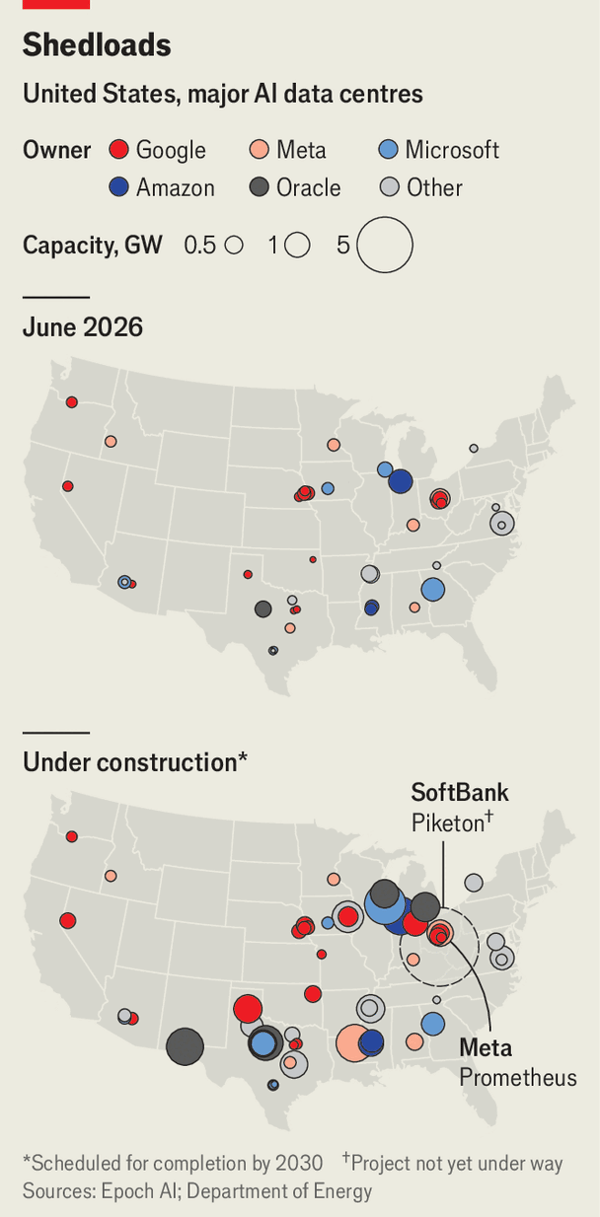
The artificial intelligence boom in the United States is driving an unprecedented expansion of data center infrastructure, with global investment projected to reach $3 trillion between 2026 and 2030. Tech giants like Amazon, Google, Meta, Microsoft, and Oracle are investing $750 billion to transition server farms from traditional coastal clusters to the "Silicon Heartland" and southern states. Consequently, U.S. AI computing capacity is expected to quintuple from under 12 gigawatts (GW) today by 2030. An example is Meta's "Prometheus" facility in Ohio, scheduled for 2026, which will feature $30 billion in semiconductors and consume a full gigawatt of power.
However, this massive expansion faces severe public backlash and regional grid constraints. In the first quarter of 2026, local opposition led to the cancellation of 20 projects worth $42 billion (representing 3.5 GW of capacity), bringing total cancellations over the past three years to $85 billion. Concerns over environmental impacts, aesthetics, and electricity costs are widespread: three-quarters of Democrats and two-thirds of Republicans in Ohio oppose local data centers. The grid is also under strain, with 1,000 GW in connection requests pending—nearly matching the entire U.S. grid capacity of 1,250 GW. To prevent consumer price spikes, Ohio mandates that operators pay for at least 85% of requested power capacity regardless of usage.
To secure U.S. technological leadership against China, Energy Secretary Chris Wright is prioritizing streamlined permitting for data centers. The Department of Energy estimates the U.S. must add 50 GW of generation by 2030 to support AI, prompting efforts to delay coal plant closures and build gas and nuclear facilities. While over a third of data centers will generate power on-site by 2030, the government is also bypassing local zoning by utilizing federal land. This includes a newly announced 10 GW project in Piketon, Ohio, funded by SoftBank. Even with these efforts, the demand for compute remains acute; training a single frontier model is projected to require 5 GW by 2028 and up to 16 GW by 2030, threatening to absorb much of the incoming capacity.
Source: America’s data-centre backlash puts the AI boom at risk
Subtitle: Opposition is spreading across the country
Dateline: 6月 25, 2026 09:14 上午 | New Albany, Ohio