日本首相高市早苗(Takaichi Sanae)在执政初期面临着激烈的政治与经济阻力。尽管她在众议院选举中带领自民党(LDP)赢得了修宪所需的绝对多数席位(三分之二多数),但其鹰派、大支出及社会保守主义议程在推进过程中遭遇了重重困难。政府被迫将国会会期延长一周至7月25日,且骨干政策(Honebuto)年度预算框架延迟至7月21日才得以敲定。民调显示高市内阁的公众支持率已从最初约70%的高位大幅下滑,突显出其强硬统治风格在党内外引发的剧烈反弹。
经济与财政政策引发了金融市场的剧烈动荡与强烈反弹。高市推出了极为庞大的产业政策,设立了从现在到2041年在AI、动漫等17个重点领域实现370万亿日元(2.3万亿美元)公私投资的目标,同时取消了长期的基础财政收支盈余目标,改为追求债务占 GDP 比率下行的模糊标准。此举导致10年期日本国债收益率暴涨至三十年来的新高,被市场称为“骨干政策冲击”;在预算文本补充了强调日本银行(BoJ)独立性的表述后,日元汇率依然在次日跌至四十年来最低水平,显示出投资者对财政纪律失控的深切担忧。
在政治层面,高市强硬的立法推行方式促使原本分崩离析的野党走向联合。自民党利用其绝对多数优势强行通过了惩罚亵渎国旗行为的法案以及关于皇位继承的争议性法律,允许远亲男性继承皇位而排除女性,这与绝大多数支持爱子内亲王继承的民意背道而驰。此外,党内财政鹰派议员因抗议减税方案辞职,而野党在参议院通过联合抵制成功拖延了立法进程。高市偏好社交媒体、拒绝新闻发布会及忽视官僚和商业领袖咨询的独断风格,使其在国会推进法案的速度慢于前三任首相,治理危机正不断加深。
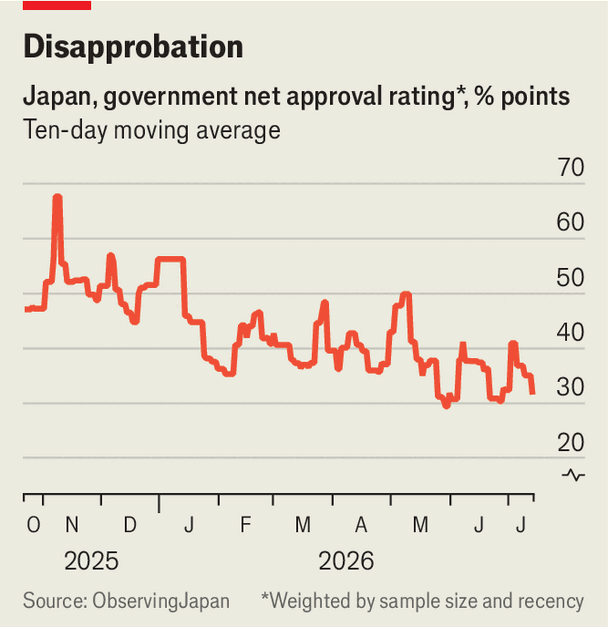
Japanese Prime Minister Takaichi Sanae faces mounting resistance to her legislative and economic agenda despite her party's electoral strength. Although leading the Liberal Democratic Party (LDP) to a two-thirds supermajority in the lower house of the Diet, Takaichi encountered significant delays in passing core legislation, forcing a one-week extension of the parliamentary session to July 25th and delaying the annual Honebuto budget framework until July 21st. Public approval ratings for her administration have declined sharply from post-election highs of nearly 70%, reflecting growing friction over her hawkish policies and centralized governing style.
Economic expansion plans have triggered volatile reactions across international bond and currency markets. Takaichi introduced an aggressive industrial strategy targeting ¥370 trillion (.3 trillion) in combined public and private investment across 17 sectors through 2041, while replacing long-held primary budget surplus targets with loose debt-to-GDP reduction metrics. Following initial drafts, yields on ten-year Japanese government bonds surged to 30-year highs in a movement termed the "Honebuto shock." Despite adding text reaffirming Bank of Japan (BoJ) independence, the yen weakened to a 40-year low as investors questioned the government's commitment to fiscal discipline.
Political resistance has unified opposition parties while straining the ruling coalition. The LDP utilized its supermajority to pass conservative legislation criminalizing flag desecration and restricting imperial succession to distant male lines—overriding public preference for female succession. Internal division escalated as fiscal hawks resigned from party committees in protest over consumption-tax cuts. Furthermore, opposition parties leveraged procedural mechanisms in the upper house to slow legislation, resulting in a slower bill-passage rate than her three immediate predecessors and underscoring the risks of her heavy-handed management style.
Source: Markets and the Diet are mounting resistance
Subtitle: [[IMAGE]]
Dateline: Jul 23rd 2026